
Behind the film
- Year
- 1967
- Director
- Arthur Penn
- Writers
- David Newman, Robert Benton
- Runtime
- 1h 51m
- Genres
- Drama, Crime, Biographical, Action
- Production
- Warner Bros. Entertainment, Warner Bros.-Seven Arts
- Country
- United States
- Cast
- Warren Beatty, Faye Dunaway, Gene Hackman, Estelle Parsons, Michael J. Pollard, Gene Wilder, Denver Pyle, Dub Taylor
About the film
Contains story spoilers.
Arthur Penn’s Bonnie and Clyde opens with a meeting that feels like an impulsive break in a stagnant day. Bonnie Parker watches Clyde Barrow try to steal her mother’s car; instead of reporting him, she is intrigued by the possibility of leaving her routine behind. Clyde is an ex-convict who presents himself as a capable outlaw, and Bonnie quickly joins him. Their first theft is awkward and small, but the pair discover that crime offers them a shared identity as much as money. The film’s early energy comes from the speed with which boredom becomes performance.
The robberies expand, and the gang grows to include getaway driver C.W. Moss, Clyde’s brother Buck and Buck’s wife Blanche. Their road life is a patchwork of planning, bad luck and improvised relationships. Bonnie wants more than to be an accessory to Clyde’s choices: she writes poetry and presses him to let the public know her name. Clyde is protective and proud, yet his sexual insecurity complicates their partnership. The film keeps these tensions close to its action; the gang’s notoriety is not a clean escape from ordinary limitations, but a louder and more dangerous form of them.
The encounters with law enforcement give the group a sense of chasing and being chased. Texas Ranger Frank Hamer is captured and humiliated, then released in a staged photograph that turns the gang into an image of defiance. Buck and Blanche’s presence shifts the tone: Buck is sociable and reckless, while Blanche’s fear and anger make her increasingly incompatible with the gang’s bravado. When the law catches up during a later confrontation, Buck is mortally wounded and Blanche is taken. The surviving group moves on with fewer people and less room to pretend their escapades are a game.
Bonnie and Clyde eventually shelter with C.W.’s father, whose attempt to protect his son becomes the route by which officers locate the couple. In the film’s final sequence, the two are driving together when they realize the roadside scene has become a trap. They are killed in a sudden ambush. The ending refuses a last-minute escape or a heroic speech; the violence arrives with brutal speed, cutting off the lovers’ shared plans and leaving the legend to be built by those who remain.
The film’s blend of comedy and violence is central to its shape. A comic exchange or a moment of sexual embarrassment can sit close to a gunfight, so the gang’s charm never settles into a safe endorsement. Their jokes and flirtations show why they might attract attention, while the abrupt consequences show what the outlaw pose costs other people and themselves. The tonal shifts are not simply tricks; they make the audience experience the same unstable mix of excitement and danger that sustains the characters’ public image.
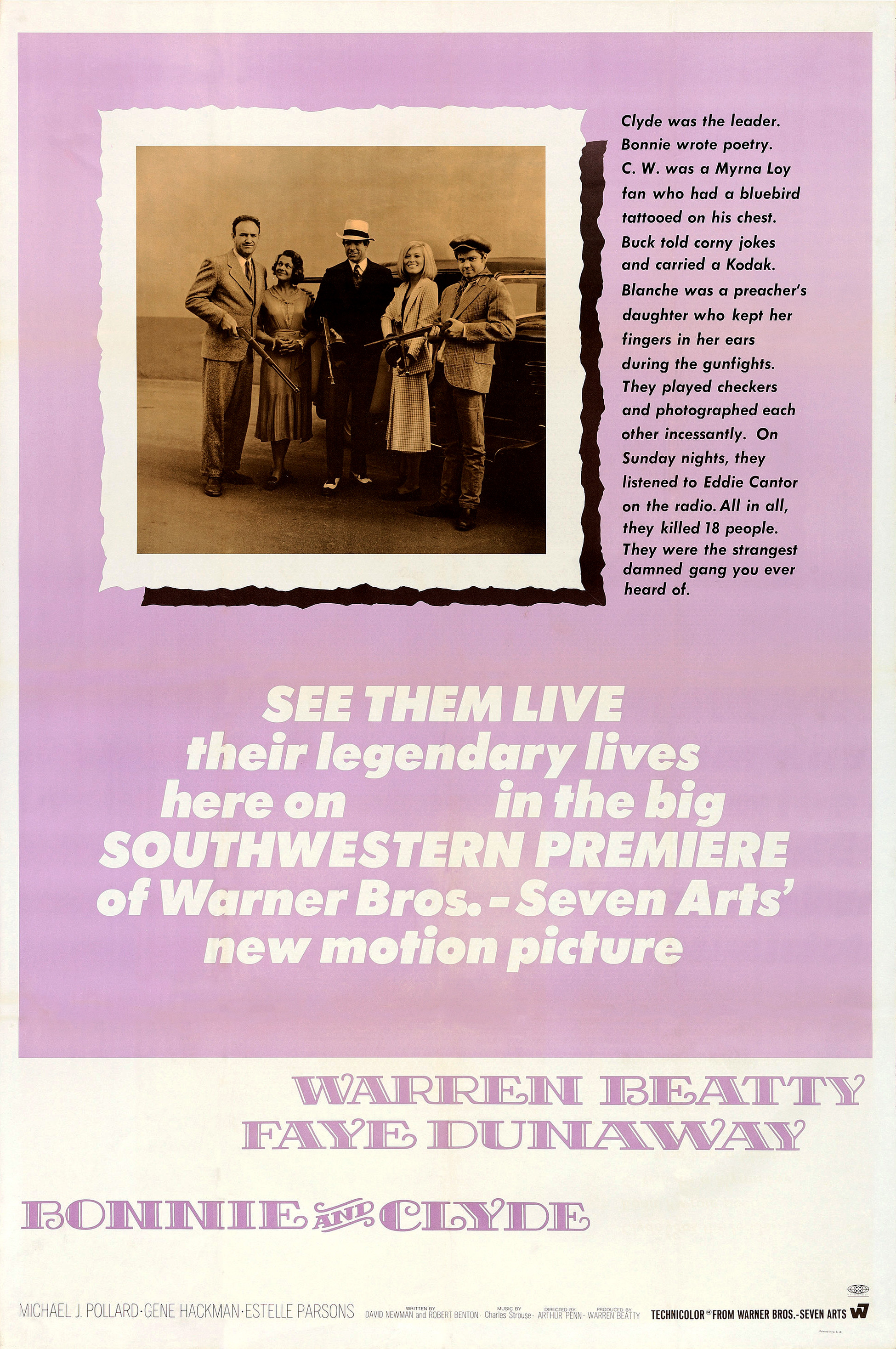
Bonnie’s wish to be seen also makes the film attentive to how fame gets manufactured. The gang poses for photographs, and their attention to newspapers and publicity turns crime into a kind of authorship. Bonnie’s poems give that wish a private form, even when the public sees only the sensational couple. Clyde, by contrast, often tries to control how others read his competence and masculinity. Their partnership works when those self-images support each other, but it frays whenever reality exposes what Clyde cannot or will not provide. The repeated photographs sharpen this difference between lived experience and public image. In a posed picture, the gang can decide where to stand and how to look; on the road, they have to react to other people’s fear, anger and weapons. The picture lets those registers collide rather than making the photographs a simple celebration of outlaw status. Bonnie’s wish for authorship is real, but the film shows how quickly a self-fashioned legend becomes a story controlled by newspapers, pursuers and chance.
The ensemble gives the road story its changing emotional temperature. Gene Hackman’s Buck brings affection and appetite for risk; Estelle Parsons’ Blanche answers with impatience, fear and a sharp awareness that the men’s excitement can leave her exposed. Michael J. Pollard’s C.W. is not a polished professional but a young man whose loyalty places him in a world he cannot fully manage. These performances prevent the gang from becoming a single romantic silhouette. They are a group of people whose different limits become visible as the pursuit tightens.
Penn’s direction and the film’s cutting make the countryside feel both open and inescapable. Cars carry the gang away from one town only to place them in another uncertain encounter; the road promises movement but cannot make the past disappear. The picture’s loose, kinetic surface—its quick changes between joking, desire and danger—helped make its 1930s setting feel immediate to late-1960s audiences. The ending’s stillness after that movement is especially stark: the couple’s story stops, while the image they cultivated continues beyond them.