
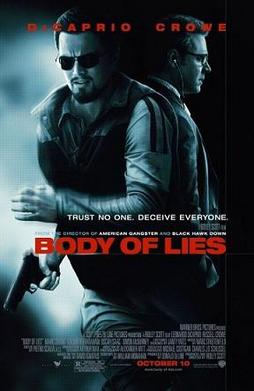
Behind the film
- Year
- 2008
- Director
- Ridley Scott
- Writers
- William Monahan
- Runtime
- 128 minutes
- Genres
- Action, Thriller, Spy, Drama
- Production
- Scott Free Productions
- Country
- United States
- Cast
- Leonardo DiCaprio, Russell Crowe, Mark Strong, Golshifteh Farahani, Oscar Isaac, Ali Suliman, Vince Colosimo, Alon Aboutboul
About the film
Contains story spoilers.
Body of Lies organises its espionage story around the distance between seeing an operation and living inside it. A person directing events remotely can understand a situation through information that looks precise while remaining removed from the relationships making that information useful. Somebody working on the ground has to deal with trust, fear and consequences that cannot be reduced to a display. The film makes that separation a source of conflict within the pursuit itself. Its agents share an objective without necessarily sharing a workable account of how to reach it, or of what the people involved should be permitted to lose.
Ridley Scott directs the 2008 film from William Monahan's screenplay, adapted from David Ignatius's novel. Leonardo DiCaprio plays Roger Ferris, Russell Crowe plays Ed Hoffman, Mark Strong plays Hani Salaam and Golshifteh Farahani plays Aisha. The action moves through Iraq and Jordan while decisions are also made in the United States. This is a fictional intelligence thriller, not a documentary account of the agencies or countries it depicts. Its operational world provides a dramatic setting for competing forms of authority: institutional command, local knowledge and personal relationships all claim importance, but none automatically gives its holder a complete understanding of the others.
Ferris's search for Al-Saleem brings him from Iraq to cooperation with Jordanian intelligence chief Hani. Hoffman's interference damages that relationship. Ferris then helps invent a terrorist organisation around innocent architect Omar Sadiki, hoping to lure the real network into contact; Sadiki is killed. Believing Aisha has been abducted, Ferris offers himself in exchange and becomes Al-Saleem's captive. Hani's agents rescue him. Hani reveals that the apparent kidnapping was his own deception, designed to draw Ferris to the target through a double agent. Ferris survives but rejects a promotion and leaves the service, hoping to see Aisha again.
Ferris's position makes effectiveness inseparable from dependence on others. An informant or local partner cannot remain useful if every commitment to them is treated as disposable. Yet an organisation built to pursue advantage may encourage exactly that treatment whenever circumstances become difficult. The resulting conflict is not simply between competence and incompetence. It concerns incompatible understandings of what a promise means. Someone can be skilled at gathering intelligence while repeatedly destroying the relationships needed to gather more. The film places that contradiction inside the protagonists' work, allowing a decision that appears successful in the immediate moment to undermine the conditions of later cooperation.
Hoffman's remoteness gives institutional authority a particular dramatic shape. Distance can make another person's exposure easier to treat as a manageable cost, especially when the decision-maker continues living within comparatively ordinary routines. The contrast does not require technology to be useless. It asks what technological reach cannot establish on its own. An image can show where somebody is without supplying a reliable understanding of why they are there or what they will do next. The thriller's pressure grows when an apparently comprehensive view is mistaken for complete knowledge, leaving the people acting within it to discover the difference through consequences they cannot observe from safety.
Hani's insistence on trust also involves power. Local knowledge can resist being treated as a service automatically available to a stronger institution, but that resistance does not make its holder transparent or free of manipulation. The film complicates the hope that one authority might offer an entirely honest alternative to another. Cooperation requires judgment between people whose interests overlap only partially. Ferris cannot resolve the difficulty by finding a superior who understands everything and means exactly what he says. The available relationships have to be assessed within a world where control is pursued partly through deciding what somebody else is allowed to know.
Aisha gives that world a relationship whose meaning cannot be comfortably contained within an operation. Intimacy asks for a different kind of presence than the management of an asset. The problem is that a person's working habits do not disappear automatically when they step outside their professional role. Concealment, calculation and exposure can reach into a connection that was supposed to offer another way of living. The film makes the possibility of ordinary attachment significant partly because ordinary attachment is so difficult to protect within the protagonist's circumstances. It cannot simply be declared separate from a career that continually draws private vulnerability into public danger.
The ending separates an intelligence objective's resolution from the question of whether the life spent pursuing it remains acceptable. Surviving and receiving recognition do not necessarily supply a reason to continue. That distinction keeps the thriller from arranging every cost into a clean account of successful duty. Ferris's final choice concerns what he wants his own participation to mean after he has seen how the system uses other people's lives. Body of Lies gives its pursuit a moral instability that the outcome cannot completely settle: knowing more about an operation can make the role within it harder to sustain, even when its immediate target has been reached.