
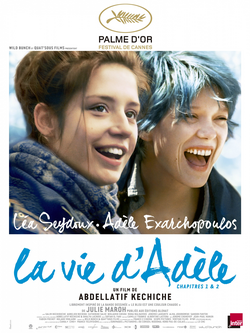
Behind the film
- Year
- 2013
- Director
- Abdellatif Kechiche
- Writers
- Abdellatif Kechiche, Ghalya Lacroix
- Genres
- Drama, Romance, Coming-of-age, Lgbtq-related
- Production
- Canal+, Eurimages, France 2
- Country
- France, Belgium, Spain
- Cast
- Léa Seydoux, Adèle Exarchopoulos, Jérémie Laheurte, Catherine Salée, Mona Walravens, Aurélien Recoing, Salim Kechiouche, Anne Loiret
About the film
Contains story spoilers.
Blue Is the Warmest Colour follows the distance between feeling a relationship intensely and being able to build a lasting shared life around it. The two are closely connected, yet the film does not let one guarantee the other. Attraction opens a new world for Adèle, but the ordinary questions of work, belonging and ambition continue inside that world. Giving those questions time makes the romance more than a movement from discovery to disappointment. It allows intimacy to become a history the characters have actually accumulated, so separation leaves more behind than an abandoned plan. The resulting story concerns growing into a self while another person has become deeply involved in how that self is understood. High-school student Adèle falls in love with art student Emma. They form a shared home, but Adèle’s teaching and Emma’s artistic life bring different expectations. Adèle has an affair with a colleague, and Emma ends the relationship. Years later Adèle still wants reconciliation, while Emma has a partner and a child in her life. Their meeting leaves tenderness without reunion. Adèle eventually attends Emma’s exhibition, sees traces of their shared past within her former partner’s present success, and leaves alone. Love has changed her life without securing a permanent place within the life of the person she loves.
The film organizes much of its emotional force around attention. Conversation, eating, classrooms and private rooms are given enough duration for small shifts in mood to register. Adèle is not presented as a character who can always explain what she feels in a tidy sentence; the camera stays with her through awkwardness, appetite, curiosity and withdrawal. This patient scale makes daily life part of the drama rather than connective filler. The viewer sees intimacy accumulate through repeated gestures, so the later rupture feels rooted in a shared history rather than imposed as a sudden plot twist.
The title’s color is first a striking sign of difference, but it never functions as a simple code with one fixed meaning. Emma’s blue hair draws Adèle toward a world she does not yet understand, while the film’s changing colors and settings track a broader movement through time. That initial image becomes less important than the ordinary forms of closeness that follow it. By the later scenes, the relationship cannot be summarized by a visual emblem. The film’s attention to faces and rooms complicates the romance: desire opens a new possibility, but it does not suspend the pressures of work, class or self-definition.
Food recurs as an unusually concrete language of family and intimacy. Meals make class differences visible without turning every conversation into a debate about status. Adèle’s family and Emma’s household have distinct expectations, and the contrast is felt through what is served, how people speak and which aspirations seem natural in each setting. Eating also produces moments of ease that sit beside more difficult questions about the future. The film uses these domestic scenes to show how people reveal themselves indirectly, through habits and preferences that can seem minor until a relationship begins to pull in two directions.
Emma and Adèle do not occupy symmetrical positions in the relationship. Emma has an artistic vocation and a social circle that increasingly shape her days; Adèle’s teaching work gives her another rhythm and another sense of fulfillment. The film does not treat one path as the obvious measure of adulthood. Instead, the gap grows through what each person expects a shared life to contain. Their conflict is specific to their choices, and that specificity prevents the breakup from becoming a generalized lesson about ambition. A relationship can be emotionally real and still fail to provide a future both people recognize.
The breakup is not staged as a clean exchange of explanations. Shame, anger, jealousy and hurt overlap, making the end of the relationship difficult to reduce to one decisive cause. The film lets the consequences linger into later encounters, where time has moved forward but memory has not become neutral. Adèle’s return to Emma’s world shows the limits of closure: she can enter the exhibition and meet the family, yet she cannot resume the life they once shared. The scene gives separation a public setting, where past intimacy sits beside Emma’s present identity.
Adapted from Julie Maroh’s graphic novel, the film credits Kechiche and Lacroix for the screenplay while transforming the source into a long, lived-in portrait of Adèle. Its sustained close attention is a formal choice with consequences: the character’s experience dominates, and the audience is asked to share her time rather than observe from a distance. The adaptation’s realism should not be confused with a neutral record of every relationship or of queer life in general. It is one crafted perspective, shaped by performance, framing and duration.
The final movement leaves Adèle with a sense of continuation rather than a restored romance. Her visit to Emma’s exhibition places her near the life she once imagined, but she must depart alone. That ending does not invalidate the years they shared or claim that memory is enough to replace them. It holds affection and loss in the same frame, allowing the character to move forward without pretending that the past has been neatly resolved. The film’s length has prepared for this quieter kind of conclusion: an emotional shift that arrives through recognition, not a final declaration.