
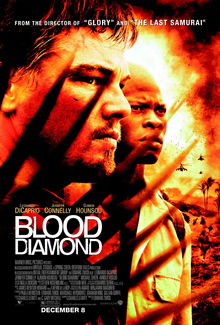
Behind the film
- Year
- 2006
- Director
- Edward Zwick
- Writers
- Charles Leavitt, C. Gaby Mitchell
- Genres
- Drama, War, Action, Adventure
- Production
- Warner Bros. Entertainment, Bedford Falls Productions, Virtual Studios
- Country
- Germany, United States
- Cast
- Leonardo DiCaprio, Djimon Hounsou, Jennifer Connelly, Kagiso Kuypers, Arnold Vosloo, David Harewood, Michael Sheen, Benu Mabhena
About the film
Contains story spoilers.
Blood Diamond begins with Solomon Vandy’s family life before showing how abruptly violence can destroy it. He is a fisherman in Sierra Leone, with ambitions for his son Dia that depend on an ordinary future: school, safety and the ability to choose a different life. Rebel forces attack his community and separate him from his wife and children. Solomon is forced into a diamond-mining operation under Captain Poison, where captivity is organised around extracting something other people will buy. The film’s 1999 setting brings warfare and commerce into the same space. A stone that will eventually look desirable in a shop starts its journey among threats, exhaustion and people who cannot leave.
Solomon finds an unusually valuable pink diamond and hides it when government forces attack the mining site. His knowledge of its location makes him valuable to several people for entirely different reasons. Captain Poison wants to recover it, while Danny Archer hears about it in prison after being arrested for smuggling. Archer has experience moving goods through the networks that profit from the conflict, and he believes this particular stone could finance a permanent departure. Solomon wants something more immediate than retirement abroad: he needs his family back. Archer offers help in return for access to the diamond, creating a bargain between men whose interests overlap without making them trust one another.
Archer’s connections lead beyond the rebel mine. His former commander, Colonel Coetzee, now operates through a private military force and expects repayment for the losses caused by Archer’s failed smuggling job. Buyers and intermediaries farther away from the fighting benefit from the same material while maintaining a more respectable appearance. Archer knows how these relationships work because he has made a living within them. That knowledge makes him useful to American journalist Maddy Bowen, who needs evidence that can connect the violence to the diamond business. She is unwilling to settle for a dramatic anecdote that leaves the transaction itself hidden. Their exchange begins with access and information rather than uncomplicated solidarity.
As fighting reaches Freetown, Solomon and Archer have to escape together. Maddy helps locate Solomon’s surviving family in a refugee camp, but Dia is missing. His absence changes the search: the journey cannot end merely by finding Solomon’s wife and daughters somewhere comparatively safe. Dia has been recruited as a child soldier and trained to treat violence as a source of authority. The boy his father remembers is still present, but he is surrounded by people trying to replace his loyalties and expectations. Solomon’s refusal to give up on him makes the family story more than a reason to retrieve the stone. It becomes a struggle over whether the war gets to determine who his son will become.
The route through the country gives the three central characters incompatible ways of looking at the same danger. Solomon sees places where his family might be held, Archer calculates contacts and escape routes, and Maddy looks for an account that can be communicated beyond the immediate crisis. Their encounters expose lives that do not fit neatly into any one of those aims. Children displaced by warfare need care, roads can become traps, and the distinction between protection and exploitation is difficult to maintain when armed groups control movement. Archer’s guarded account of his own childhood adds context to his cynicism without making it a justification for everything he has done. His history explains some of his defences; it does not remove their consequences.
Near the mining camp, the alliance becomes more precarious. Archer uses Coetzee’s military resources to attack the rebels, but the arrival of the mercenaries does not place Solomon safely outside the struggle over the diamond. Captain Poison dies, and Coetzee tries to take control of what remains. Archer turns against him, accepting that his former commander will not protect them once the stone has been recovered. Dia briefly threatens his father, forcing Solomon to reach him through memories of family rather than an argument about who has the stronger weapon. The scene brings the film’s larger conflict down to recognition: a boy trained to obey his captors must decide whether he can still hear the person calling him home.
Archer is badly wounded during their escape and cannot complete the journey. He gives the diamond to Solomon and helps arrange a flight for father and son, abandoning the exit he wanted to buy for himself. A final call to Maddy connects that decision to the evidence she has been pursuing. Solomon later meets a representative of the diamond company in London, where the transaction is documented and his family can be reunited. Public testimony follows, giving his experience an audience beyond those who tried to profit from it. The ending offers a resolution for this family and exposes a particular network, without suggesting that one successful escape brings an entire civil war or trading system to an end.
Edward Zwick frames the film as a fictional thriller within a real historical conflict, so its central characters and their journey should not be mistaken for a documentary record. Its urgency comes from placing very different motives around one object. Djimon Hounsou gives Solomon a force that is directed toward his family, while Leonardo DiCaprio’s Archer approaches most situations as negotiations until that method fails him. Jennifer Connelly’s Maddy represents the difficulty of turning what she witnesses into evidence other people cannot easily dismiss. The diamond keeps changing meaning as it moves between them: enforced labour, leverage, an escape plan and a possible future. Its beauty matters less than the human relationships built or damaged in pursuit of it.