
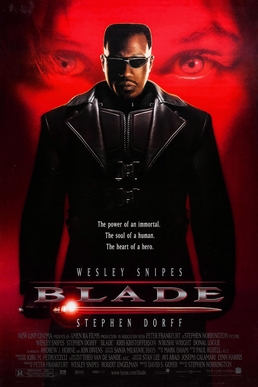
Behind the film
- Year
- 1998
- Director
- Stephen Norrington
- Writers
- David S. Goyer
- Runtime
- 2h 0m
- Genres
- Action, Thriller, Horror, Fantasy
- Production
- New Line Cinema, Marvel Entertainment
- Country
- United States
- Cast
- Wesley Snipes, Kris Kristofferson, Stephen Dorff, N'Bushe Wright, Donal Logue, Udo Kier, Tim Guinee, Sanaa Lathan
About the film
Contains story spoilers.
Blade builds its vampire world around a contradiction embodied by the hunter himself. The qualities that make him dangerous to his enemies also connect him to those enemies, so every victory leaves a problem he must continue managing. This makes his discipline more consequential than an action hero's taste for efficiency. He cannot retire from his own body, and fighting does not free him from its requirements. The film's contemporary city gives that conflict an outward setting: supernatural predation can operate through modern nightlife and hidden social hierarchies without looking like a relic from a different century. Blade has to recognise the enemy behind the familiar surfaces while keeping control of what he shares with it. Blade raids a vampire nightclub, then rescues bitten hematologist Karen from a hospital. His mentor Whistler shelters her while Deacon Frost seeks a ritual requiring Blade’s blood. The attack on their refuge leads Blade to Frost and to his own mother, now a vampire. Frost gains supernatural power through the ceremony, but Blade defeats him with the anticoagulant Karen has discovered. Karen offers help with his condition; he asks for better serum so he can continue hunting. Their cooperation defeats this threat without curing the bodily need that links him to his enemies.
Blade’s hybrid identity shapes every part of the film’s action. He has the strength and senses that make him effective against vampires, but the need for blood keeps him connected to the condition he resists. His self-control is not an abstract virtue; it is a daily discipline built through serum, weapons and ritual. Snipes plays him with clipped economy, letting posture and pauses convey a person who treats emotion as something to manage. The character’s isolation is therefore visible in his physical vocabulary: he moves with precision, rarely relaxes, and belongs fully to neither community.
The film introduces its world through an industrial nightlife rather than a misty gothic setting. The opening club is crowded, loud and saturated with red light; the dance floor becomes a trap once the human guest realizes what the venue really is. This sharp reveal establishes the movie’s preferred collision between modern surfaces and old predation. Vampires have adapted to urban infrastructure, but the scene’s ritual violence exposes how little their appetite has changed. The contrast between electronic music and the sudden, intimate threat gives the action a percussive quality that continues through the film’s fights.
Frost’s challenge is political as well as supernatural. He is powerful, ambitious and resented by the elders because he was not born into their bloodline. His faction’s grievance gives the hierarchy a credible fault line, even though his desire to overturn it becomes indistinguishable from a plan to dominate everyone else. The elders’ old authority is shown as rigid and exclusionary; Frost’s rebellion offers movement without liberation. By making both camps compromised, the film gives Blade an enemy whose threat comes from an entire system of status, not merely one villain’s appetite.
Karen provides a human point of entry into that hidden order, but her medical training also gives her practical value. She responds to the bite as a bodily problem with measurable consequences, bringing clinical attention into a world of folklore and weapons. Her questions help translate Whistler’s rules for the audience, while her willingness to remain involved changes her from protected guest to participant. The film gives her competence without pretending she can immediately master the supernatural system. Her presence keeps the story from becoming only a sequence of Blade proving his superiority through combat.
Whistler’s workshop makes their relationship tangible. Weapons, antidotes and repairs are forms of care, so the mentor’s role is expressed through labor rather than speeches about fatherhood. The safe house provides a pause from the club and street settings, but it is not a conventional home: its function is preparation for the next fight. That distinction helps explain Blade’s closed emotional life. The people closest to him share a mission and a set of procedures, yet survival leaves little room for ordinary intimacy. Their bond is genuine precisely because it is built inside a life that cannot become safe.
The film’s violence uses clear physical objectives. Silver, sunlight and ultraviolet light operate as rules the audience can understand, so each fight becomes a test of timing and position as well as strength. Blade’s sword and disciplined movement contrast with Frost’s theatrical appetite for spectacle. The effects and editing sometimes lean into exaggerated comic-book impact, but the action remains anchored by recognizable cause and consequence. This combination gives the supernatural world a tactile quality: the audience can follow how a door, light source or weapon changes the balance of a scene.
As a comic adaptation, the film builds its hero from a particular contradiction instead of pausing to explain a universe of lore. The premise is legible through action, and the dialogue supplies only enough history to make choices matter. That economy lets the genre mix horror, martial arts and superhero adventure without flattening them into one tone. Blade’s victory over Frost does not resolve his need or remove his difference; it restores a fragile capacity to keep choosing what he will do with it. The final image leaves the character moving forward, not assimilated into either side.