
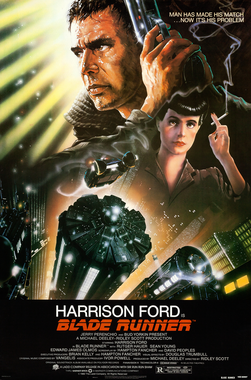
Behind the film
- Year
- 1982
- Director
- Ridley Scott
- Writers
- Hampton Fancher, David Peoples
- Runtime
- 1h 57m
- Genres
- Tech noir, Cyberpunk, Thriller, Neo-noir
- Production
- The Ladd Company, Tandem Productions, Warner Bros. Entertainment
- Country
- United States, Hong Kong
- Cast
- Harrison Ford, Edward James Olmos, Rutger Hauer, Sean Young, Daryl Hannah, Brion James, Joanna Cassidy, M. Emmet Walsh
About the film
Contains story spoilers.
Blade Runner takes place in Los Angeles in 2019, a city crowded with people, advertisements and rain. Human beings with enough resources are encouraged to leave Earth for off-world colonies, while replicants—biologically engineered people—are sent there to perform dangerous work. After a violent revolt, replicants are forbidden on Earth. Special police called blade runners identify and kill those who return. The film opens with Leon, suspected of being a replicant, shooting an officer during an interrogation. The case is handed to Rick Deckard, a former blade runner who has left the job. His former supervisor, Bryant, orders him back to track down a group of escaped replicants. Deckard refuses, but the choice is taken from him: he is reminded that obedience is part of the job.
The fugitives are Roy Batty, Leon, Zhora and Pris. Their time on Earth is limited because the Nexus-6 models were designed with a four-year lifespan. Deckard investigates their movements through clues left in cheap rooms, street markets and crowded entertainment venues. The case leads him to the Tyrell Corporation, the company that created the replicants, and to Rachael, an assistant who believes she is human. Tyrell has given her memories from another person's life, making her more difficult to identify and allowing her a sense of history that she does not actually possess. When Deckard tells her what she is, she leaves in distress. Her reaction makes the police test and the label of artificial being feel less reliable than the people using them claim.
Roy and Leon also pursue Tyrell, hoping their maker can extend their lives. Roy's strength and intelligence make him dangerous, but his goal is not conquest: he wants more time. Pris finds J. F. Sebastian, a designer who lives alone and has a condition that causes premature ageing. Sebastian is also connected to Tyrell, and agrees to help Roy reach the company founder. Deckard follows the replicants through the city, eventually finding and killing Zhora after she flees through a crowded street. After Zhora's pursuit, Leon attacks Deckard in the street. Rachael takes Deckard's fallen gun and shoots Leon, saving him. Their connection becomes more complicated, though Deckard still controls much of what she learns about herself.
The investigation ends at Tyrell's tower. Roy reaches his maker and learns that the four-year limit cannot be reversed. He kills Tyrell, then returns to Sebastian's apartment, where Pris waits. Deckard arrives and kills Pris. Roy catches him and pursues him through the building, while Deckard tries to escape across the rooftops. He slips and hangs from the edge of a roof. Roy could let him fall, but instead pulls him up. As his own life ends, Roy speaks of what he has seen and lost; then he dies. The replicant hunter survives because one of the people he was sent to kill chooses to save him. That reversal changes the emotional weight of the chase without undoing the violence Deckard has inflicted.
Deckard returns to his apartment and finds Rachael alive. Gaff has apparently allowed her to escape, though he warns Deckard that her life may be limited like that of other replicants. Deckard chooses to leave with her. The film does not settle every question raised by their relationship, and its versions differ in how they present the ending. What is clear is that the hunter has moved from treating replicants as targets to protecting one of them. Roy's final decision has exposed a moral distinction that the official language of 'retirement' was designed to obscure: the beings being hunted experience fear, attachment and a desire to live.
Ridley Scott's film mixes a detective investigation with science-fiction world-building. Deckard gathers evidence, questions witnesses and follows a trail through the city, but each clue also expands the audience's sense of how this society works. The Tyrell pyramid dominates the skyline; down below, people barter, repair, sell and move through crowded streets. The contrast makes the corporations feel powerful and remote, while ordinary life appears improvised beneath them. The replicants themselves are difficult to distinguish from humans except through specialized tests, so police procedure tries to turn a moral problem into a technical classification. The scenes with Rachael complicate this approach by showing how implanted memories can form a person's sense of self.
The film's design supports a mood of exhaustion and uncertainty. Its Los Angeles mixes towering buildings with cramped interiors, bright signs with shadowed rooms, and a constant sense of weather that keeps the city from feeling clean or futuristic in an abstract way. Deckard's investigation takes him through spaces that are visually striking but socially worn. Vangelis's electronic score brings a reflective, sometimes lonely quality to these surroundings. The film lets sound and image carry atmosphere, and it often leaves motives or details unresolved. That openness can be disorienting by design: viewers follow a police case, but the case's simple question—who is human?—keeps becoming harder to answer as Deckard meets the people he is meant to eliminate.
The final rooftop scene draws the story's central conflict into one choice. Roy is physically stronger and has every reason to hate the officer who has killed his companions, yet he saves him. Deckard, who has survived by carrying out orders, must reckon with an act of mercy from the people his work treats as disposable. Rachael's departure offers him a chance to make a different choice, although the film refuses to guarantee what that future will look like. Blade Runner ends without presenting a clean escape from its world or a settled definition of humanity. Its last movement leaves the viewer with the people who have been called artificial, and asks what their actions reveal about the humans who made them.