
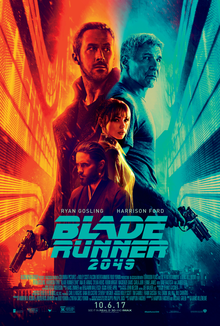
Behind the film
- Year
- 2017
- Director
- Denis Villeneuve
- Writers
- Hampton Fancher, Michael Green
- Runtime
- 2h 44m
- Genres
- Science fiction, Mystery, Cyberpunk, Dystopian
- Production
- Warner Bros. Entertainment, Alcon Entertainment, Columbia Pictures
- Country
- United States, United Kingdom, Canada, Hungary
- Cast
- Ryan Gosling, Harrison Ford, Robin Wright, Dave Bautista, Ana de Armas, Sylvia Hoeks, Mackenzie Davis, Barkhad Abdi
About the film
Contains story spoilers.
Blade Runner 2049 returns to a world where replicants are manufactured workers and blade runners are still tasked with killing those who escape. K is a replicant working for the Los Angeles police, and his opening assignment takes him to a rural farmstead. He kills Sapper Morton, another replicant, but discovers something buried beside the farm: a body that appears to have died in childbirth. The discovery is impossible within the rules K has been taught, because replicants are not supposed to reproduce. Lieutenant Joshi orders him to find and destroy any evidence before it destabilises the social order. K is obedient, but the case has put a question in front of him that is more personal than the ordinary work of identifying a fugitive.
The body is identified as Rachael, a replicant from the earlier story, and the evidence points to a child who may have been born to her and Rick Deckard. K searches records and memories for clues. At home, he has a holographic companion named Joi, who offers him affection and a shared domestic routine. The relationship matters to K, but it is shaped by her function as a commercial product. He also carries memories implanted by memory designers, and later seeks out Dr. Ana Stelline, a memory designer. One of them seems to match a childhood event involving a wooden horse. K's belief that the memory may be his own gives him a reason to think he could be the child in the case, although the film leaves room to question whether emotional force proves personal history.
K's investigation brings him into conflict with Niander Wallace, the corporate leader whose company now manufactures replicants after acquiring Tyrell's work. Wallace wants to find the child because reproduction could make replicant production easier and expand his power. His enforcer Luv pursues the same evidence, killing people and retrieving the remains. K finds the wooden horse inside the orphanage, where a trace of his apparent childhood story survives. As he learns more, K becomes less certain of the difference between implanted memory and lived experience. His police tests, which measure his emotional responses, mark him as a useful and controlled replicant. Yet he is visibly disturbed by the possibility that he has been singled out as more than an instrument.
The search takes K to Las Vegas, a ruined city buried in orange dust. There he finds Deckard, who has been living alone since his earlier flight with Rachael. Deckard resists K's questions and attempts to drive him away. Their meeting turns the sequel into a continuation of the first film's unresolved choices: Deckard still has to protect the memory of Rachael, while K needs to know whether his own life is connected to hers. Luv captures them and takes Deckard toward Wallace. K survives, aided by a replicant resistance group led by Freysa, who tells him the child is a woman and that the group plans to kill Deckard to keep the child hidden. K has to confront the gap between solving the case for himself and serving a broader struggle.
K escapes and stops Luv's transport vehicle in a fight near the flooded sea wall. He saves Deckard, then allows him to continue toward Ana Stelline. The revelation is that Ana, the memory designer whose work K admired, is the child born to Rachael and Deckard. The wooden horse and the memory of its hiding place belonged to her, not K. His strongest evidence that he might be special was a real memory, but it belonged to another person and had been placed inside him. K does not respond by turning against Ana or trying to claim her life. Instead, he chooses to reunite father and daughter, leaving Deckard at the building where she works. He lies down outside in the snow, badly injured, after making this quiet act possible.
Denis Villeneuve's sequel expands the earlier film's questions through a new protagonist who already knows he is artificial. K does not begin with Deckard's uncertainty about what he is; his conflict is whether a replicant can possess a life that feels personally meaningful. The case gives that question a concrete shape. A child would prove that replicants can create new life, which makes the discovery both intimate and politically dangerous. Wallace treats it as a route to power, while the resistance sees it as a possible source of freedom. K initially interprets the evidence through his desire to be exceptional, then learns to make a choice without needing that status. The story moves from the question 'could this be mine?' to what he will do for another person.
The film carries over the first movie's corporate towers, police work and artificial people, then moves through landscapes with distinct visual textures. Rain-darkened city blocks, the farm, Wallace's monumental interiors and the sand-buried remains of Las Vegas present a world shaped by scarcity and commercial power. K's apartment and his interaction with Joi bring the story down to a smaller scale, though even companionship is tied to a manufactured service. The quiet scenes give Gosling room to show how K measures his own reactions against the standards imposed on him. The case's spectacle never erases that personal scale: each new clue changes how K understands the memory and the person he may or may not be.
K's last decision does not overthrow Wallace, end the system that creates replicants or settle whether Deckard is human. It is a limited act with direct consequences for Ana and Deckard. K has spent the film hoping for proof that his life is unique; the truth takes that proof away, yet he still decides his actions matter. That ending gives the sequel a different resolution from the first film's rooftop encounter. K now gives up the identity he wanted in order to help two people meet. Blade Runner 2049 leaves the larger society unresolved, while showing that care can exist inside a world built to make artificial people disposable.