
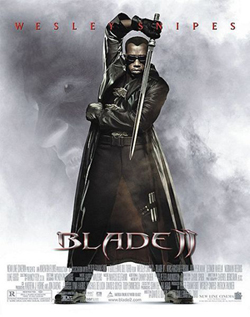
Behind the film
- Year
- 2002
- Director
- Guillermo del Toro
- Writers
- David S. Goyer
- Genres
- Action, Thriller, Horror, Fantasy
- Production
- New Line Cinema
- Country
- United States, Germany
- Cast
- Wesley Snipes, Kris Kristofferson, Leonor Varela, Norman Reedus, Ron Perlman, Luke Goss, Thomas Kretschmann, Donnie Yen
About the film
Contains story spoilers.
In Prague, Blade recovers his mentor Whistler from captivity and returns him to the fight. A new strain is transforming victims into Reapers, predators dangerous to both humans and vampires. Vampire leader Damaskinos offers a truce, sending his daughter Nyssa and the Bloodpack—once assembled to hunt Blade—to fight beside him. Their investigation reveals Reapers’ unusual resistance and a nest beneath the city. The alliance breaks down as its members are infected, killed or exposed as traitors; Blade learns Damaskinos created the strain and that Nomak, its first carrier, is the leader’s son. In the final conflict, Nyssa turns against her father, and Blade wounds Nomak after he attacks her; Nomak then drives the sword deeper to end his own suffering. Nyssa dies in the sunlight outside. Blade later tracks down the vampire who led him to Whistler and kills him.
Blade’s position as a daywalker makes him valuable to the vampires and impossible for them to accept as an equal. He can operate in daylight and fight with their strength, but his human loyalties and independence make him a threat to their hierarchy. The Bloodpack’s hostility is therefore more than personal dislike: they were trained for a single purpose and now have to share space with the target they expected to kill. The team dynamic stays unstable even during cooperation. Blade’s authority is enforced through blunt intimidation, while the other fighters have to decide whether obeying him is preferable to facing the Reapers alone. The film uses that uneasy partnership to keep its action charged with distrust.
Whistler’s return puts an old bond under strain. Blade has spent time searching for him, but rescue does not immediately restore the mentor’s former place. Whistler has endured captivity and transformation, and his reintroduction into the group brings vulnerability into a world organized around strength and tactical utility. Scud, the new technician, represents a different kind of relationship to Blade: he is young, eager and useful, but trust is not guaranteed by proximity. Together, these men let the story examine how Blade relies on people while keeping them at a controlled distance. His team can assemble weapons and share dangers without becoming a conventional family, a tension that makes the film’s loyalty tests more than simple plot twists.
Nyssa is the Bloodpack member who most visibly understands the political cost of the alliance. She carries the name and authority of her father’s vampire order, yet the Reapers reveal the danger of treating living beings as experiments in strength. Her relationship with Blade is built through guarded attention rather than quick sentiment. She sees that he is capable of restraint and that he does not share her father’s ambition to dominate every other species. Her decisions are not a sudden conversion to human sympathies; they emerge from the gap between the ideals her family claims and the violence it practices. This makes her role important to the film’s moral structure even while Blade remains its central figure.
The Reapers change the film’s threat from a familiar species rivalry into a contagion story. Their altered mouths, speed and resistance to traditional weapons make them visually distinct from the vampires who fear them. The danger crosses categories: a bite can transform a human or a vampire, and the mutated body becomes a source of further infection. That premise forces the alliance to confront a shared vulnerability rather than an abstract common enemy. The Reapers’ origin also matters because their existence is not an accident of nature; it is connected to a deliberate attempt to engineer power. The film’s monster design makes the consequences bodily and immediate, while the revelation behind it turns the vampire ruling class into part of the crisis.
Del Toro’s action style places readable combat inside richly shadowed spaces. The vampire nightclub, sewers and fortress interiors have different textures and levels of visibility, so the hunt changes with each environment. Blade’s weapons are extensions of his disciplined movement, while the Bloodpack brings specialized fighting styles that give the group battles a varied rhythm. Fast cuts and sharp bursts of ultraviolet light make danger legible without removing the horror of the Reapers’ bodies. The film’s palette and production design lean into grime, metal and saturated darkness, but the threat is not only atmospheric: the physical spaces shape escape routes, ambushes and the possibility that a team member may be infected before anyone notices.
At its core, the sequel asks whether a coalition can survive when its members disagree about who counts as disposable. The vampires ask Blade to help preserve their order, but the film’s conflict gradually exposes that order as capable of creating the very danger it claims to manage. Nomak’s personal grievance does not make him harmless, and Damaskinos’s status does not make his choices defensible. Blade’s response is characteristically practical rather than conciliatory: he acts to stop the immediate threat, then continues his own hunt. The final image of Nyssa facing the sunrise leaves the alliance’s cost with the person who chose to break ranks. Her fate gives the action a quiet consequence after the spectacle has ended.