
Behind the film
- Year
- 2018
- Director
- Ryan Coogler
- Writers
- Ryan Coogler, Joe Robert Cole
- Runtime
- 2h 14m
- Genres
- Superhero, Action, Adventure, Science fiction
- Production
- Marvel Studios
- Country
- United States
- Cast
- Chadwick Boseman, Michael B. Jordan, Lupita Nyong'o, Danai Gurira, Winston Duke, Andy Serkis, Forest Whitaker, Florence Kasumba
About the film
Contains story spoilers.
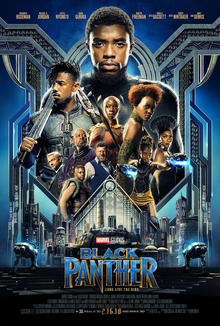
Ryan Coogler’s Black Panther begins in the aftermath of T’Chaka’s death, with his son T’Challa returning to Wakanda to become king. The country has hidden its technological power from the outside world for generations, presenting itself as a poor nation while using vibranium to build advanced transport, medicine and weapons. T’Challa inherits more than a crown: he has to uphold a policy of secrecy that his father defended, while learning what sort of ruler he wants to be. The Black Panther is both protector and sovereign, and the film gives that double role a political setting. Its central conflict grows from competing answers to what Wakanda owes its own people and the wider world.
At his coronation, T’Challa takes the throne after M’Baku challenges him and yields. Later, he joins Okoye, leader of the Dora Milaje, and former partner Nakia on a mission to stop arms dealer Ulysses Klaue. The raid brings them to South Korea, where Klaue plans to sell a vibranium artefact. Everett Ross, a CIA agent, is caught in the operation and injured while protecting Nakia. T’Challa brings him to Wakanda, where his sister Shuri uses advanced technology to heal him. At home, Shuri’s teasing and inventive confidence give the royal household a lighter rhythm, while Queen Ramonda and the council remind T’Challa that every choice as king has consequences. The mission also makes clear that Wakanda’s hidden wealth can draw dangerous attention.
Klaue escapes with help from Erik Stevens, an American special-operations veteran known as Killmonger. Erik kills Klaue and takes his body to Wakanda, where he reveals that he is the son of N’Jobu, T’Challa’s uncle. Years earlier, T’Chaka killed N’Jobu in Oakland after discovering his brother had tried to smuggle vibranium out of the country. He left the boy behind, and Erik grew up separated from his family and nation. That history makes his challenge to T’Challa more than a bid for power. He accuses Wakanda of remaining safe while Black communities elsewhere face oppression, and argues that its weapons should be used to overturn that order.
The question becomes literal when Killmonger invokes the ritual right to challenge the king. T’Challa accepts, and the duel at Warrior Falls ends with Killmonger throwing him over the edge. Presumed dead, T’Challa is found by the Jabari and cared for by M’Baku’s people. Killmonger takes the throne and consumes the heart-shaped herb, gaining the Panther’s abilities. He orders the remaining herbs burned and prepares to send Wakandan weapons to allies around the world. Nakia saves one herb before the fire consumes the stock. In the capital, Okoye faces an impossible choice between loyalty to the throne and loyalty to the country when W’Kabi supports Killmonger’s plan.
Nakia, Shuri, Ramonda and Ross seek help from the Jabari. T’Challa wakes after taking the rescued herb and returns to challenge Killmonger. The fighting spreads from the palace to the vibranium mines, where Wakanda’s technology and natural resource meet in a volatile setting. Shuri and Nakia fight beside Okoye, while Ross remotely pilots a jet to stop weapon shipments from leaving the country. M’Baku and the Jabari join the resistance. W’Kabi’s forces finally lower their weapons when Okoye stands against him. The battle is not resolved by T’Challa’s strength alone; it depends on alliances across Wakandan factions and on people deciding that the new king’s vision is worth defending.
T’Challa defeats Killmonger in the mine by disrupting his suit and stabbing him. He offers to heal his cousin, but Killmonger refuses and asks to see the Wakandan sunset before dying. The scene holds two truths together: Killmonger’s methods have made him dangerous, and his anger grew from an abandonment that T’Challa’s family caused. T’Challa cannot restore what was taken from Erik, but he can change the policy that kept Wakanda insulated. He establishes an outreach centre in Oakland at the building where N’Jobu died, placing Nakia and Shuri in charge. In the mid-credits scene, he announces Wakanda’s resources to the United Nations, choosing engagement over the secrecy his father maintained.
The film’s visual world gives that debate a home. The film distinguishes its communities through architecture, textiles, colour and ceremonial detail. The capital blends contemporary technology with landscapes and forms that point to varied African cultural sources rather than one uniform aesthetic. The Dora Milaje’s red armour, Shuri’s laboratory and the Jabari’s mountain stronghold each signal a different relationship to tradition and change. Rachel Morrison’s cinematography moves between the saturated spectacle of Wakanda, the night-time casino operation and the open ceremonial falls, making place part of how authority is seen.
T’Challa’s arc is a negotiation between inherited responsibility and a more outward-looking idea of leadership. He does not adopt Killmonger’s plan to arm a global uprising, but he cannot return to the old arrangement without accepting its cost. The film gives the antagonist a personal history and a political argument, then makes the king answer both with changes to Wakanda’s institutions. Its action remains built around a family and a nation: Shuri’s inventions, Nakia’s commitment to service, Okoye’s duty, and Ramonda’s counsel all shape the outcome. The final opening to the world is deliberately a beginning. Wakanda has changed its policy, but the film leaves the consequences of that decision beyond the ceremony and speech.