
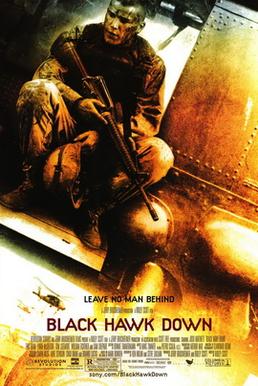
Behind the film
- Year
- 2001
- Director
- Ridley Scott
- Writers
- Ken Nolan
- Genres
- War, Action, Drama, Historical
- Production
- Revolution Studios, Scott Free Productions, Jerry Bruckheimer Films
- Country
- United States
- Cast
- Josh Hartnett, Eric Bana, Ewan McGregor, Tom Sizemore, William Fichtner, Sam Shepard, Ewen Bremner, Kim Coates
About the film
Contains story spoilers.
In the film's account of Somalia in 1993, American Rangers and Delta Force soldiers launch a raid to capture two advisers to Mohamed Farrah Aidid. The operation becomes much more dangerous when a soldier falls from a helicopter and the ground convoy comes under fire. Two Black Hawks are shot down, drawing different groups towards their crash sites. Matt Eversmann's soldiers defend one wreck while Randy Shughart and Gary Gordon volunteer to protect surviving pilot Michael Durant at the other. Both snipers are killed and Durant is captured. Roadblocks and casualties prevent the Americans from completing their extraction as planned. Fighting continues through the night until a relief convoy involving American, Malaysian and Pakistani forces reaches the trapped men. Some soldiers finish the retreat on foot. The epilogue records Durant's later release. This is a dramatized account of the Battle of Mogadishu, not a complete history of Somalia or an unaltered record of every participant.
Black Hawk Down makes distance difficult to judge. An objective can be visible from above and almost unreachable from the street, where a turn, a barrier or uncertainty about directions changes what a unit can do. Scott uses that difference to make the city's geography an active source of tension. The audience can move between perspectives but still has to piece together how the groups relate to one another. This gives the film a crowded, unsettled rhythm. The practical task is repeatedly reduced to getting a person from one place to another, then enlarged by the danger and confusion that stand between those places. Movement is never merely a transition between scenes.
The ensemble prevents the battle from belonging to a single heroic viewpoint. Josh Hartnett's Eversmann provides one emotional centre, while the surrounding performances bring different levels of experience and different ways of responding to danger. The characters' attention is often directed towards immediate needs rather than eloquent explanations of their own motives. A person has to know who is nearby, what equipment is available and whether an instruction has been understood. That focus makes competence visible through behaviour. It also gives uncertainty space to remain frightening, because experience can help someone react without granting control of the situation. Leadership appears as a burden carried inside confusion rather than above it.
The film's sound and editing make communication feel physically vulnerable. Voices compete with machinery and gunfire, and a message can be crucial without being easy to hear or act upon. The effect is to keep planning close to the conditions that undermine it. Instructions do not instantly turn into coordinated movement, especially when the people receiving them cannot share the same view. Scott repeatedly brings attention to the gap between knowing that help is needed and being able to provide it. This is where much of the suspense lives. The audience is made aware of interconnected obligations while watching those obligations become harder to fulfil as the battle extends.
Rescue gives the film its strongest organizing principle. The purpose of action changes when a mission becomes dominated by the need to recover people already exposed to danger. That shift allows individual loyalty to remain understandable even when the wider operation has become difficult to explain through its original objective. The movie's emotional force depends on refusing to make a wounded person an abstract part of a tactical calculation. At the same time, the effort required to reach someone can put others at risk. The film keeps that pressure visible, making solidarity a demanding practice rather than an uncomplicated slogan. Care has to be carried through a setting that continually frustrates it.
Its restricted perspective also has limits. The American soldiers receive the most sustained attention, while the city and the people beyond their immediate field of understanding are less fully explained. That choice makes the combat experience concentrated, but does not make it a sufficient account of the conflict's causes or the lives around it. The dramatization is best approached as a constructed view of a particular battle. Intensity should not be mistaken for historical completeness. Scott's immersive style can make immediate fear persuasive while still leaving larger political questions outside the frame, and recognizing that distinction allows the film's emotional achievement and its narrower viewpoint to be considered together.
What remains distinctive is the persistence of practical detail under overwhelming pressure. Equipment, routes, transport and medical attention never become background matters, because the characters' chances depend on them. The film's scale comes from connecting many small needs rather than replacing them with one decisive gesture. A moment of relief can therefore coexist with exhaustion and unresolved loss. Its closing movement cannot make the preceding danger feel neatly purposeful, even when the soldiers reach safety. Black Hawk Down presents endurance through the effort people make for those beside them, giving that effort an urgent physical form. The result is a war drama whose strongest question is immediate and difficult: what can be done for another person when the means of helping are breaking down?