
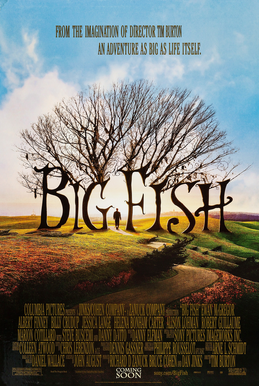
Behind the film
- Year
- 2003
- Director
- Tim Burton
- Writers
- John August
- Genres
- Fantasy, Drama, Comedy, Magic realist
- Production
- Columbia Pictures
- Country
- United States
- Cast
- Ewan McGregor, Albert Finney, Billy Crudup, Jessica Lange, Helena Bonham Carter, Alison Lohman, Marion Cotillard, Danny DeVito
About the film
Contains story spoilers.
Will Bloom has heard his father Edward’s stories all his life and has grown tired of their impossible heroes and events. Years after their estrangement, Edward’s cancer brings Will and his pregnant wife Joséphine back to Alabama. Edward’s tales trace his travels through a hidden town, a circus and a life of unlikely adventures; Will searches for the people behind them, including Jenny, who says Edward remained devoted to his wife Sandra. After Edward suffers a stroke, Edward asks Will to tell him how his life ends. He invents a journey from hospital to river, where Edward becomes a great catfish and swims away. Edward accepts the story and dies. At the funeral, Will sees the figures from his father’s tales gathered as ordinary people, then begins passing those stories on to his own son.
Tim Burton structures the movie around two ways of telling a life: Will’s present-day effort to verify facts and Edward’s expansive memory. The film does not offer a neat key that sorts each anecdote into true or false. Instead, it lets the stories sit beside the family scenes, where a phrase, location or person can return with a different shape. That arrangement makes the son’s investigation emotional rather than merely forensic. Will wants reliable information, but his deeper frustration is that his father’s performance seems to leave no room for a private conversation between them.
Edward’s imagination has a social purpose as well as a private one. He wants experience to arrive already shaped for an audience, with the dull connective tissue removed and every encounter carrying the possibility of wonder. That habit can look generous when it gives a listener something memorable, and selfish when the listener needs space to offer a different account. Ewan McGregor and Albert Finney give youth and age a common confidence in the act of telling. The important continuity is not that their bodies look identical. It is that Edward assumes a room will become more interesting when he begins to speak, an assumption that can charm strangers while exhausting the person who has heard him longest.
Will’s skepticism is important because the film does not ask the viewer to treat imagination as an automatic virtue. Billy Crudup plays him as someone who has learned to hear the rhythm of a familiar anecdote before its ending arrives. He is not only objecting to exaggeration; he feels edited out of his father’s self-portrait. The two men want recognition in opposite ways. Edward wants an audience that will receive his stories, while Will wants the father beneath the performance to answer a direct question. The tension gives the fantasy episodes a human cost without making them feel like a simple rebuke of realism.
The Southern setting is rendered as a chain of distinctive spaces rather than a single generic backdrop. The Bloom home, small-town streets and imagined landscapes all contribute to Edward’s map of a life. The town of Spectre, with its dreamlike stillness, contrasts with the more ordinary textures of Will’s present. Burton’s design and Philippe Rousselot’s cinematography give the fables a bright, composed quality that can tip toward storybook artifice, while the present-day scenes stay closer to recognizable domestic spaces. That visual distinction helps the film move between memory and fact without needing every transition explained aloud.
The family disagreement also raises a question about ownership. A father’s life belongs to him, but the stories he tells about a household shape how everyone else in it is understood. Will cannot simply remove himself from that inheritance by refusing to listen; refusal becomes another part of the relationship. Sandra’s presence helps keep the conflict from swallowing the entire marriage, because Edward is a husband as well as the father whose son feels excluded. The film leaves room for one person to be familiar and opaque at the same time. Intimacy supplies knowledge, but it can also make a repeated performance seem like an obstacle that a newcomer might overlook.
Danny Elfman’s score helps the film keep its shifts in scale buoyant without making every episode weightless. Music often carries the transition from one time or imagined place to another, joining the fable sequences into an emotional rather than strictly chronological pattern. The screenplay’s multiple narrators are especially important near the end: Will becomes the storyteller at the moment when Edward can no longer sustain his own account. The gesture does not prove that the tales were literally true. It shows that Will can now shape a story with his father, using invention as an act of attention rather than a reason to dismiss him.
There is a difference between forgiving a storyteller and deciding that factual distinctions no longer matter. Will’s problem has always involved both knowledge and affection, and a factual answer alone cannot repair the feeling that he has been kept outside a conversation. The film’s fantasy gives that distinction a visible shape: an account can be exaggerated and still contain an emotional truth, while a charming account can also prevent someone from answering honestly. Neither possibility cancels the other. That is what gives the father and son’s disagreement more weight than a contest between a dull realist and an inspired dreamer. They are negotiating what it means to know someone who has made storytelling part of his identity.