
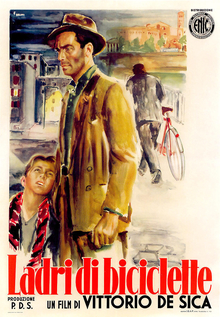
Behind the film
- Year
- 1948
- Director
- Vittorio De Sica
- Writers
- Cesare Zavattini, Vittorio De Sica, Suso Cecchi d’Amico, Oreste Biancoli, Gherardo Gherardi, Gerardo Guerrieri
- Genres
- Drama, Art
- Country
- Italy
- Cast
- Lamberto Maggiorani, Enzo Staiola, Lianella Carell
About the film
Contains story spoilers.
Vittorio De Sica’s film begins in a Rome where unemployment is visible in a daily queue. Antonio Ricci is offered work putting up advertising posters, but the job has one condition: he must have a bicycle. His wife Maria helps make it possible by pawning household bed linens to redeem the bicycle from storage. The decision is practical and costly, joining family life directly to Antonio’s chance at earning wages. The bicycle is more than transport; it is the fragile opening through which the family might regain stability. The film makes the work requirement feel immediate: Antonio has a position, but only as long as he can bring the necessary tool to the streets.
Antonio’s first morning on the job is interrupted almost at once. While he is hanging a poster, a thief rides away with the bicycle. Antonio chases him but loses him in the movement of the city. He reports the theft to the police, though the scale of the problem is clear: there are too many stolen bicycles and too little capacity to recover one. With the job at risk, Antonio turns to friends and fellow workers. His young son Bruno accompanies him, making the search a father-and-son journey through the same city that has offered opportunity and taken it away. The speed of the theft leaves Antonio with no time to finish his task or secure the income on which the family was counting.
The search takes them to Piazza Vittorio, where bicycle parts and repair stalls make ownership difficult to prove. Antonio believes he spots his bicycle’s frame, but the serial number does not match, leaving him without a claim. He and Bruno continue to Porta Portese, following a suspected thief and an older man who may know him. Their pursuit passes through commerce, religious gathering and street work. The city’s scale repeatedly swallows a lead just as Antonio thinks it may take him closer to the missing object, while ordinary activity continues around his emergency. The market offers many near-matches, but resemblance is not enough to establish ownership in front of the people who could help.
Antonio confronts the older man and asks for help finding the thief. The man withdraws into a church service for the poor, where Antonio follows him and tries to keep the questioning alive. Bruno is left waiting, and the interruption makes Antonio’s search feel divided between the urgency of work and responsibility for his child. Eventually Antonio locates the young man he believes stole the bicycle in a working-class neighborhood. Neighbors defend the suspect and resent Antonio’s accusation. A policeman arrives, but without the bicycle or firm evidence he cannot resolve the dispute. Antonio has reached the person he sought without gaining the proof or public support that would make the confrontation effective.
Near the football stadium, Antonio sees an unattended bicycle and tries to take it. He is caught and surrounded by a crowd; the owner is prepared to have him arrested, while Bruno watches the humiliation. Seeing the boy’s distress, the owner lets Antonio go. The release does not solve the family’s material problem, and the film does not turn compassion into replacement income. Father and son walk away together, carrying a changed understanding of one another through the streets. The attempted theft reverses the day’s roles without making Antonio’s desperation equivalent to the earlier theft: the audience has followed the pressure that brought him to that choice.
The search also damages the ordinary relationship between Antonio and Bruno before the final attempted theft. Antonio's frustration spills into anger toward the child, and a sudden fear for Bruno's safety exposes how quickly his attention can shift from the missing bicycle to what cannot be replaced at all. Their meal together supplies a brief interruption. Antonio tries to offer pleasure and reassurance, but another family's more comfortable circumstances make the distance in resources visible at the table. Hunger, pride, and parental care occupy the same small moment. The meal cannot recover a day's wages, yet treating it as pointless would miss what Antonio is still trying to give his son.
Maria's visit to a fortune-teller initially meets Antonio's skepticism. Later, desperation takes him toward the same kind of reassurance he has dismissed. The advice provides no reliable route to the bicycle, but the appeal makes sense in a search where official reports, friends, markets, and confrontation have all failed. Persistence is not a resource that can replace evidence or money. Lamberto Maggiorani's Antonio can be purposeful in one scene and painfully uncertain in the next without becoming a different person. Enzo Staiola's Bruno has to keep pace with these changes, watching the adult he depends on seek help from people whose answers do not necessarily make them useful.
De Sica's Rome is active around the search rather than arranged only to supply its clues. Crowds, trade, worship, and leisure continue while the loss of one bicycle becomes a household emergency. That difference in scale helps explain why so many encounters fail to deliver justice: Antonio's entire future can depend on something others see as an everyday inconvenience or an unsupported accusation. The film's attention to waiting, walking, and looking gives those failures time to accumulate. Bruno's presence then makes public shame intimate. His father does not disappear into the anonymous crowd when he tries to steal; a child who has followed the whole search is there to recognize him.