
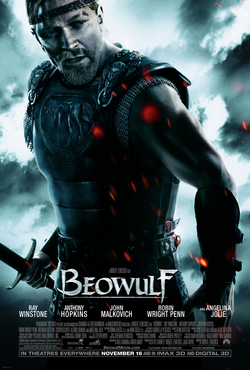
Behind the film
- Year
- 2007
- Director
- Robert Zemeckis
- Writers
- Neil Gaiman, Roger Avary
- Genres
- Fantasy, Adventure, Action, Drama
- Production
- Warner Bros. Entertainment, ImageMovers Digital, ImageMovers
- Country
- United States
- Cast
- Ray Winstone, Anthony Hopkins, John Malkovich, Robin Wright, Angelina Jolie, Brendan Gleeson, Crispin Glover, Alison Lohman
About the film
Contains story spoilers.
The film begins when Beowulf travels to Heorot, where Grendel’s attacks have made the hall unsafe. He kills the creature, then follows the conflict into a cave and encounters Grendel’s mother. Their bargain redirects the story: Beowulf returns celebrated, becomes king and carries a secret whose consequences surface decades later. A dragon attacks the kingdom, and the aging ruler goes to meet it in a final battle. His death leaves Wiglaf to inherit both authority and the unresolved cost of the earlier bargain. This is the 2007 film’s reworking of the Old English poem, not a straightforward screen version of the poem’s sequence or meaning. This causal link is the film’s own invention within its adaptation, and understanding it prevents confusion with the source poem.
The film’s major adaptation choice is to make temptation the hinge between its first monster conflict and its later catastrophe. Rather than treating the dragon as a separate episode, the screenplay connects it to Beowulf’s earlier decision and turns heroic reputation into a debt that compounds over time. That change gives the story a unified tragic arc: the celebrated victory at Heorot is also the beginning of a concealed failure. Viewers familiar with the poem should expect substantial differences. The movie uses the legend as raw material for a modern dramatic structure, emphasizing secrecy, desire and the instability of public heroism. The picture’s tone depends on that stylization, which can feel uncanny by design rather than like conventional live action.
Performance capture shapes the film’s relationship to bodies and spectacle. Human expressions are translated through digital imagery, while movement and scale can be exaggerated beyond ordinary live-action limits. The method suits a story filled with monstrous forms, impossible spaces and a hero whose public image grows larger than the man. At the same time, the technique can make the characters feel deliberately stylized, emphasizing how the film constructs a legendary world rather than presenting a naturalistic historical past. Its visual surface is not an archaeological reconstruction; it is a designed fantasy that turns the poem’s legendary material into cinematic spectacle. The hall’s public rituals turn reputation into a kind of currency that Beowulf can spend before the hidden cost appears.
Robert Zemeckis stages Heorot as a place where reputation is performed in public. The hall’s feasts, boasts and songs create a community that depends on storytelling as much as physical defense. Beowulf arrives already prepared to become the answer to a crisis, and the crowd’s attention helps make him a hero. Later scenes complicate that arrangement by showing the distance between the tale told about him and the decisions he has hidden. The film’s action therefore serves a thematic function: combat is public proof, while the more consequential bargain takes place away from the audience that will later celebrate him. The aging body changes the meaning of heroism, replacing youthful conquest with an attempt to face consequences directly.
The time jump changes the film from youthful challenge to inheritance. An older Beowulf confronts not just a dragon but the durability of choices he has spent decades containing. Wiglaf’s presence matters because he represents a future that cannot simply repeat the king’s legend. The climax gives the hero a final act of courage, yet it does not restore a clean moral record. That ambivalence distinguishes sacrifice from absolution. The kingdom receives a protector’s death and a new ruler, but the film leaves the audience considering what secret histories will shape the next reign. Wiglaf’s inheritance also suggests that political continuity may preserve the legend while obscuring the private truth behind it.
Neil Gaiman and Roger Avary’s screenplay draws on recognizable names and episodes while rearranging their relationships. This approach can be compelling for viewers who want an adaptation that argues with its source, but it can frustrate anyone expecting fidelity to the poem’s cultural and literary context. The movie’s choices should be discussed as choices made by this production, not as evidence about the original text or medieval history. Its version foregrounds a psychological question—whether heroic fame can survive private compromise—and makes that question the engine of its fantasy plot. This distinction matters for any account of the poem, whose structure and concerns cannot be inferred from the film alone.
Ray Winstone's central performance gives the enormous digital hero a voice that can express weariness as well as a boast. That difference becomes important as the film's spectacular scale meets the limitations of an aging ruler. Anthony Hopkins's Hrothgar supplies another version of authority compromised beneath its public display, while Brendan Gleeson's Wiglaf remains close enough to the hero to inherit more than a crown. The ensemble keeps the consequences personal inside the elaborate imagery. It is the relationship between the legend and the people required to live with it that makes the final confrontation matter beyond its physical size and destructive force.