
Behind the film
- Year
- 1959
- Director
- William Wyler
- Writers
- Karl Tunberg
- Genres
- Epic, Drama, Action, Sword-and-sandal
- Production
- Metro-Goldwyn-Mayer
- Country
- United States
- Cast
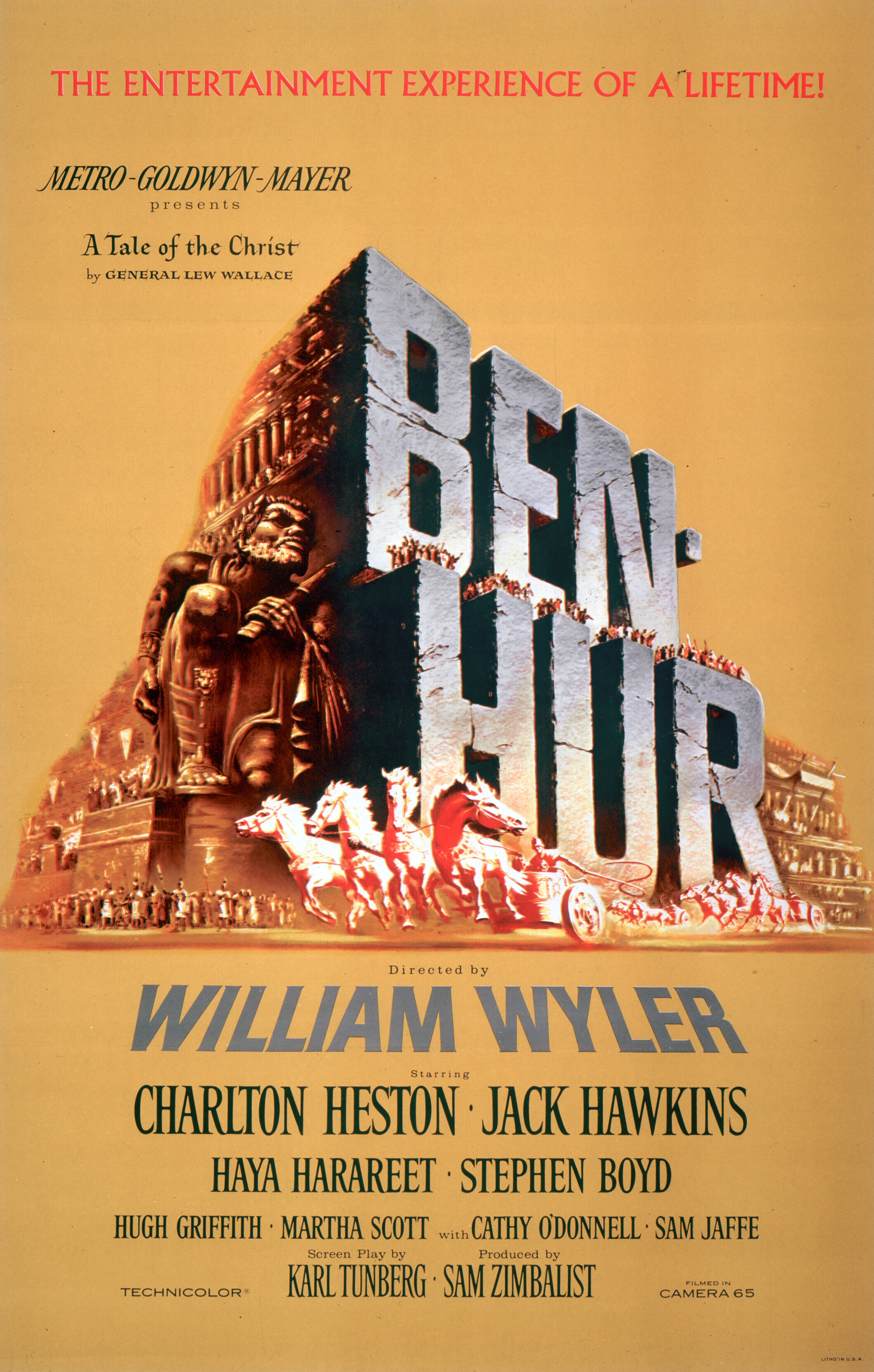
- Charlton Heston, Stephen Boyd, Haya Harareet, Jack Hawkins, Hugh Griffith, Martha Scott, Cathy O’Donnell, Sam Jaffe
About the film
Contains story spoilers.
William Wyler’s Ben-Hur opens with the birth of Jesus before moving forward to Jerusalem in the first century. Judah Ben-Hur is a wealthy Jewish prince whose childhood friend Messala returns as a Roman officer. They greet one another warmly at first, but their loyalties have changed: Messala wants Judah to identify potential rebels, while Judah refuses to betray his community. Their disagreement is political as well as personal. The film gives this friendship a large historical setting, yet it keeps the conflict intimate by showing how a demand made by the empire breaks a bond that once seemed unshakable.
During the governor’s entry into Jerusalem, loose roof tiles fall from Judah’s house and nearly injure the Roman official. The accident is treated as deliberate, and Messala uses it to condemn Judah to the galleys while imprisoning Judah’s mother Miriam and sister Tirzah. As a prisoner, Judah is marched through Nazareth and receives water from Jesus, an encounter he remembers later. On a Roman ship, he survives a sea battle and saves Consul Quintus Arrius. Arrius rewards him with freedom and later adopts him. Judah’s change in status gives him resources and access, but he returns to Judea still driven by the need to find his family and confront Messala.
On the journey home, Judah meets Sheik Ilderim, who owns a team of racing horses and recognizes a possible charioteer in him. In Jerusalem, Judah finds Esther living in his old house. Miriam and Tirzah are alive but have leprosy; they hide the truth from him and leave the city rather than let him see them. At the women’s request, Esther tells Judah they have died, trying to spare him the sight of their illness. Believing this account, he directs his anger toward Messala. Ilderim encourages him to enter the chariot race, where Messala plans to demonstrate Roman dominance. Training gives Judah a new purpose, but the race is not simply a sporting event: it offers a public reckoning between former friends. Ilderim trains Judah with the horses and encourages him to read Messala’s habits rather than rely only on speed. Esther provides a contrast to that public contest: she remains connected to the household and its losses, while Judah measures justice through the opponent he can confront. Judah does not yet know where the women are living. Esther carries that knowledge alone, torn between the promise she has made to Miriam and the grief her account has caused Judah. Their separation from him remains unresolved when he enters the arena.
The chariot race is staged as a contest of control as much as speed. Messala uses his spiked wheels to damage other teams, while Judah tries to keep his horses together and avoid being pulled into the same cruelty. Judah wins, and Messala is fatally injured. Before dying, Messala tells him that his mother and sister live, but are confined with other lepers. Judah returns to Esther with the news and admits that his desire for revenge has not restored anything. Their concern shifts toward the women’s safety, and Esther hopes that Jesus may be able to help them.
The film brings Judah’s story back to the opening image of Jesus. As Jesus is led to crucifixion, Judah recognizes him as the man who gave him water. Judah follows the procession and tries to return the kindness, but Jesus falls under the burden of the cross. During the storm surrounding the crucifixion, Esther shelters with Miriam and Tirzah in a cave. When the storm lifts, their leprosy is gone, and the family reunites. The resolution links physical healing with Judah’s change in outlook: the man who once organized his life around vengeance is able to return to his mother and sister. The film frames this as a religious miracle within its story, not as a historical claim about the fictional Ben-Hur family.
Wyler’s scale is most obvious in the chariot sequence, whose arena, crowd and racing teams fill the wide frame with movement. The race is built from practical sets, stunt work and carefully coordinated camera positions, so the viewer can follow the horses and understand the peril without losing the larger spectacle. Miklós Rózsa’s score gives the film a ceremonial weight, while close views of Judah and Messala keep the rivalry personal amid the public event. The production’s grandeur serves a story of loyalties: the monumental world makes the private consequences of a broken friendship feel equally large.
This 1959 adaptation of Lew Wallace’s novel is distinct from the silent 1925 film and later screen versions. Its treatment of ancient Judea, Roman rule and the life of Jesus is shaped as a religious epic, not a documentary reconstruction of the period. Judah’s fictional story intersects with events and figures that the film presents reverently, and its ending makes a theological choice about mercy and healing. The human conflict remains its anchor: a family separated by political power, a friendship changed by allegiance, and a man who must decide what to do after revenge has already taken its toll.