
Behind the film
- Year
- 1999
- Director
- Spike Jonze
- Writers
- Charlie Kaufman
- Genres
- Comedy drama, Fantasy, Comedy, Drama
- Production
- Propaganda Films, Gramercy Pictures
- Country
- United States
- Cast
- John Cusack, Cameron Diaz, Catherine Keener, John Malkovich, Orson Bean, Mary Kay Place
About the film
Contains story spoilers.
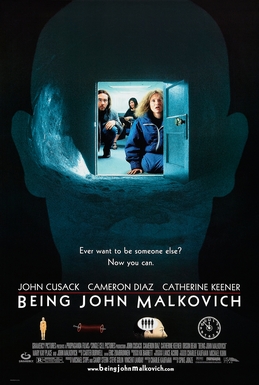
Being John Malkovich follows Craig Schwartz, an unemployed puppeteer whose marriage to Lotte is strained and whose artistic ambitions have nowhere to go. A file-clerk job in a strangely short office puts him near Maxine, a co-worker who does not share his attraction. Behind the files, he finds a door and crawls through a tunnel into the mind of actor John Malkovich; after fifteen minutes he is ejected beside a highway. Maxine turns the discovery into a paid attraction, and Lotte’s own visits awaken feelings for Maxine, who reciprocates only while she is inside Malkovich. Craig later takes control of the actor and uses his puppeteering ability to build Malkovich’s career. Dr. Lester reveals that he is Captain Mertin, who plans to transfer himself and his friends into Malkovich on the actor’s forty-fourth birthday. Craig’s exit lets them take over; years later, Craig enters too late to control Maxine’s daughter Emily and remains trapped inside her, watching Lotte and Maxine together.
The premise begins as a joke about celebrity access, but the film treats the portal as a physical workplace discovery. The door is not a polished science-fiction machine: it is hidden behind office storage, reached through a muddy crawlspace, and ends at a very ordinary stretch of roadside. That abrupt movement from cramped corporate interior to another person’s consciousness gives the impossible event a blunt material quality. The Mertin-Flemmer office itself is built around a half-floor with low ceilings, so its workers stoop and shuffle through rooms that seem designed to reduce them. The architecture makes Craig’s life feel pinched before he finds a route into someone else’s body. Its comic proportions also let ordinary office manners persist inside an increasingly impossible premise, so strange discoveries arrive amid filing, calendars, and workplace hierarchy.
Craig’s puppet theatre supplies an important idea about control. He can choreograph a puppet’s gestures with remarkable sensitivity, yet his talent has brought neither stable work nor recognition. Inside Malkovich, he discovers the same skill can operate a living adult body, turning the actor into a performer whose public career reflects Craig’s craft. The film makes the exchange unsettling by showing how readily spectators accept a new creative identity when it arrives through a famous face. Craig’s skill is real, but the success he earns depends on inhabiting another person without consent. His artistic triumph and ethical failure become inseparable.
Lotte and Maxine complicate that violation by giving the portal different meanings to its users. Lotte’s visits unsettle her sense of gender and awaken a desire she had not been able to articulate in her marriage. Maxine’s attraction is directed toward Lotte as she inhabits Malkovich, not toward Craig’s ordinary self; that distinction forces the characters to confront the difference between a person and the body through which someone else is appearing. Craig responds to being excluded by intensifying his control rather than listening. The relationship triangle therefore evolves through questions of agency, not simply romantic rivalry: who is present, who is desired, and who gets to decide what a body means?
John Malkovich’s participation as a fictionalized version of himself provides a different comic register. His celebrity persona is not treated as an untouchable emblem; it becomes a vulnerable person whose routines and public identity are invaded. The film’s famous interior detour, in which Malkovich himself enters the portal and encounters a world populated by copies of himself, turns the conceit into a visual gag while also dramatizing the terror of being reduced to one repeated identity. Malkovich plays the scene with enough bewilderment to make the absurdity legible, and the movie trusts the audience to follow a chain of nested viewpoints without explaining every rule aloud.
The older conspirators add a different dimension to the portal's appeal: fear of running out of time. Their project treats another person's existence as a resource available for extending their own. That is a useful contrast with Craig's hunger for recognition and the relationships forming around Maxine. The same extraordinary opportunity can attract incompatible ambitions, none of which grants automatic permission to use the host. The comedy becomes darker as private wishes acquire an organised structure. A desire that might look merely eccentric in an individual can become an institution when several people share it, arrange its procedures and protect the conditions that make it possible.
The severity of Craig's fate follows from that concern with agency. Witnessing a life is different from participating in it, just as performing control is different from forming a relationship. A person who treats others as materials for his own fulfilment can become unable to recognise the lives continuing outside his plans. The film's absurd device makes that emotional limitation literal. It leaves room for escape and change, but refuses the assumption that having unusual talent entitles someone to take possession of another person. Its comedy keeps returning to a troubling question beneath the spectacle: how much of what we call desire is really a demand that somebody else cease to be independent?