
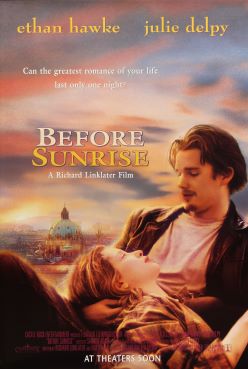
Behind the film
- Year
- 1995
- Director
- Richard Linklater
- Writers
- Richard Linklater, Kim Krizan
- Genres
- Romance, Drama
- Production
- Castle Rock Entertainment
- Country
- Austria, United States, Switzerland
- Cast
- Ethan Hawke, Julie Delpy, Andrea Eckert, Hanno Pöschl, Karl Bruckschwaiger, Tex Rubinowitz, Erni Mangold, Dominik Castell
About the film
Contains story spoilers.
Jesse, an American travelling towards a flight home, meets French student Céline on a train from Budapest. He persuades her to leave the train with him in Vienna. Unable to afford a room, they wander until morning, talking about relationships, belief and their lives. They kiss on a Ferris wheel and encounter strangers, including a poet who works their chosen word into a poem. Both admit recent romantic disappointments. In a café they pretend to telephone friends, revealing feelings indirectly. They share wine in a park and become more intimate, aware that separation is approaching. At the station, they choose not to exchange contact details and instead promise to meet there six months later. The film leaves that promise untested, preserving the night as an encounter whose future remains unknown.
Richard Linklater gives this apparently small premise room to change shape through the people inside it. A conversation is not only a means of delivering information about Jesse and Céline; it is what they are doing together. Each response alters the next possibility. Someone can make a claim to seem interesting, discover a genuine disagreement or retreat into a joke when a feeling becomes too exposed. The screenplay by Linklater and Kim Krizan allows those shifts to provide movement without requiring an external crisis every few minutes. Attention becomes a dramatic action. Whether one person is willing to hear the other, and whether that hearing changes anything, matters as much as where their wandering takes them.
Ethan Hawke's Jesse arrives with a style of speaking that can make uncertainty sound like a theory. He is articulate enough to defend an impression, but fluency does not mean he has finished understanding himself. The character's appeal includes that mixture of confidence and vulnerability. An idea can be sincere and still function as a way to manage how someone sees him. Hawke gives Jesse room to be curious, performative, embarrassed and thoughtful without treating those qualities as mutually exclusive. The night asks him to remain responsive rather than simply interesting. Meeting a person who can challenge his account of himself makes conversation more demanding than the pleasant experience of finding someone willing to listen.
Julie Delpy's Céline is equally active in shaping that exchange. Her attention is not an empty space Jesse gets to fill. She can recognise an argument's attraction while refusing its conclusion, and her own convictions make the relationship feel like an encounter between distinct minds. Delpy gives her a directness that does not eliminate self-consciousness. The possibility of intimacy is exciting partly because it makes the stakes of speaking higher: an answer may reveal something, provoke resistance or change the way the other person imagines her. The film's romance depends on that independence. Agreement can be pleasurable, but the more substantial connection emerges through the discovery that difference need not end a conversation or reduce the desire to continue it.
Vienna offers a world they can inhabit without possessing it. Streets and public spaces keep their meeting open to interruptions, allowing the city to remain present rather than becoming a private stage arranged entirely for romance. The surroundings give them things to notice and discuss, so the developing relationship is continually connected to attention beyond the couple. That matters because attraction can otherwise narrow a film's world until everyone else becomes decoration. Here passing people bring different rhythms, judgments and purposes. The night belongs intensely to Jesse and Céline, yet the city does not know that. Its continuing life makes their encounter feel particular and temporary, a small shared experience inside places that will remain after they leave.
The limit of one night changes how both characters use time. A conversation that might normally be postponed becomes possible because postponement could mean losing it altogether. At the same time, the deadline offers a form of protection: neither person has to demonstrate immediately how well a connection would operate within a settled routine. That gives the romance its productive uncertainty. They can reveal more because the future is limited, while still wondering whether the apparent depth partly depends on that limit. Before Sunrise does not dismiss the feeling for being shaped by circumstance. It allows circumstance to be part of what makes the feeling real, even if reality does not guarantee permanence or establish what either person should do next.
The film also pays attention to the difference between speaking directly and finding a form that makes directness possible. Humour, speculation and imaginative play can allow someone to approach an admission without experiencing it as a demand. Those changes of register make the intimacy feel earned through a shared willingness to participate. Neither character can fully control how a remark will be received, so the exchange contains small risks that remain readable beneath the casual surface. Linklater's direction permits pauses, glances and changes of posture to matter alongside the words. A person may appear comfortable talking in general while becoming suddenly uncertain about saying the particular thing that would change the relationship.
The ending preserves that uncertainty instead of resolving it through evidence the characters do not yet have. A promise can be meaningful without being secure, and the choice to make one tells us something about the night rather than proving the future. Before Sunrise is interested in how an encounter becomes important while it is still happening. It gives ordinary conversation enough room to contain attraction, disagreement, memory and a tentative willingness to be known. The places the pair pass through lend the experience a physical shape, but what develops between them cannot be reduced to an itinerary. They leave with a possibility they have chosen to take seriously, and the film allows both its hope and its fragility to remain.