
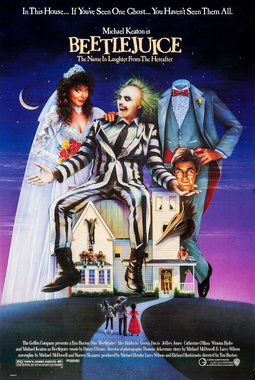
Behind the film
- Year
- 1988
- Director
- Tim Burton
- Writers
- Michael McDowell, Warren Skaaren
- Runtime
- 1h 32m
- Genres
- Comedy horror, Fantasy, Ghost, Gothic
- Production
- Warner Bros. Entertainment, The Geffen Film Company, Warner Bros. Pictures
- Country
- United States
- Cast
- Michael Keaton, Alec Baldwin, Geena Davis, Jeffrey Jones, Catherine O'Hara, Winona Ryder, Glenn Shadix, Sylvia Sidney
About the film
Contains story spoilers.
Adam and Barbara Maitland drown in a car accident and return to their house as ghosts. The incoming Deetz family remodels their home, while the afterlife gives them rules and paperwork instead of an easy solution. Only teenager Lydia can see them. Against caseworker Juno's advice, they approach the unruly bio-exorcist Betelgeuse, whose help creates new problems. The Deetzes treat a haunting as a commercial opportunity; their associate Otho then accidentally endangers the Maitlands with an exorcism. Lydia agrees to marry Betelgeuse to save them. Barbara returns riding a sandworm that swallows him, and the two families settle into a shared household. The troublemaker winds up back in the afterlife's waiting room. That is the story's broad shape: an attempt to recover an old life produces a different kind of home.
The clever reversal is that the ghosts are the people asking for peace and quiet. A haunted house usually belongs emotionally to its frightened new residents, with its old occupants functioning as a threatening secret. Here the familiar household is what needs defending. Adam and Barbara's modest preferences give the supernatural disorder a human scale: there is something recognisable about discovering that somebody else has decided your comfortable surroundings are desperately unfashionable. Their predicament also carries a gentler sadness. They cannot resume their lives simply by staying in the same rooms. Possession of a building and the experience of belonging are starting to come apart, long before the most outrageous visitor arrives.
Lydia provides the connection that the adults struggle to make. Her outsider identity gives her more in common with the displaced couple than with the people who are supposed to understand her. Winona Ryder's character fits naturally into the film's strange visual world, but her loneliness does not function merely as an accessory to it. She makes the question of being seen literal and emotional at once. Attention can recognise a person, display them as a curiosity or exploit their vulnerability. Those possibilities matter more than a simple division between friendly humans and frightening ghosts. The household becomes interesting when its inhabitants stop assuming that their own category determines whose feelings deserve consideration.
The Deetzes turn decoration into a kind of argument. Delia's taste announces itself, demanding a reaction; the Maitlands' attachment to their surroundings assumes that comfort needs no announcement at all. Catherine O'Hara and Alec Baldwin occupy opposing ends of that domestic dispute, with Geena Davis giving the ghosts' predicament its anxious warmth. The collision is funny because neither household has chosen to enter the other's world, yet each behaves as if its own preferences should be obvious. Interior design becomes a way of exercising authority over people who cannot object through ordinary channels. You do not need a monster in the doorway to understand how invasive that can feel.
Michael Keaton's title character represents another kind of intrusion altogether. His energy promises to cut through hesitation, rules and politeness, making him attractive precisely when patience has become unbearable. Yet his apparent usefulness comes attached to an appetite for control. He can turn other people's distress into an opening for his own performance. That makes the film's central bargain more interesting than a routine instruction to avoid dangerous magic. Desperation makes a loud, confident solution sound reasonable; confidence gives no assurance that the person offering it shares your objective. Keaton supplies the disruptive excess, while the quieter characters establish why a solution is wanted in the first place.
The supernatural world has the texture of an inconvenient public service. Its strangeness does not exempt anyone from waiting, misunderstanding instructions or discovering that the relevant official has other cases to deal with. That combination makes death absurdly familiar without making it ordinary. Burton's creatures and distorted spaces invite curiosity as much as fear: the eye wants to inspect this world, even when entering it would be a terrible idea. Danny Elfman's music suits a universe whose rules seem to have been devised with a grin. The visual imagination works because the characters still bring everyday impatience, embarrassment and loyalty into surroundings that refuse to behave sensibly.
The film's comedy also depends on competing definitions of a successful scare. For one person, frightening proof of the impossible might mean the world has become unsafe; for another, it means there is something new to sell or show off. Once novelty can be consumed, terror loses some of its authority. That leaves the Maitlands with a problem larger than learning a ghostly technique. They need to understand their audience. The distinction between spectacle and recognition runs through the whole household: being noticed is easy when you become an extraordinary attraction, but being understood requires a less theatrical kind of attention. The film's louder inventions keep returning to that quieter difficulty.
Beetlejuice finally makes room for coexistence without insisting that everyone must acquire the same temperament or taste. Its warmth comes from the possibility that a household can accommodate differences which first looked intolerable. Even the grotesque humour belongs to that idea: the strange need not be erased before life becomes comfortable again. The threats are more specific than ugliness, eccentricity or death. They involve using people, refusing to listen and treating another person's world as available for takeover. Beneath the noisy supernatural business is a domestic fantasy about finding the people who will make space for you. The house matters because of the relationships it can hold, rather than because one family must own its meaning forever.