
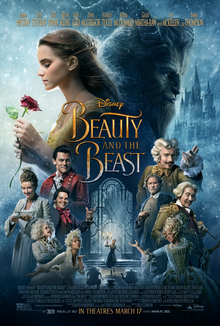
Behind the film
- Year
- 2017
- Director
- Bill Condon
- Writers
- Stephen Chbosky, Evan Spiliotopoulos
- Runtime
- 2h 9m
- Genres
- Romance, Fantasy, Musical, Melodrama
- Production
- Walt Disney Pictures, Mandeville Films
- Country
- United States
- Cast
- Emma Watson, Dan Stevens, Luke Evans, Kevin Kline, Josh Gad, Ewan McGregor, Emma Thompson, Ian McKellen
About the film
Contains story spoilers.
The 2017 Beauty and the Beast turns the familiar fairy tale into a live-action musical fantasy while keeping its central contrast: a young woman who wants a larger life meets a prince whose vanity has made him cruel. Belle lives in a provincial French village with her widowed father Maurice; his eccentric inventions and her own reading set them apart. Gaston treats Belle as a prize he expects to win, but she refuses the future he proposes. Her danger is not only the Beast’s castle, but a community that mistakes conformity for happiness.
When Maurice loses his way in the woods, he finds shelter in an imposing castle and takes a rose before leaving. Its master, the Beast, imprisons him for the theft. Belle follows her father and offers herself in exchange, leaving Maurice to return to the village. The castle is inhabited by servants transformed into household objects, including Lumière, Cogsworth, Mrs. Potts and her son Chip. They welcome Belle with a warmth their master cannot manage. Their enchantment gives the rooms an odd, lively personality, but also puts a clock on the story: when the last rose petal falls, they may remain objects forever.
The Beast's first response to Belle is anger, and hers is fear. He tries to control her through confinement and commands, while she resists rather than performing gratitude for a rescue she did not request. When she discovers the forbidden west wing and its rose, his rage drives her outside. Wolves attack, and the Beast saves her at the cost of his own safety. Belle returns with him and nurses his wounds. Their later exchanges, including his gift of the library, grow out of that changed relationship. Books offer common ground where rank and appearance have previously kept them apart; each must learn to listen before the other can feel safe.
The film gives both leads more room for memory and regret than a simple courtship plot would require. A magical book carries Belle and the Beast to Paris, where she discovers the place where her mother died during an epidemic and understands why Maurice took her away. The Beast’s past is shaped by a father who raised him to value rank over compassion. Their losses do not erase their differences, but explain why each guards against attachment. A new song for the Beast makes his inward change visible as he watches Belle leave to return to her father.
Gaston initially accompanies Maurice to find the castle, but abandons him to the wolves when Maurice rejects his marriage plans. Agathe saves Maurice. Belle later returns with the magic mirror and proves the Beast exists, prompting Gaston to stir up a murderous crowd. He locks father and daughter in a carriage; they escape and Belle races back to the castle. Her arrival gives the Beast reason to resist his attacker. He spares Gaston, who shoots him before falling from a collapsing bridge. The Beast dies and the servants become lifeless objects. Belle's declaration of love moves Agathe, revealed as the enchantress, to restore the prince and household.
The production builds fairy-tale scale through sets, costumes, digital environments and a computer-generated Beast performed by Dan Stevens. That design must let a nonhuman face carry embarrassment, anger and tenderness without losing its strangeness. The answer often lies in posture and timing. The Beast’s awkwardness at the ballroom dance, set against Belle’s calmness, makes their trust legible before dialogue does. The enchanted objects also receive distinct rhythms and personalities rather than functioning as one decorative chorus.
Emma Watson's Belle has to occupy two kinds of crowded room: a village where everybody assumes they know her and a castle where nobody quite knows how to approach her. Her relatively direct manner gives the elaborate musical surroundings a human point of reference. Luke Evans makes Gaston's public confidence feel like something rehearsed until he no longer notices he is performing. His hearty sociability becomes threatening when somebody refuses the role he has assigned them. Josh Gad's LeFou begins as an admiring audience for that performance, making his doubts a disruption of Gaston's usual routine. Kevin Kline gives Maurice a gentler kind of distractedness, so Belle's concern for him rests on recognizable affection rather than an abstract obligation to a helpless parent. Inside the castle, Ewan McGregor's Lumiere and Ian McKellen's Cogsworth have contrasting approaches to a visitor: theatrical welcome and anxious management. Emma Thompson's Mrs. Potts supplies a quieter domestic rhythm between them. Their human voices make the digitally animated furniture more than a collection of visual tricks. A candlestick can boast, a clock can worry and a teapot can reassure; those familiar responses help Belle find company in a place whose architecture initially seems designed to intimidate her.
Music supplies the film’s changes of scale. The village opening is bright and public, while the castle numbers turn spectacle into hospitality Belle may choose to accept. “Be Our Guest” lets servants express themselves through choreographed movement and transforming scenery; it is both showpiece and an attempt to make a frightening place welcoming. The ballroom sequence slows that energy into a private encounter. Added songs and expanded backstories make the romance more explicit, but its test remains practical: whether the Beast can give Belle freedom, and whether she can see a person beyond the curse.