
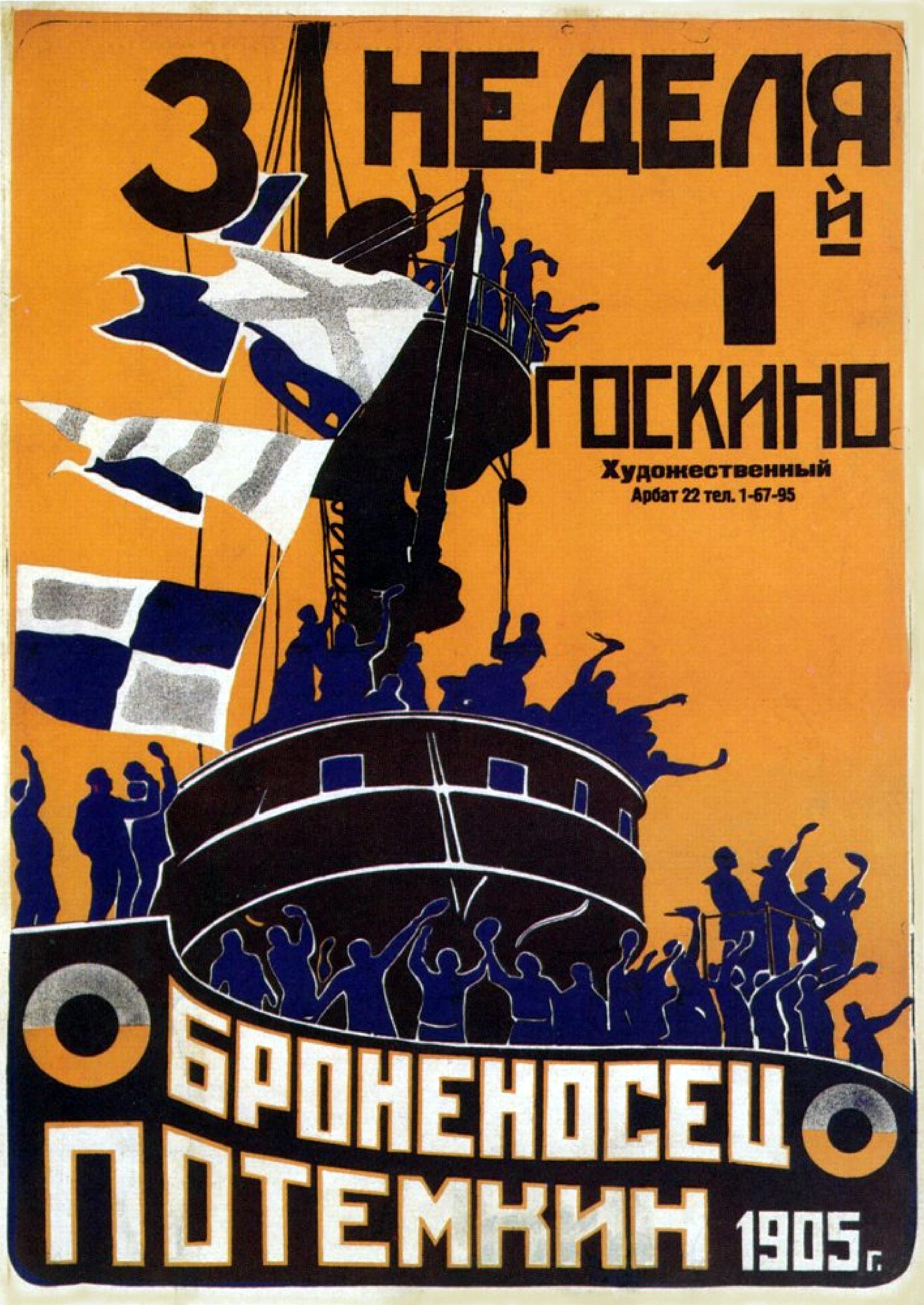
Behind the film
- Year
- 1925
- Director
- Sergei Eisenstein, Grigori Aleksandrov
- Writers
- Sergei Eisenstein, Nina Agadzhanova
- Runtime
- 1h 12m (2025 re-release)
- Genres
- Silent, Historical drama, Drama, Propaganda
- Production
- Mosfilm, State Committee for Cinematography
- Country
- Soviet Union
- Cast
- Aleksandr Antonov, Vladimir Barsky, Grigori Aleksandrov, Ivan Bobrov, Mikhail Gomorov, Beatrice Vitoldi
About the film
Contains story spoilers.
Battleship Potemkin builds its story around a mutiny in the Russian navy during the unrest of 1905, treating one ship as a small, brutally ordered version of the society around it. Officers command the vessel, sailors carry out the labor, and even the food makes the difference in power tangible. The crew finds maggots in the meat intended for their meal, but the ship’s doctor dismisses their complaint. When the meat becomes soup, refusal to eat it is treated as defiance. Sergei Eisenstein begins the film with bodies at rest below deck and develops the rebellion from the things those bodies need: sleep, decent food and freedom from humiliation. Political conflict grows out of conditions that the men can see and feel before anybody has to explain an ideology.
On deck, the captain threatens the men with execution. A group is covered with a canvas sheet, and an armed squad is ordered to fire on fellow sailors. Vakulinchuk appeals to the squad’s solidarity, interrupting the apparent inevitability of the punishment. The refusal to shoot allows the crew to turn on the officers, and the ship passes out of its commanders’ control. The doctor who defended the rotten meat is thrown overboard, making his dismissal of the sailors’ suffering part of the mutiny’s violence. Victory on deck is incomplete, however, because Vakulinchuk is killed. The man whose intervention helped make collective action possible becomes the rebellion’s first central casualty. Eisenstein moves from threatened anonymous bodies under the canvas to an individual body whose death the city can mourn.
The ship reaches Odessa, where Vakulinchuk’s body is placed on shore and people gather around it. The gathering develops from curiosity and grief into public solidarity with the sailors. Citizens bring provisions to the battleship, extending the rebellion beyond the people who work aboard it. The crowd is not shown as perfectly united from the outset: an antisemitic attempt to redirect its anger meets resistance within the gathering. That interruption matters because the film presents solidarity as something people actively create, not a condition that simply exists wherever a crowd assembles. The dead sailor links the ship and the city through a recognizable injustice, while the exchange of food gives their alliance a practical form. People who were previously separated by the shoreline begin to act as participants in the same event.
The most famous section takes place on the Odessa Steps, where the mood of support is shattered by advancing troops. The soldiers descend in a regular formation, while civilians scatter in confusion. Eisenstein cuts between the coordinated movement of boots and rifles and individual people who cannot match that organization: a mother carrying her injured child, a woman confronting the attackers, frightened faces and a baby carriage rolling down the stairs. The geography remains clear enough to understand the danger, but the editing stretches the experience into successive shocks. A person’s fall does not close the incident; another face or movement reopens it. The sequence transforms a wide public staircase into a trap, placing the crowd’s vulnerability against the military’s capacity to keep advancing without acknowledging the people in front of it.
The battleship responds by firing at the opera house used as an imperial military headquarters. That retaliation brings the ship back into the foreground, but it does not settle the wider conflict. A loyalist squadron approaches, and the mutineers prepare to fight vessels that could overpower them. The final movement makes waiting itself dramatic: men watch the water, machinery works below deck, guns are readied and the distance between ships narrows. The question becomes whether the other crews will obey orders to fire or recognize the people aboard Potemkin as fellow sailors. They allow the battleship to pass, and cheers replace the battle the crew expected. The film ends at that moment of solidarity, giving its immediate story a release without claiming to recount the entire course of Russia’s revolutionary history.
The film’s five movements give an audience several different ways to experience a crowd. Below deck, the sailors are workers living under discipline; during the mutiny, they become an organized force. At the harbor, citizens become mourners and supporters, and on the steps those same civilians become scattered targets. The last encounter asks whether armed crews serving elsewhere in the navy can also become allies. Faces and gestures carry much of this change because the film is silent, using intertitles alongside the images rather than spoken dialogue. Eisenstein and cinematographer Eduard Tisse make individual details do the work of a conventional central hero: a plate, a hand, a pair of spectacles or a gun can suddenly concentrate the meaning of a larger confrontation.
Its power as a constructed political film also makes the distinction between drama and historical record useful. Potemkin draws on a real mutiny, but the steps sequence is a staged cinematic account, not documentary footage of a massacre unfolding in front of a camera. Eisenstein combines locations, performers and separate shots to produce the impression of an event with an overwhelming internal rhythm. A cut can make two movements seem to collide even when they occupy different spaces; repeated angles can make a short action feel prolonged. The resulting world is organized around the opposition between official discipline and collective revolt. The film asks the audience to feel that opposition through the arrangement of images, so understanding how the sequences are assembled adds to the story rather than standing outside it.