
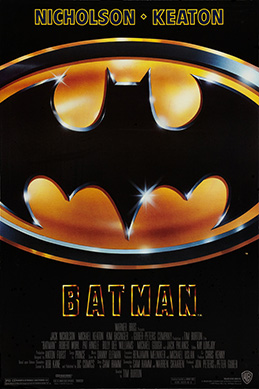
Behind the film
- Year
- 1989
- Director
- Tim Burton
- Writers
- Sam Hamm, Warren Skaaren
- Runtime
- 2h 4m
- Genres
- Neo-noir, Action, Superhero
- Production
- PolyGram Filmed Entertainment, Universal Pictures, Warner Bros. Entertainment
- Country
- United States, United Kingdom
- Cast
- Michael Keaton, Jack Nicholson, Kim Basinger, Robert Wuhl, Pat Hingle, Billy Dee Williams, Michael Gough, Jack Palance
About the film
Contains story spoilers.
Gotham City is preparing to celebrate itself while crime gives its residents little reason to feel secure. Batman initially exists between eyewitness accounts, newspaper investigation, and police reluctance to acknowledge him. Journalist Alexander Knox wants to establish that the figure is real, and photographer Vicki Vale joins his search. Their interest provides a route toward Bruce Wayne, the wealthy host of a benefit who seems less commanding in conversation than his surroundings suggest. Michael Keaton's Bruce can look distracted or uncertain without losing the secrecy beneath that behavior. The public man and the figure on the rooftops belong to the same city but occupy it in very different ways.
Gangster Jack Napier has a different problem with concealment. His boss, Carl Grissom, sends him to Axis Chemicals under the cover of protecting the syndicate's interests, while arranging a betrayal that should get him killed. Batman enters the confrontation with police already arriving, and Napier falls into a chemical vat after a struggle. His survival leaves his face changed and his mouth fixed in a smile. Adopting the Joker identity lets him convert injury into a performance of power. He kills Grissom and takes over the criminal organization, no longer content to remain an underling. The change gives Gotham a threat who wants to be seen rather than merely to conduct business unseen.
The Joker's attacks spread through familiar products instead of remaining limited to armed confrontations. His poison leaves victims wearing a grotesque expression of happiness, turning the city's attention to the danger concealed in ordinary consumption. Television gives him an audience and a way to advertise himself. Batman works to identify the threat while Vicki becomes another object of the Joker's interest. He arranges an encounter at an art museum, where destruction of the exhibits becomes part of his entertainment. The setting makes his idea of creativity tangible: he can call a violation an improvement because he has the force to impose it. Batman's intervention gets Vicki out, but does not make either man's identity simple to her.
Bruce's effort to tell Vicki who he is is interrupted by Napier arriving at her apartment. An expression the gangster uses brings Bruce back to the childhood killing of his parents, and he recognizes Napier as the man who shot them. That recognition makes the present conflict part of the loss behind his hidden life. The film gives its own version of these origins, connecting hero and villain through events that do not apply to every Batman story. Alfred's role as confidant also becomes visible to Vicki when she encounters the life beneath the mansion. Discovering Batman means learning why Bruce maintains a distance, not only seeing that he owns the equipment used by the masked figure.
The Joker plans a public celebration in which money draws people close enough to be endangered. Parade balloons carrying poison turn a city's appetite for spectacle into an opportunity for mass harm. Batman uses the Batwing to remove that threat, but the confrontation brings him down rather than providing an effortless airborne victory. The Joker takes Vicki into Gotham's cathedral and climbs toward an escape by helicopter. The pursuit contracts the crowded parade into stairs, ledges, and a dangerous height. Public performance has become a more private struggle, with Vicki caught between the men whose relationship now contains far more than she understood when she began looking for a newspaper story.
At the top, Batman confronts the Joker over his parents' murder. The villain, in turn, blames Batman for the fall that produced his altered face, making their claims of responsibility collide. When the Joker tries to leave by helicopter, Batman attaches him to a heavy stone gargoyle. Its weight pulls him away from the escape and he falls to his death. Bruce saves Vicki from their own fall, and Gotham is left with a public defender whose identity remains concealed. The final signal in the sky establishes a way for the city to reach him. The conclusion resolves this particular threat without making the masked life unnecessary or turning Bruce into an ordinary citizen again.
Anton Furst's production design makes Gotham feel assembled from incompatible eras rather than tied to a single contemporary city. Heavy industrial structures, crowded streets, an immense cathedral, and older architectural forms occupy one visual world. That mixture allows the Batmobile and Batman's equipment to appear both technological and almost ceremonial against the buildings around them. Danny Elfman's score gives the hero a brooding scale, while Prince's songs participate in the Joker's more outward-facing performances. The two figures move through different registers of spectacle: one uses a controlled silhouette to create fear, and the other surrounds himself with color, jokes, and an audience that may not realize it is under attack.
Jack Nicholson's Joker makes aggression inseparable from the pleasure of commanding a scene, while Keaton often keeps Bruce's reactions smaller and harder to read. Kim Basinger's Vicki has a professional reason to investigate before romance makes the discoveries more personal, and Robert Wuhl's Knox keeps the newspaper pursuit present beside the larger action. Tim Burton's film devotes attention to the city and the villain rather than explaining every stage of Batman's training. Equipment, the cave, Alfred, and fragments of memory reveal an established hidden life. Gotham encounters its defender as an unsettling presence first, and the story gradually supplies the private grief beneath that image without stripping away all of its strangeness.