
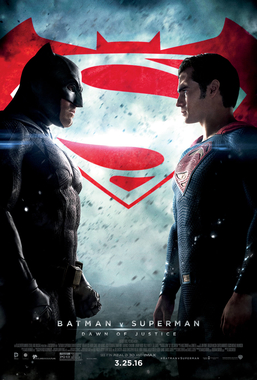
Behind the film
- Year
- 2016
- Director
- Zack Snyder
- Writers
- Chris Terrio, David S. Goyer
- Runtime
- 2h 31m (theatrical cut)
- Genres
- Crossover fiction, Superhero
- Production
- RatPac-Dune Entertainment, The Stone Quarry, DC Entertainment
- Country
- United States
- Cast
- Ben Affleck, Henry Cavill, Amy Adams, Jesse Eisenberg, Diane Lane, Laurence Fishburne, Jeremy Irons, Gal Gadot
About the film
Contains story spoilers.
Batman v Superman: Dawn of Justice begins with Bruce Wayne as a child fleeing his parents’ funeral and falling into a cave filled with bats. The image returns to an older Bruce, a Gotham vigilante hardened by years of violence. Eighteen months after Superman’s battle with General Zod destroyed much of Metropolis, Bruce has personally seen the devastation and lost people at a Wayne building. He interprets Superman’s power as a threat without reliable limits. Clark Kent, meanwhile, is troubled by Batman’s brutal methods and writes against him in the Daily Planet.
The film moves between Gotham and Metropolis as the public argues over what Superman’s interventions mean. A congressional hearing, led by Senator June Finch, is meant to examine his actions, while Lex Luthor seeks access to Kryptonite recovered after Zod’s attack. Finch rejects the request, but Luthor finds another route to Zod’s body and the Kryptonian scout ship. Lois Lane investigates violence in Africa and traces a suspicious bullet connected to the incident. Her reporting and Clark’s journalism run alongside Bruce’s private preparations for a fight.
At a LexCorp gala, Bruce tries to obtain encrypted files, but Diana Prince takes his device first and later returns it. Bruce decrypts them and discovers Luthor’s records on metahumans, including an old photograph of Diana. His dreams of a ruined future, where Superman rules over devastation, deepen his suspicion. Meanwhile, the Capitol hearing ends in a bomb hidden in a wheelchair; Superman fails to prevent the explosion and blames himself. Luthor’s manipulation feeds Bruce’s existing fear, and Bruce steals Kryptonite to build a weapon against Superman.
Superman withdraws from public life, while Batman turns the mineral into gas and a spear and challenges him beneath the Bat-Signal. Luthor has kidnapped Martha Kent and threatens her life unless Superman kills Batman. Clark tries to explain, but their conversation becomes a fight after Batman attacks with Kryptonite. The older vigilante gains the upper hand, preparing to use the spear. When Superman pleads for him to save Martha—the same name as Bruce’s mother—Bruce finally understands that Luthor has engineered the conflict around personal grief and mistaken assumptions. Lois arrives and clarifies the plea; Batman stops and goes to rescue Martha.
Luthor then releases his backup weapon, a creature engineered from Kryptonian material and his own DNA. Wonder Woman joins Batman and Superman in the battle, using her shield and sword against the monster. Batman recognizes that Kryptonite can weaken it, and Superman takes the spear to finish the fight. He fatally impales the creature but is mortally wounded in return and dies in Lois’s arms. The threat has forced the two men to cooperate, but the cost is not undone by their brief alliance.
After the battle, Luthor is arrested and warns Batman in prison that a larger alien danger is coming. Metropolis holds a memorial for Superman, while Clark is also declared dead and buried in Smallville. Bruce tells Diana he regrets failing to understand Superman in time and asks her help finding other people with extraordinary abilities. The film closes on the small movement of dirt above Clark’s coffin, suggesting that his story may not be over. Its theatrical ending gives the title’s promised conflict a tragic turn before widening the frame to a possible team of heroes.
Zack Snyder presents the catastrophe through contrasting urban textures: Gotham is shadowy and decaying, while Metropolis feels exposed beneath towers, screens and public monuments. The opening destruction is filtered through Bruce’s ground-level view, giving his suspicion a personal origin. Hans Zimmer and Junkie XL’s score, Larry Fong’s compositions and the heavy machinery of Batman’s armoured suit give the confrontation a mythic scale. Alfred supplies a more intimate challenge to Bruce’s certainty. He can recognise the experience and intelligence behind Batman’s preparations while questioning the direction they are taking. A plan can be carefully engineered and still rest on a mistaken judgement. The scarred city and the reminders of earlier losses make Bruce’s fear understandable without making his conclusions reliable. Luthor exploits that vulnerability through images, events and personal pressure that seem to confirm what Bruce already believes. The political hearing offers another setting in which Superman’s actions are interpreted for him before he can establish what happened.
Ben Affleck’s Batman is experienced and physically imposing, but also compromised by grief and certainty; Henry Cavill’s Superman is powerful yet increasingly aware that being able to act does not settle how an action will be understood. Jesse Eisenberg’s Luthor manipulates those vulnerabilities through institutional channels as much as through force. Diana’s presence opens another part of this world: her old photograph suggests a history longer than either man’s immediate conflict, while her decision to join the battle demonstrates abilities Bruce had previously known only through stolen data. The ending turns his suspicion of extraordinary people toward the possibility of seeking their help, leaving the future shaped by Superman’s sacrifice.