
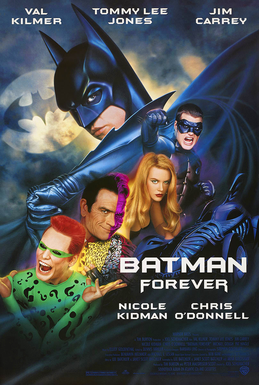
Behind the film
- Year
- 1995
- Director
- Joel Schumacher
- Writers
- Lee Batchler, Janet Scott Batchler, Akiva Goldsman
- Runtime
- 2h 2m
- Genres
- Action, Superhero, Neo-noir, Fantasy
- Production
- PolyGram Filmed Entertainment, Warner Bros. Entertainment, Tim Burton Productions
- Country
- United States
- Cast
- Val Kilmer, Tommy Lee Jones, Jim Carrey, Nicole Kidman, Chris O'Donnell, Michael Gough, Pat Hingle, Drew Barrymore
About the film
Contains story spoilers.
Batman Forever gives Gotham City a bright, theatrical surface while keeping Bruce Wayne's divided identity at the centre of its story. Joel Schumacher's version of the city is full of coloured light, oversized architecture and villains who make a spectacle of their grievances. Val Kilmer's Bruce is quieter within that environment, trying to decide how the life behind the mask relates to the one outside it. The conflict is not simply whether Batman can defeat two criminals. It is whether he understands his own role well enough to share it, build a relationship beyond it or stop somebody else from treating a similar loss as permission for revenge. The new young person in his household makes those questions difficult to keep private.
Two-Face kills Dick Grayson's family during a circus attack, and Bruce takes the surviving acrobat in. Dick discovers he is Batman and wants to avenge his family. Meanwhile, rejected Wayne Enterprises inventor Edward Nygma becomes the Riddler and allies with Two-Face. His commercial Box secretly collects people's mental information and reveals Bruce's identity. The villains attack the manor and abduct psychologist Chase Meridian. Bruce accepts Dick as Robin, and they confront the pair. Robin spares Two-Face; Batman destroys the Riddler's receiver and rescues both Robin and Chase from a trap. Distracting Two-Face with extra coins causes his fatal fall. Nygma is confined to Arkham, and Batman continues with a partner.
Dick brings a particular challenge to Bruce because his anger resembles the emotional foundation of Batman's own life. He is not somebody who needs to be told that violence has consequences; he has already endured them. What he lacks is an alternative way to respond to that knowledge. Bruce's responsibility therefore cannot be satisfied by providing a room and refusing every request to act. The young acrobat has abilities and a will of his own, but abilities alone do not determine what he should do with them. Chris O'Donnell's Dick occupies the space between a dependent member of the household and a potential equal in danger. Becoming Robin involves recognising that space rather than pretending either side of it can simply be erased.
Nygma approaches Bruce from another direction. He wants recognition from a powerful person and turns rejection into a grievance he can build around. Jim Carrey's Riddler makes that hunger conspicuous through performance, costume and an expanding belief in his own intelligence. The Box provides a technology suited to his desire: other people's minds become something he can take in and use to enlarge himself. Its entertainment surface hides the imbalance of the exchange. Customers receive a pleasurable experience, while Nygma gains information they do not know they are supplying. That gives the movie's spectacular villainy a domestic route into Gotham. The threat is not confined to a hideout or a public attack; it arrives through a device people choose to put in their homes.
Two-Face gives the alliance a different ritual of decision. His coin allows him to present choices as the verdict of chance rather than as acts for which he remains responsible. Tommy Lee Jones's character makes that division visibly theatrical, but the device also narrows how he can respond to uncertainty. He returns to it when another person's fate is at stake, treating an object as an authority that resolves the problem for him. The Riddler's need to know everything and Two-Face's dependence on a binary answer create distinct relationships with control. Neither offers much room for acknowledging other people as independent agents. Their partnership combines those appetites without giving either villain a stable reason to trust the other beyond the immediate usefulness of Batman as a target.
Chase and Alfred occupy different positions around Bruce's secrecy. Chase is drawn into the tension between the public man and the masked figure, while Alfred has long lived with knowledge that other people are denied. Their presence keeps identity from being merely a puzzle the villains need to solve. For Bruce, revealing himself can be an act of intimacy; for Nygma, discovering the same information is a means of domination. The contrast gives the final trap its underlying argument. The Riddler tries to force Bruce's relationships into a choice that can be measured as a victory over him. Batman's response resists the idea that his civilian attachments and heroic obligations must destroy one another, even though keeping them together exposes people he cares about to danger.
The screenplay by Lee Batchler, Janet Scott Batchler and Akiva Goldsman puts partnership beside the city's exaggerated visual divisions. Masks, competing identities and contrasting surfaces are everywhere, but the ending asks Bruce to make a coherent choice within them. Robin's refusal to kill Two-Face is important because it distinguishes joining Batman from merely gaining access to his enemy. The young hero can enter the role without making revenge its complete definition. Gotham's large, colourful world remains a setting for confrontations, and the Riddler's final delusion twists the question of identity once more. Bruce's answer is more practical: he will continue as Batman, with someone beside him who understands the work and can help shape what it becomes.