
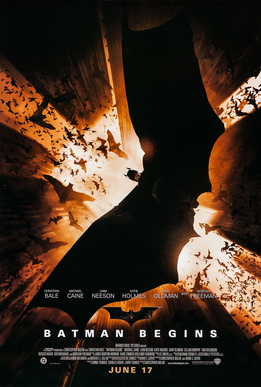
Behind the film
- Year
- 2005
- Director
- Christopher Nolan
- Writers
- Christopher Nolan, David S. Goyer
- Runtime
- 2h 20m
- Genres
- Action, Neo-noir, Crime, Drama
- Production
- DC Comics, Legendary Pictures, Warner Bros. Entertainment
- Country
- United States, United Kingdom
- Cast
- Christian Bale, Michael Caine, Liam Neeson, Katie Holmes, Gary Oldman, Cillian Murphy, Tom Wilkinson, Morgan Freeman
About the film
Contains story spoilers.
Bruce Wayne’s childhood is shaped by fear before he knows what to do with it. A fall into a well leaves him frightened of bats, and his parents Thomas and Martha are killed in front of him after an evening at the opera. Bruce grows up under the care of Alfred Pennyworth, while Rachel Dawes becomes his closest friend and a reminder of the ordinary justice Gotham is supposed to offer. Years later, Bruce travels across the world, living among criminals and trying to understand what makes people violent. When he is imprisoned, Henri Ducard offers him a way to turn that experience into disciplined action.
Ducard brings Bruce to the League of Shadows, led by Ra’s al Ghul. The League teaches him combat, stealth and the use of fear, but its purpose is more extreme than Bruce can accept: it intends to destroy Gotham because the city has become irredeemably corrupt. Bruce refuses to execute a prisoner as proof of loyalty and escapes the mountain temple, leaving the League behind. His training gives him techniques, not a cause. The distinction matters when he returns to Gotham: Bruce wants to challenge injustice while refusing the League’s claim that an entire population can be condemned for its crimes.
Gotham has deteriorated while Bruce was away. Mob boss Carmine Falcone controls officials and streets alike, and Rachel, now an assistant district attorney, believes the city’s institutions have surrendered. Bruce reconnects with her and with Alfred, then begins assembling a practical version of his mission. Lucius Fox, an inventive executive at Wayne Enterprises, supplies equipment from a military research programme, including protective armour, a vehicle and tools for concealment. Bruce tests the gear in the field, learns where it fails, and builds the Batman identity around speed and intimidation. The dark costume makes him appear larger and less human to the criminals he confronts.
The Scarecrow, psychiatrist Jonathan Crane, uses a fear-inducing toxin on Falcone’s associates and Gotham residents. Bruce follows the drug’s trail from the mob to Arkham Asylum, where Crane has authority and access to patients. Rachel discovers the compound is being introduced into the city’s water supply, but Crane poisons her with a potentially lethal dose. Batman rescues her and turns Crane’s toxin against him before questioning him. Crane says he works for Ra’s al Ghul, whom Bruce believes died at the temple. A police pursuit follows, forcing Batman to use the Tumbler to reach the Batcave, where Lucius Fox’s antidote saves Rachel.
Bruce gives Rachel two antidote vials, one for Gordon and one for mass production, before returning to his birthday party at Wayne Manor. There, Ducard reveals himself as the real Ra’s al Ghul and explains that the League intends to use Wayne Enterprises’ stolen microwave emitter to vaporise Gotham’s water supply, sending Crane’s toxin into the air. Bruce rejects the plan, and Ra’s has Wayne Manor burned; Alfred gets Bruce out. The League releases Arkham inmates into the Narrows as the attack begins. Rachel reaches Gordon with the antidote and tries to help people trapped amid the panic, including a boy threatened by the escaped Scarecrow.
Batman confronts Ra’s aboard the monorail carrying the emitter toward Wayne Tower, where the machine could spread the toxin through the whole city. Gordon takes the Tumbler and destroys the elevated track ahead, preventing the train from reaching its target. Batman escapes the carriage and leaves Ra’s aboard as the train crashes. Their final argument returns to the disagreement at the temple: Ra’s sees Gotham’s destruction as necessary, while Bruce still believes its people deserve a chance. The danger ends through both Batman’s confrontation and Gordon’s intervention. It is a victory for their partnership, although the choice to leave Ra’s behind complicates Bruce’s professed refusal to kill.
The film grounds its heightened premise in physical spaces and practical machinery. Gotham is a city of elevated rail lines, industrial infrastructure, old buildings and congested streets; its monorail is both a civic project and the route along which the final threat travels. Wally Pfister’s photography and Nathan Crowley’s production design make the environment feel used and imposing rather than cleanly futuristic. The sequence in which Batman moves through the Narrows, where Crane’s toxin makes people see their fears, turns architecture and point of view into part of the danger. The city feels unstable because its spaces are being weaponised.
After the crisis, Bruce begins rebuilding Wayne Manor with Alfred and keeps working with Gordon. Rachel tells him that the man beneath the mask has changed, but she cannot simply return to the childhood relationship they once shared. Gordon shows Batman a playing card left at a crime scene, pointing toward a new criminal threat and an ongoing partnership. The ending completes Bruce’s first transformation while opening the next case. He has made fear a tool, rejected the League’s vision of justice and accepted that protecting Gotham will require more than a single victory or a single identity.