
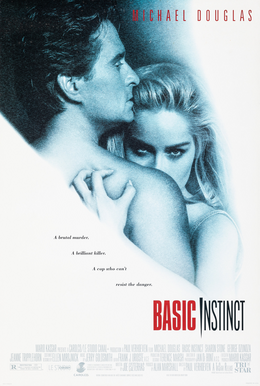
Behind the film
- Year
- 1992
- Director
- Paul Verhoeven
- Writers
- Joe Eszterhas
- Genres
- Crime, Mystery, Erotic thriller, Erotic
- Production
- Carolco Pictures, Canal+, StudioCanal
- Country
- France, United States
- Cast
- Michael Douglas, Sharon Stone, George Dzundza, Jeanne Tripplehorn, Daniel von Bargen, Stephen Tobolowsky, Dorothy Malone, James Rebhorn
About the film
Contains story spoilers.
Basic Instinct begins with the murder of retired rock star Johnny Boz during an intimate encounter. Detective Nick Curran and his partner Gus Moran investigate, and attention quickly turns to Catherine Tramell, Boz's girlfriend and a crime novelist whose latest book resembles the killing. Catherine is wealthy, composed under questioning and unwilling to make the detectives' job easy. The case therefore begins with a troubling overlap between fiction and evidence: her writing seems to predict violence, but that resemblance alone does not prove she committed it. Paul Verhoeven builds the police inquiry around the discomfort of watching Nick try to remain an investigator while his own fascination with the suspect steadily compromises his judgment. The first crime scene establishes the film's combination of forensic inquiry and carefully staged intimacy, which continually blurs the boundary between evidence and performance.
Nick is not an impartial observer. He is recovering from alcoholism and drug use, has a history of reckless conduct, and attends mandatory sessions with police psychologist Dr. Elizabeth Garner. He becomes involved with Catherine while learning that she is writing a new detective character who resembles him and is destined for a fatal mistake. Their attraction makes the investigation harder to separate from Nick's professional responsibilities. Gus voices concern, but the partnership itself does not give Nick enough distance to step back. Catherine's relationship with Roxy Hardy, and the history of other violent people around her, create a network of possible motives without producing a simple answer about whether she is the center of every crime. The mandatory counseling sessions place Nick's vulnerabilities on the record, but Catherine's interest in the confidential file means even that private space may be compromised.
Nick suspects that someone has leaked his confidential psychiatric file and assaults internal-affairs lieutenant Marty Nilsen, who had access to it. When Nilsen is found murdered, Nick is placed on administrative leave, turning the investigation into a personal and professional crisis. The case also points toward Catherine's past: a professor connected to both her and Garner died in an unsolved ice-pick murder, and Garner's former husband was killed in another case examined by Nilsen. Nick cannot tell whether Catherine's stories are borrowing from real violence, anticipating it, or creating a pattern he is too compromised to interpret fairly. The film keeps the evidence open while showing how his own behavior makes official suspicion easier to justify. His assault on Nilsen puts professional misconduct alongside the murder investigation, creating a reason for colleagues to doubt Nick even when he believes his suspicions are justified.
Catherine's relationship with Nick grows more intimate, while Gus searches for independent information about the payments and people surrounding the investigation. Roxy tries to kill Nick in a car attack and dies in the resulting crash. Catherine then tells Nick about an intense college relationship with a woman who became obsessed with her; Garner gives Nick a conflicting account that reverses who pursued whom. The contradictions direct his attention toward Garner, but they do not settle the larger case. Each woman may be protecting herself, and Nick's tendency to treat personal access as investigative insight makes him vulnerable to both. The noir structure depends on uncertainty, not on asking the audience to accept every provocative gesture as proof. The crash is a decisive change in the case and in Nick's circle, but it does not answer which account of Catherine's past is true.
Nick finds a draft of Catherine's new novel in which the detective discovers his partner's body in an elevator. Gus arranges to meet Catherine's former college roommate in Oakland, hoping to clarify the history between Catherine and Garner. When Nick reaches the meeting place, he finds Gus stabbed to death in the elevator, echoing the manuscript. Garner arrives shortly afterward and says a message brought her there. Nick believes she is reaching for a weapon and shoots her, only to find she is unarmed. Evidence in her apartment appears to connect her to several killings and to Catherine, but the discovery does not turn the shooting into a clean resolution; Nick is left shaken by how little he knew in the moment he acted. Garner’s account is no longer available for him to test, and the evidence appears after he has acted fatally. The discovery leaves the investigation compromised by his decision, even as it offers colleagues a version of the crimes that can be closed.
Catherine later returns to Nick's apartment, and the two resume their relationship. As they lie together, the film reveals an ice pick beneath the bed without showing whether she intends to use it. The image strongly suggests that Catherine remains dangerous while withholding a final murder or confession. Nick’s decision to stay beside her does not give the audience the reassurance he seems willing to accept. Verhoeven and cinematographer Jan de Bont use polished San Francisco interiors, glass, night streets and the police interview room to make observation feel like a contest. Joe Eszterhas’s screenplay keeps the mystery entangled with a detective whose choices repeatedly undermine his authority. Sharon Stone’s controlled performance offers a striking contrast to Michael Douglas’s increasingly agitated Nick, making apparent composure part of the struggle to interpret the evidence. The film leaves Nick beside the person he cannot confidently accuse, and the object beneath the bed keeps danger present without confirming what happens next.