
Behind the film
- Year
- 1985
- Director
- Robert Zemeckis
- Writers
- Robert Zemeckis, Bob Gale
- Runtime
- 1h 55m
- Genres
- Science fiction, Adventure, Comedy, Teen
- Production
- Amblin Entertainment, Universal Pictures
- Country
- United States
- Cast
- Christopher Lloyd, Lea Thompson, Crispin Glover, Michael J. Fox, Thomas F. Wilson, Marc McClure, Wendie Jo Sperber, James Tolkan
About the film
Contains story spoilers.
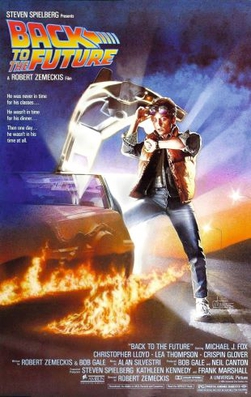
Back to the Future follows Marty McFly, a teenager in 1985 who is close to his inventor friend Doc Brown and uncomfortable with the way life seems to be settling around his family. Doc's latest invention is a time machine built into a DeLorean. After a dangerous demonstration, Marty ends up in 1955, where he meets his parents as teenagers. The trip gives the story a clear rule: Marty can visit the past, but his actions there may alter the chain of events that leads to his own birth. The premise is an adventure engine and a family story at once, because the history he has to repair belongs to people he knows only as adults.
In 1955, Marty finds his father George and mother Lorraine before they become the couple he remembers. George is shy and routinely pushed around by Biff Tannen, while Lorraine is outgoing and initially mistakes Marty for a prospective romantic interest. Marty has accidentally interrupted the meeting that should bring his parents together. He must now help George become confident enough to stand up to Biff and attract Lorraine, without making himself the centre of her attention. The problem is comic because Marty has knowledge of their future but almost no authority in their present. He must work with the awkwardness and limited resources of the time rather than simply explain what will happen.
Doc Brown of 1955 is a different version of the inventor Marty knows: brilliant, energetic and not yet fully aware that his machine will work. Their partnership gives the film an appealing asymmetry. Marty knows Doc's future personality and carries information about the machine, but Doc has the scientific knowledge required to make the trip home possible. The DeLorean needs a very large burst of energy, so the pair must coordinate their plan around the town's clock tower and a lightning strike. The clock is not just background decoration; it makes time visible and gives the climax a precise deadline. Every attempt to reunite Marty's parents also has to leave room for the machine to function.
The film's comedy comes from Marty moving through the same town at two different moments in its history. Familiar places change, and people who occupy settled roles in his home life appear as uncertain young adults. The setting therefore rewards recognition: a diner, a school dance and a central street take on different meanings in 1955, even as they resemble the places Marty knows. Robert Zemeckis and Bob Gale build a tightly linked narrative in which props and actions echo across the two eras. A small decision in the past can appear later as a changed photograph, a different family dynamic or a new possibility for Marty. These repeated details help viewers track the consequences without needing the film to pause for a lecture.
The performances keep the time puzzle rooted in character. Michael J. Fox gives Marty quick reactions and improvisational energy, while Christopher Lloyd's Doc is a physical, expressive presence whose excitement often outruns his caution. Lea Thompson and Crispin Glover play younger versions of Lorraine and George whose behaviour still connects to the parents Marty knows. Thomas F. Wilson's Biff gives the conflict a direct source of pressure. The film also uses music as a bridge between generations: Marty knows songs that do not yet exist in 1955, creating comic moments in which his contemporary taste lands as alien material. These details make the past feel lived-in rather than a neutral stage for the plot.
Back to the Future's craft is unusually clear about cause and effect. The clock-tower sequence follows the school dance and builds suspense around Doc working on the electrical connection, Marty preparing his run and the storm approaching the town. The audience understands what can go wrong, what each character must do and how little time is available. The DeLorean's movement provides a physical image for an abstract journey, while recurring visual details make the two time periods easy to compare. The film blends science fiction with comedy, adventure and romance; the combination works because the genre elements all serve the same problem of changing the past. Marty's successful return alters his family's circumstances, giving the ending a warm but still open sense of what his future might become.
The film makes its time-travel rules concrete through details that can be seen and checked. A family photograph records the consequences of Marty's interference, and the fading image offers a visual countdown without adding a new technical explanation. The DeLorean needs a powerful electrical charge, so the clock tower's lightning rod becomes part of a plan with several linked stages. Doc must connect the cable, Marty must reach the right speed and the storm has to arrive at the predicted moment. This is a comic adventure, but its climax is carefully engineered: a missed connection or a late turn would strand Marty. The clock face, street layout and moving car give the viewer a clear map of the final attempt, while the emotional stakes remain the future of a family Marty has only just met.