
Behind the film
- Year
- 1989
- Director
- Robert Zemeckis
- Writers
- Bob Gale, Robert Zemeckis
- Runtime
- 1h 48m
- Genres
- Science fiction, Teen, Comedy, Time-travel
- Production
- Amblin Entertainment
- Country
- United States
- Cast
- Michael J. Fox, Christopher Lloyd, Lea Thompson, Thomas F. Wilson, Elisabeth Shue, James Tolkan, Jeffrey Weissman, Flea
About the film
Contains story spoilers.
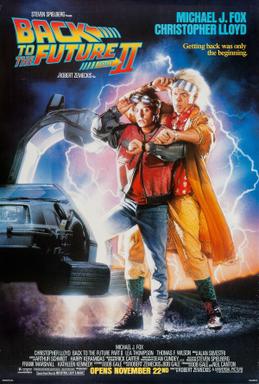
Back to the Future Part II picks up on October 26, 1985, when Doc Brown returns in the DeLorean and persuades Marty McFly and Jennifer to join him in 2015. Their future son Marty Jr. is expected to join a robbery with Biff Tannen’s grandson Griff, so Doc sends Marty to impersonate his son and refuse the offer. Jennifer is knocked unconscious by Doc and left in an alley while he tries to keep her from learning too much about the family’s future. Marty’s intervention sparks a hoverboard chase through Hill Valley that ends with Griff and his gang arrested.
Before they leave 2015, Marty buys a sports almanac listing results from 1950 through 2000. Doc warns him not to use time travel for profit and throws the book away, but old Biff overhears them, retrieves it and steals the DeLorean. Biff returns to 1955 and gives the almanac to his younger self. The older man returns the car without Marty and Doc noticing. Meanwhile, police take Jennifer to her 2015 home, where she hides and witnesses the unhappy future produced by Marty’s choices. The separate strands return her to the porch of her1985home after the journey back.
Their 1985 is not the one they left. Biff has used the almanac to become rich and powerful, married Lorraine after George’s murder, and turned Hill Valley into a violent, corrupt landscape. Doc has been committed to a mental hospital and Marty sent away. The discovery makes the almanac’s impact visible in familiar streets and relationships rather than in an abstract time chart. Doc determines that the change began when Biff handed the book to his younger self in 1955, the same date Marty recently visited, so they return to that day.
Marty moves through the events of the previous film while trying not to collide with his earlier self. He watches young Biff receive the almanac and has to avoid disrupting the school dance where his parents’ relationship is taking shape. Biff’s gang nearly corners the other Marty, forcing this Marty to intervene. The chase shifts back onto a hoverboard, and Marty recovers the book after Biff crashes into a manure truck. He burns it, undoing the source of the alternate future, while Doc waits above in the DeLorean.
Lightning strikes the time machine before Marty can rejoin Doc. A Western Union courier delivers a letter from Doc, who says the bolt sent him to 1885. Marty rushes to the 1955 Doc he knows, who has just helped the first Marty return to 1985, and finds himself facing another impossible rescue. The film ends with the message that the story will continue, not with the western adventure itself. Its cliffhanger depends on the audience recognizing that time travel has created a new problem instead of tying off the earlier one.
Robert Zemeckis and Bob Gale structure the sequel around revisiting scenes from the 1955 climax of the first film. The same setting is now crowded with overlapping versions of Marty, and the camera effects allow Michael J. Fox to appear alongside himself as members of one family. The future streets, alternate 1985 and 1955 dance each carry different social textures, so small changes in the almanac’s path produce a visibly different home. This is a film about the instability of remembered events: Marty knows where he is going, but each return forces him to move carefully through a story already in motion.
The 2015 sequence also turns ordinary consumer objects into plot devices. A self-lacing shoe, hoverboard and automated house make the future feel both playful and familiar, while Jennifer’s encounter with her older self demonstrates how dangerous knowledge can be in this series. Biff’s theft is quieter than the action sequences but more consequential: he uses the DeLorean only long enough to alter a single choice, and the new timeline magnifies it across decades. Marty’s willingness to burn the almanac marks his rejection of easy profit, but the lightning strike immediately replaces that moral choice with another urgent problem.
Jennifer’s visit to the future gives the technology a less glamorous use than the hoverboard chase. A video call lets Needles pressure the older Marty into a dubious transaction, and a message announcing his dismissal arrives by fax. The automated home cannot protect the family from the consequences of his willingness to take a dare. Jennifer carries a copy of that message away, turning a piece of office equipment into evidence about a future she would rather avoid. In the altered1985, the equivalent evidence is public: Biff’s wealth is displayed through a casino and a version of local history arranged around his triumph. Doc and Marty must distinguish the timeline they remember from the one in front of them before they can repair it. The sequel makes its causal rules visible through these physical records. A book stores results from the past, a fax records a possible future, and newspaper information can change when the almanac is destroyed. Characters have something tangible to inspect even when their experience of time has become unstable.