
Behind the film
- Year
- 2017
- Director
- Edgar Wright
- Writers
- Edgar Wright
- Genres
- Crime comedy, Action comedy, Adventure, Action
- Production
- Big Talk Studios
- Country
- United Kingdom, United States
- Cast
- Ansel Elgort, Lily James, Kevin Spacey, Jon Hamm, Eiza González, Jamie Foxx, Jon Bernthal
About the film
Contains story spoilers.
Baby Driver gives its central character a way to organise experience before giving him a reliable way to control it. Music supplies rhythm and a private structure, while the work around him remains dangerous and subject to other people's decisions. That contrast makes his skill both an advantage and a trap. Being exceptionally useful can protect a person within a criminal arrangement while making the arrangement less willing to release him. The film's escape story begins there: a talented driver may be able to find a route through traffic, but finding a route out of the relationships built around his talent is a different problem.
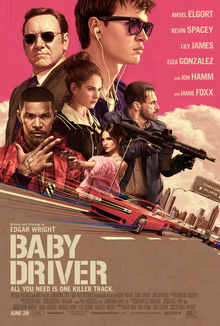
Edgar Wright wrote and directed the 2017 film. Ansel Elgort plays Baby, Lily James plays Debora and Kevin Spacey plays Doc, with Jon Hamm as Buddy, Eiza González as Darling and Jamie Foxx as Bats. The film connects driving to the rhythm of Baby's music, giving action a personal frame rather than treating the soundtrack as merely an accompaniment added to it. The criminal crews have their own agendas and temperaments, so a journey that appears controlled from the driver's seat can remain unstable within the car. His precision does not make the people relying on it predictable or willing to respect his limits.
Baby drives for Doc to repay a debt while caring for his foster father and beginning a relationship with Debora. Repayment does not secure his exit: Doc coerces him into another heist. The operation collapses, and Buddy pursues Baby after Darling's death. Baby and Debora survive the confrontation, but he surrenders at a police roadblock rather than prolonging their flight. Testimony about people he helped becomes part of his sentencing, and the story moves towards their reunion after imprisonment. Escape eventually includes accepting consequences instead of simply driving beyond the point where consequences can reach him.
The music creates an apparent enclosure that is different from physical safety. A person can regulate what he hears without regulating everything happening around him. That difference is useful to the film's action because the familiar rhythm can make danger look manageable even while the wider arrangement is becoming less manageable. The contrast also gives Baby's private routines a vulnerable quality. They help him operate, but other people can interrupt them or misunderstand what they mean. A soundtrack is a way of maintaining a relationship to experience, and the story repeatedly tests what happens when that relationship meets people who care only about the work it helps produce.
Doc's refusal to accept the completed debt changes the meaning of obligation. A clearly defined requirement should have an endpoint, but the boss treats usefulness as a reason to keep extending it. That makes the relationship coercive beyond its original explanation. Baby cannot earn freedom merely by satisfying a rule if the person enforcing the rule can replace it whenever satisfaction becomes inconvenient. The film's criminal world is therefore not just a setting filled with dangerous jobs. It is an arrangement in which apparent agreements remain vulnerable to power, leaving someone who wants to withdraw unable to rely on the terms that supposedly brought him there.
Debora represents a possible future, but that future cannot stay insulated from Baby's present. Wanting an ordinary relationship does not remove the people already making demands upon him. The romance becomes consequential because it supplies something the criminal arrangement can threaten, turning the desire to leave into an immediate conflict rather than a distant preference. At the same time, Debora's involvement should not be reduced to a reward for a successful escape. Her safety matters independently of whether Baby can achieve the life he imagines with her. The story's pressure comes partly from his need to stop allowing that imagined life to obscure the risks reaching her.
The changing crew prevents professional distance from becoming an adequate moral shelter. Baby can occupy a specialised role without being the person making every violent decision, but his role still helps those decisions take effect. The distinction between reluctance and refusal grows more urgent as the work exposes people to harm. This gives the driving skill a changing meaning across the film. At first it makes him effective within somebody else's operation; later it becomes part of trying to protect people from that operation. The action therefore carries a question about responsibility beneath its speed: what does a useful ability serve, and when does continuing to supply it become a decision of its own?
The surrender supplies a different kind of stopping point from the completion of a spectacular chase. It acknowledges that freedom cannot be built entirely through evasion, especially when another person is being asked to share the flight. The later prospect of reunion gives hope a slower scale than the driving scenes. Baby Driver combines a highly organised sensory world with an increasingly disorganised moral situation, allowing its central skill to remain impressive without making skill equivalent to innocence. Its eventual route towards a future depends on accepting that leaving crime involves more than becoming better at getting away from the people and institutions that might demand an account.