
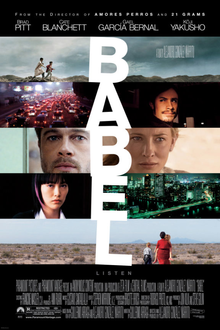
Behind the film
- Year
- 2006
- Director
- Alejandro González Iñárritu
- Writers
- Guillermo Arriaga
- Genres
- Drama
- Production
- Paramount Vantage, Summit Entertainment, Central Films
- Country
- United States, Mexico, France
- Cast
- Brad Pitt, Cate Blanchett, Adriana Barraza, Gael García Bernal, Rinko Kikuchi, Kōji Yakusho, Elle Fanning, Nathan Gamble
About the film
Contains story spoilers.
Babel moves among four places and several languages, revealing how one event can be interpreted very differently by people who are far apart. In rural Morocco, goatherder Abdullah buys a rifle to protect his flock from jackals and gives it to his sons, Yussef and Ahmed. The boys test how far it can reach and fire toward a passing tourist bus; Yussef's shot wounds Susan Jones, an American traveler. Their childish experiment becomes an international crisis as officials treat the shooting as a possible terrorist attack, and the family tries to hide the weapon. The film does not present the boys as masterminds. Their act is reckless, but its consequences expand beyond anything they understand. The camera's attention to the boys at work with the goats makes their world specific before the rifle links it to travelers who would otherwise remain strangers.
Susan and her husband Richard are left in a village while the other tourists press on. Richard tries to secure medical help while a local guide assists them, but time and the absence of an ambulance increase the tension. The couple's recent loss of an infant has already strained their relationship, so the emergency exposes a grief they have not been able to discuss directly. The tourists' departure leaves Richard and Susan dependent on unfamiliar people and an uncertain route to treatment. When a helicopter finally carries Susan to a hospital in Casablanca, the immediate danger changes, but the film keeps the consequences moving through news reports, diplomatic pressure and the lives of people who never meet the couple. Waiting for treatment becomes its own ordeal: Richard must weigh the need to keep the tour group together against Susan's need for immediate care.
In San Diego, Amelia Hernández cares for Richard and Susan's children. When she learns of the shooting, she worries that she will miss her son's wedding in Mexico, and Richard tells her to stay with the children. Unable to arrange other care, she takes Debbie and Mike to the celebration with her nephew Santiago. The family event offers a warm contrast to the other stories, but the return trip becomes dangerous after Santiago has been drinking. At the border, officials question the party because the children have no parental consent letter, despite Amelia carrying passports. Santiago panics and speeds away, leaving Amelia and the children in the desert. Amelia goes for help; the children are found, but she is detained and ultimately deported. At the border, her newlywed son waits to meet her. Amelia's decision grows from competing obligations, not indifference to the children. Her return to the border shows how a single emergency can meet immigration rules without context.
The fourth strand follows Chieko Wataya, a deaf teenager in Tokyo who struggles to connect with peers and adults after her mother's death. Her father, Yasujiro, is questioned by detectives about a hunting trip in Morocco, but Chieko assumes the questions concern her mother's suicide. She brings one detective, Mamiya, into her apartment and gives an account of her mother’s death that later conflicts with what her father tells him; he understands that she is grieving and comforts her when she breaks down. Their communication is partial, shaped by gestures, writing and misread intentions. Chieko's attempts to reach people can be impulsive and painful, yet the film does not reduce her to a symbol for silence: she has a specific home, a father who loves her and a life that continues after the detective leaves. Chieko's scenes use pauses and close attention to faces and hands to place viewers near her perspective, while the city's visual noise continues around her.
The rifle's path connects the strands without making the characters part of one conspiracy. Yasujiro gave it to his Moroccan hunting guide, Hassan, who later sold it to Abdullah; once the boys use it, the same object alters Susan's recovery, Amelia's future and Chieko's meeting with Mamiya. The film's order is deliberately non-chronological, so a clue learned in Tokyo can change the meaning of an earlier image in Morocco. That structure asks the audience to do some of the connecting work, while the characters themselves remain separated by language, distance and institutions that translate events into categories such as crime, terrorism or immigration status. Guillermo Arriaga’s screenplay also joins the stories through parents and children: Richard cannot reach his family, Amelia’s care becomes a legal crisis, and Yasujiro struggles to understand a daughter whose distress he cannot easily answer.
The resolutions arrive at different speeds. Susan recovers, and the news reaches Mamiya in Tokyo; he then speaks with Yasujiro, who clarifies that the rifle was a hunting gift rather than a black-market purchase. Yasujiro returns to Chieko and comforts her on the balcony, where the film ends on a private relationship rather than a global explanation. Police find the Moroccan family; Ahmed is shot, and Yussef surrenders while pleading for help for his brother, while Amelia returns to the border without the life she had been building in the United States. Iñárritu's cross-cutting and the distinct sound worlds of each place make the film's connections felt as much as understood: the shared object links stories, but no single character can see the whole chain. The score's plucked timbres and each location's languages help distinguish the strands without implying that one culture can translate another's grief.