
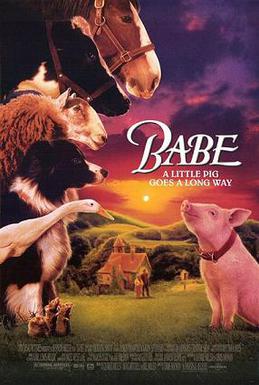
Behind the film
- Year
- 1995
- Director
- Chris Noonan
- Writers
- George Miller, Chris Noonan
- Runtime
- 1h 32m
- Genres
- Comedy, Drama
- Production
- Kennedy Miller Mitchell
- Country
- Australia, United States
- Cast
- James Cromwell, Magda Szubanski, Christine Cavanaugh, Miriam Margolyes, Hugo Weaving, Danny Mann, Roscoe Lee Browne, Miriam Flynn
About the film
Contains story spoilers.
Babe looks at a farm through the eyes of someone who has not learned to accept its hierarchy. Chris Noonan's film makes an animal's uncertainty about his place the beginning of a question about everyone else's confidence. Roles appear settled because they have been repeated for so long, and the creatures occupying them often mistake familiarity for a rule of nature. The humour comes from a pig approaching those rules without the expected resignation. Its warmth comes from allowing that approach to become a relationship rather than merely a joke about an unusual talent. The farm feels recognisable while the newcomer makes its ordinary arrangements increasingly strange.
Farmer Hoggett wins Babe at a fair, and the sheepdog Fly takes him in. Babe discovers that politely asking sheep to move can succeed where intimidation fails. His value remains precarious: after dogs kill a sheep, Hoggett wrongly suspects him before learning the truth. Later, the household cat explains what pigs are normally kept for, leaving Babe unwilling to eat until Hoggett helps restore his spirit. At a sheepdog trial, unfamiliar sheep refuse to cooperate. Rex obtains a password from the home flock, allowing Babe to communicate with them and complete the course perfectly. Hoggett's quiet praise recognises the achievement. The story allows a creature assigned one fate to establish a different relationship with the people and animals around him.
James Cromwell's Hoggett gives that change a human counterpart without needing to narrate every feeling. His reserve makes attention visible as an action in itself. An adult can remain quiet because he is indifferent, or because he is considering something carefully; the performance lets the distinction matter. Babe's possibility depends on being noticed before it can become an achievement. That makes the relationship more substantial than the conventional pleasure of a pet amusing an owner. The farmer has to respond to a creature whose behaviour unsettles what he already knows, and his willingness to continue looking creates room for the unfamiliar to become credible.
Magda Szubanski's presence keeps the household close to its practical routines. The human world does not automatically share the animals' understanding of themselves, and that difference supplies much of the comedy. What appears obvious from one side of a relationship may remain invisible from the other. The film uses the gap without making ordinary domestic life feel malicious in every detail. Instead, it shows how an accepted purpose can prevent someone from seeing a possibility. The same farm can consequently appear comfortable, threatening or full of opportunity, depending on whose future is being considered. Its gentleness does not require pretending that these perspectives already agree.
The animal voices give those perspectives their own emotional texture. Christine Cavanaugh makes Babe's openness sound vulnerable without making him empty of thought. Miriam Margolyes's Fly and Hugo Weaving's Rex bring different expectations to the question of belonging, while Danny Mann's Ferdinand adds the nervous energy of someone acutely aware that usefulness can determine survival. The voices turn the farm into a community of competing assumptions rather than a collection of decorative companions. Listening becomes as important as speaking. Babe's difference is expressed through the way he approaches another creature, so the conversation itself becomes an alternative to the authority everyone has learned to recognise.
That alternative does not depend on discovering that strength is secretly unnecessary in every circumstance. The film is more interested in whether strength must always take the form of dominance. A command can secure a response while leaving the relationship unchanged; respectful communication can make cooperation possible for a different reason. Babe's smallness gives that distinction a physical shape. He cannot simply imitate the intimidating confidence associated with the role he wants to occupy. His apparent disadvantage obliges him to approach the task otherwise, turning the comedy of the unlikely candidate into an examination of the methods that supposedly qualified candidates take for granted.
The story's tenderness sits beside an awareness of vulnerability that keeps the farm from becoming an uncomplicated paradise. Being loved and being useful are not necessarily the same condition, even when the people offering care believe themselves kind. That unease makes Hoggett's attention emotionally significant. Recognition must extend beyond what the creature was originally expected to provide. The film allows young viewers to encounter this difficulty through a clear story rather than an abstract argument, while adults can notice the arrangements surrounding it. Its reassurance grows from a change that has to be made within the world, instead of announcing that the world's existing rules were harmless all along.
The conclusion is satisfying because the achievement has acquired a meaning beyond winning. A place within a community can be revised, and the method of finding that place can change the community's expectations in return. Babe's success does not erase every uncomfortable question raised by the farm, but it gives care a practical consequence. Someone has been allowed to become more than the category first assigned to him. The film's lasting emotional movement lies in that simple enlargement of attention: noticing a possibility, taking it seriously, and making enough room for another creature to act on it. Its quiet confidence rests on the belief that kindness can be a way of understanding the world.