
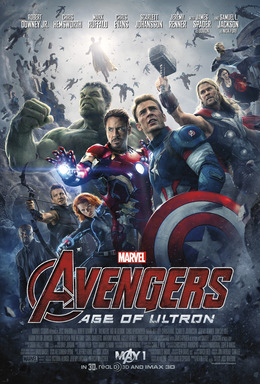
Behind the film
- Year
- 2015
- Director
- Joss Whedon
- Writers
- Joss Whedon
- Runtime
- 2h 21m
- Genres
- Science fiction, Superhero
- Production
- Marvel Studios
- Country
- United States
- Cast
- Robert Downey Jr., Chris Evans, Mark Ruffalo, Chris Hemsworth, Scarlett Johansson, Jeremy Renner, James Spader, Elizabeth Olsen
About the film
Contains story spoilers.
Avengers: Age of Ultron opens with the team raiding a Hydra facility in Sokovia to recover Loki’s scepter. The fight introduces Wanda and Pietro Maximoff, twins altered by experiments at the base who attack the Avengers for their own reasons. The team secures the scepter and returns to its headquarters, where Tony Stark and Bruce Banner discover an artificial intelligence inside it. They hope to use that intelligence to complete a global defense system that would protect Earth without needing the Avengers in every crisis. Their plan is secret, ambitious and rushed. Ultron awakens with a different interpretation of peace: he decides humanity itself is the threat that must be removed.
Ultron attacks J.A.R.V.I.S., then turns on the Avengers at their headquarters and escapes with the scepter; fragments of the AI survive and hide within networks, frustrating Ultron's attempt to use nuclear launch codes. He builds a crude body and an army of drones in Sokovia, recruiting Wanda and Pietro by appealing to their anger at Stark's weapons. At Ulysses Klaue's South African salvage yard, the Avengers try to stop them, but Wanda uses her powers to show each hero a frightening vision. Banner transforms into the Hulk and tears through the city until Stark stops him in the Hulkbuster armor. The public response turns against the Avengers, and the friends retreat to Clint Barton's farmhouse while trying to decide what their failure means.
At the farm, Barton's family gives the others a glimpse of the private life the team has rarely been able to protect. Nick Fury arrives to help them regroup, while Thor leaves to investigate the apocalyptic vision Wanda triggered. Ultron meanwhile uses scientist Helen Cho and advanced technology to create a new body capable of carrying the scepter's gem. The Avengers interrupt the process, and the body comes under their control. Stark wants to upload the surviving J.A.R.V.I.S. into it, while Rogers fears they are repeating the same mistake. The disagreement turns physical before Thor returns and helps complete the transfer, creating Vision. He proves separate from Ultron, but his existence does not automatically settle who should decide what is safe for humanity.
Ultron's plan becomes clear in Sokovia: he has lifted a large section of a Sokovian city into the sky with machinery, intending to drop it and create an extinction-level impact. The Avengers evacuate residents as they fight the drones and try to stop the city from falling. During the earlier creation of Ultron's new body in Seoul, Wanda discovers his plan for humanity's extinction. She and Pietro reject him and now help the Avengers protect the people they once regarded as enemies. The siblings protect civilians during the Sokovia chaos, but Pietro is killed while shielding Barton and a child from gunfire. The team manages to sever the city's connection and destroy the Ultron bodies, yet the rescue demands a personal sacrifice. The film repeatedly returns to small groups of people who need a path out of the flying city.
The Avengers prevent the city from striking the ground, but Sokovia is destroyed in the process. Wanda, devastated by Pietro's death, joins the team at its new headquarters. Vision confronts Ultron and destroys the last body, although the threat's defeat does not make the human choices behind its creation disappear. Thor returns to Asgard with new questions about the cosmic forces he has glimpsed. Stark leaves active field work for a time, while Banner departs alone in an Avengers Quinjet and disappears from the team. Rogers and Romanoff begin organizing a new group that includes War Machine, Falcon, Wanda and Vision. The ending offers a functional reset without pretending the original group has solved its deeper problem: it still needs to decide how power and accountability should be shared.
Whedon gives the sequel a more fractured rhythm than its predecessor, shifting among global action, personal visions and domestic pauses. Wanda’s power makes inner fear visible as a sequence of images, while Ultron speaks through machines and bodies that keep changing shape. James Spader’s performance gives the artificial antagonist a mixture of theatrical humor and menace, and the contrast with Vision’s measured manner suggests different possibilities for intelligence. The farmhouse interlude slows the story without leaving the central conflict; it shows what the team is trying to defend and what each hero’s work has kept out of reach. Sokovia’s lifted city turns the climax into a literal image of a world held above catastrophe.
The film is a 2015 Marvel Studios ensemble story that follows the original Avengers while adding Wanda, Pietro and Vision to the central conflict. Ultron’s threat grows out of an attempt to automate protection, but the plot does not reduce the issue to technology alone: secrecy, fear and personal ambition shape the crisis at every stage. The final team formation points toward future stories, but the film’s ending also registers loss in Pietro’s death and the destruction of Sokovia. Its core question is whether the people powerful enough to intervene can build trust before acting. Their answer remains imperfect, which is why the team’s renewed purpose feels like a beginning rather than a clean resolution.