
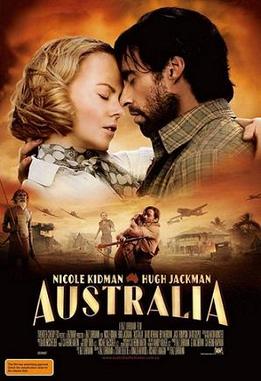
Behind the film
- Year
- 2008
- Director
- Baz Luhrmann
- Writers
- Richard Flanagan, Stuart Beattie, Baz Luhrmann, Ronald Harwood
- Runtime
- 2h 45m
- Genres
- Romance, Drama, War
- Production
- 20th Century Studios, Bazmark, Screenwest
- Country
- Australia, United States, United Kingdom
- Cast
- Nicole Kidman, Hugh Jackman, David Wenham, Bryan Brown, Bruce Spence, Jack Thompson, Barry Otto, Ben Mendelsohn
About the film
Contains story spoilers.
Australia gives its romance a setting in which arriving, owning and belonging are different things. Lady Sarah can acquire responsibility for a station without immediately understanding the people living and working around it. The journey forces her to depend on knowledge she did not bring with her, making practical cooperation part of her changing relationship to the country. The film's scale comes from letting a personal arrival expand into several kinds of conflict. Property, family and war place different demands on its characters, and a solution to one does not guarantee that the others will remain safely settled. That distinction also makes the station an unstable centre for the story. It can hold the characters together through work and affection while remaining unable to contain every claim made on their lives, leaving home important without making it sufficient protection from everything outside.
Baz Luhrmann directs the 2008 film, starring Nicole Kidman as Sarah, Hugh Jackman as the Drover, Brandon Walters as Nullah and David Gulpilil as King George. Richard Flanagan, Stuart Beattie, Luhrmann and Ronald Harwood wrote the screenplay. The story begins in 1939 and places its fictional family amid northern Australia's wartime history and the removal of Aboriginal children. It is a heightened melodrama rather than a documentary account of a particular family. Its historical pressures shape the characters' choices, while the cattle-station intrigue and romance arrange those pressures within an invented story of competing attachments.
After her husband's murder, Sarah discovers Fletcher's attempt to take control of Faraway Downs. She dismisses him and joins the Drover in moving cattle to Darwin. Their partnership develops alongside her care for Nullah, whose mother dies while hiding from police seeking to remove him. Fletcher later reveals his responsibility for the murder and his relationship to the boy. Nullah is taken to Mission Island, and wartime attacks precipitate a rescue. The Drover brings the children back; King George kills Fletcher when he threatens Nullah. The family returns to the station, and eventually respects Nullah's departure with his grandfather.
Sarah's authority changes as she recognises how little an ownership claim can accomplish on its own. The station needs work, judgment and relationships that do not automatically follow from possessing it. Cooperation with the Drover requires her to encounter independence she cannot simply command into agreement. The romance grows within that practical dependency, making affection part of a broader adjustment in how she sees the people around her. The film's adventure lets unfamiliar conditions challenge a social position that initially seems sufficient, without making learning the landscape equivalent to becoming its sole authority.
The Drover's place beside her makes partnership a question of chosen responsibility. His independence is important to how he understands himself, yet the developing household makes the limits of remaining detached more visible. Being free to leave does not mean that leaving has no consequences for people whose lives have become connected to his. The relationship therefore asks something beyond attraction. It asks how a person accustomed to moving through work and country can respond to a continuing demand for care, while also recognising that another person's idea of protection may not be the only valid one.
Nullah gives belonging a complexity the romance cannot absorb into itself. Sarah's care matters, but his relationships existed before she arrived and extend beyond the household she wants to preserve. Treating him only as the answer to an adult's longing would make those connections secondary. The ending resists that reduction by allowing family attachment and kinship with his grandfather to remain distinct. The film's emotional resolution depends on the adults recognising that love can include accepting a direction they have not chosen, rather than making the child's future proof of their own completed happiness.
Fletcher's ambition connects private betrayal with the desire to control a larger arrangement of property and power. The station becomes an object through which he can advance, while the people connected to it are treated as obstacles or leverage. That makes his conflict with Sarah more than a disagreement about management. Their relationship to Nullah reveals how different forms of authority can act upon the same person, with protection, coercion and possession claiming competing meanings. Luhrmann's melodrama makes those differences emphatic, using personal confrontation to give broad structures a recognisable human antagonist.
The movement from cattle drive to wartime rescue prevents the first achievement from securing the entire future. A successful journey can preserve the station while leaving the family exposed to forces that the station cannot keep outside. The eventual reunion matters because separation has become possible in more than one way. Australia closes by letting that reunion coexist with Nullah's later departure, giving the household continuity without requiring permanent possession of everybody within it. Its sweeping story finds a more intimate condition for belonging: the people who want to remain connected must also recognise the connections and choices that extend beyond themselves.