
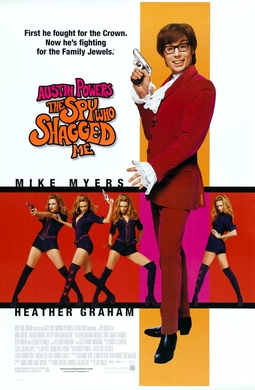
Behind the film
- Year
- 1999
- Director
- Jay Roach
- Writers
- Mike Myers, Michael McCullers
- Runtime
- 1h 35m
- Genres
- Parody, Spy
- Production
- New Line Cinema
- Country
- United States
- Cast
- Heather Graham, Seth Green, Robert Wagner, Rob Lowe, Will Ferrell, Elizabeth Hurley, Michael York, Charles Napier
About the film
Contains story spoilers, including the ending.
The 1999 sequel Austin Powers: The Spy Who Shagged Me begins with a honeymoon interrupted by an assassination attempt. Vanessa, Austin's new wife, turns out to be a fembot controlled by Dr. Evil. Her destruction leaves Austin single again, while his enemy returns from space and receives a miniature clone called Mini-Me. Dr. Evil takes his companion back to 1969 and has Fat Bastard extract Austin's mojo from his cryogenically frozen body. Austin experiences the loss in 1999 and follows the villain into the past in a time-travelling Volkswagen New Beetle. He meets CIA agent Felicity Shagwell, who helps him survive another attack. Their investigation uncovers Dr. Evil's island headquarters, but recovering the stolen essence is only part of the mission: the villain also plans to threaten cities with a giant laser installed on the Moon. Myers plays Austin, Dr. Evil and Fat Bastard in the film.
Austin's fear that he has lost his sexual confidence complicates his attraction to Felicity. She plants a tracker on Fat Bastard, though the trail ultimately depends on analysing what he has eaten. The spies reach Dr. Evil's island, escape captivity and pursue him into space. At the lunar base, Austin fights Mini-Me before confronting Dr. Evil, who has confined Felicity in a chamber filling with poison gas. The villain suggests using the time portal, allowing Austin to go back ten minutes and meet his earlier self. One Austin can stop the laser while the other rescues Felicity. Dr. Evil then starts the base's self-destruct system and throws the mojo into the air; Austin fails to catch it. Felicity points out that he has already defeated his enemy and saved the world without it. Before they escape, Austin invites Felicity to come back with him to 1999, thirty years after their adventure together. She hesitates because she wants to experience the intervening decades. The escape leads into a final encounter with Fat Bastard, whose attempt to kill the couple ends in another bodily gag. Back in 1969, Dr. Evil also retrieves Mini-Me from space and promises revenge on Austin.
The opening dance turns Austin's renewed bachelorhood into a sequence built around carefully concealed nudity. Jay Roach traced the idea to the first film's prop-blocking scene, expanded here into a musical number with more elaborate movement. He and choreographer Marguerite Derricks planned the action on index cards and rehearsed with the camera so that a raised drink or piece of fruit would obscure precisely the right part of Myers's body. Roach's interest in silent cinema and Busby Berkeley musicals fed the scale of the staging, particularly the synchronized-swimming finale. Becky Dyroen-Lancer arranged the swimmers' underwater work, while Derricks handled Myers's movement above the surface. The hotel was actually a large house in Malibu. For Austin's final emergence from the pool, the crew reversed footage of Myers entering the water, making him appear to rise already dry. Robert Dawson's animated credits also participate in the concealment. Roach cited the Pink Panther films as an influence on letting the letters have a life of their own, so names and titles become moving parts of the jokes rather than sitting apart from the performance. Yellow lettering against a starfield opens the sequence, joining a Bond-style song to the space imagery.
Composer George S. Clinton approached the sequel by developing the first film's music while finding room for new characters. Austin and Dr. Evil retained their themes; Mini-Me and Fat Bastard required additional material, and Felicity's arrival brought a new love theme. Clinton described period style as a matter of instrumentation as well as melody. For Austin's stealthier scenes, he used a rhythm ensemble and four horns, drawing on the kind of sound associated with Henry Mancini. Dr. Evil and the larger adventure passages called for heavy brass and percussion in the tradition of John Barry's Bond scores. The orchestra included five trombones, a tuba, four French horns and four trumpets, with piccolos and bass flutes playing in unison alongside a large string section. Temp music also presented a practical problem: Mini-Me's entrance had been cut to an orchestral hit from the first film. Clinton reworked it for the sequel, then had to find another suitable hit when the dubbing team reconsidered the earlier version. The score extends an existing musical world, with its changes shaped by new characters and the practical demands of working to an edited picture. For Clinton, existing themes provided starting points rather than material to recycle.
Myers described Austin's story as a search for love after heartbreak, complicated by his attachment to the sexual revolution. Derricks researched 1960s dancing but left room for Myers's physical manner and comic instincts to shape the movement. Rob Lowe, playing young Number Two, used a Robert Wagner impersonation that had already amused his friends; Wagner himself responded enthusiastically after a screening.