
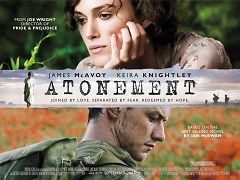
Behind the film
- Year
- 2007
- Director
- Joe Wright
- Writers
- Christopher Hampton
- Runtime
- 2h 3m
- Genres
- Drama, War, Romance
- Production
- StudioCanal, Relativity Media, Working Title Films
- Country
- United Kingdom, France
- Cast
- James McAvoy, Keira Knightley, Saoirse Ronan, Romola Garai, Vanessa Redgrave, Juno Temple, Benedict Cumberbatch, Brenda Blethyn
About the film
Contains story spoilers.
Joe Wright’s Atonement begins in an English country house in 1935, where thirteen-year-old Briony Tallis is already arranging life into scenes. She is writing a play and watching the adults as if their motives should be as legible as characters on a page. When she sees her older sister Cecilia and Robbie Turner, the educated son of the family housekeeper, at the fountain, she misunderstands their charged encounter. Later, a letter meant for Cecilia is delivered through Briony, and her partial knowledge hardens into a story she thinks she understands. The film makes a child’s confidence consequential without treating it as harmless.
The Tallis estate is a social system as much as a home. Robbie's education has been supported by the family, but his position remains precarious beside Cecilia's inherited status. Their mutual attraction crosses a class boundary Briony can observe without understanding. An accusation can therefore enter a setting already prepared to distribute credibility unevenly. Robbie has acquired learning without acquiring the unquestioned security of a family name, while Briony's confidence has an authority her age alone would not provide. The formal rooms and shared meals establish proximity without equality. People may occupy the same house and have very different powers to decide how an event inside it will be described.
The film’s shifts of perspective ask viewers to notice how evidence changes meaning when filtered through expectation. A fountain, a letter, a library encounter and an interrupted glimpse are not neutral facts once Briony turns them into a narrative. Wright repeatedly frames doors, windows and corridors so that characters see only fragments of one another. That visual arrangement supports the story’s moral problem: the viewer is also invited to infer, and must recognize how quickly inference becomes certainty. The film does not make Briony’s youth an excuse; it shows how a powerful family’s readiness to believe her compounds her error.
Briony's accusation after Lola's assault sends Robbie to prison. His later army service separates him from Cecilia, who works as a nurse, while Briony enters nursing and recognizes Paul Marshall as the actual attacker. The film then presents an attempted apology in a scene whose status the ending changes. That apparent opportunity to repair the accusation initially asks what a confession could achieve after the damage has become part of other people's lives. Being able to identify an error does not give Briony command over its consequences. The relationship she once misread has continued outside her control, and the wartime setting makes every delay carry a possibility of permanent separation.
Saoirse Ronan, Romola Garai and Vanessa Redgrave play Briony at three ages, creating a visible continuity between the child who narrates confidently, the young woman who seeks to amend her testimony, and the novelist who controls the final account. The casting makes her older self feel both recognizably connected and altered by time. Keira Knightley’s Cecilia and James McAvoy’s Robbie carry their relationship through glances, pauses and restrained exchanges; their intimacy becomes visible when it is briefly outside the family’s formal spaces. The performances keep the story grounded in people rather than in a puzzle about who lied.
Robbie’s wartime sequences change the film’s scale. One long tracking movement through the crowded evacuation at Dunkirk follows him past soldiers, vehicles, civilians and a burning landscape without cutting away to a detached overview. The camera’s passage makes retreat feel like a continuous human crisis rather than a map animation. In London, Briony’s hospital work offers a different kind of wartime labor: close, repetitive care for wounded men. The contrast between the battlefield’s vast movement and the hospital’s intimate tasks links the consequences of public catastrophe to the private harm she helped cause.
The film’s final interview reveals that the version in which Robbie and Cecilia live together and receive Briony’s apology is the ending she wrote, not what happened. Robbie dies from an infected wound at Dunkirk; Cecilia later dies in the Balham station flood during an air raid. The older Briony has spent her life writing toward a meeting that never occurred. The imagined image of the couple together at the seaside is therefore both a gift and an admission of power: she can give them happiness on the page, but cannot return the life her earlier story took from them.
Christopher Hampton’s adaptation keeps the novel’s concern with storytelling but gives it a cinematic form through repeated images, shifts in time and that moving Dunkirk passage. Dario Marianelli’s score incorporates the sound of a typewriter into its rhythm, letting the act of writing press against the scenes it describes. The house’s green rooms, the hospital’s white surfaces and the beach’s smoke-filled horizon each mark a different kind of confinement. The title’s promise remains unresolved: Briony can acknowledge her wrongdoing, yet the film refuses to equate acknowledgment with repair. It leaves the audience with the distance between telling the truth and making the truth sufficient. Its changing compositions also remind us that every account has an author: even a beautifully shaped ending can conceal the people it excludes. The film's last image offers tenderness without allowing that tenderness to cancel the underlying facts.