
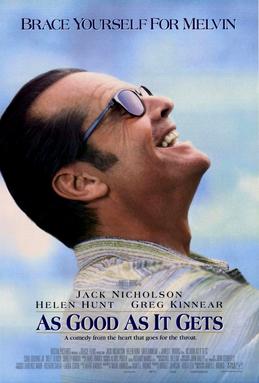
Behind the film
- Year
- 1997
- Director
- James L. Brooks
- Writers
- Mark Andrus, James L. Brooks
- Runtime
- 2h 18m
- Genres
- Romantic comedy, Lgbtq-related, Comedy drama, Comedy
- Production
- Gracie Films, TriStar Pictures
- Country
- United States
- Cast
- Jack Nicholson, Helen Hunt, Greg Kinnear, Cuba Gooding Jr., Skeet Ulrich, Shirley Knight, Yeardley Smith, Jesse James
About the film
Contains story spoilers.
Melvin Udall is a successful romance novelist in Manhattan whose life is organized around rituals: he avoids cracks in the pavement, uses disposable cutlery, locks his door repeatedly and eats at the same restaurant. His routines do not make him gentle. At the diner he insists that Carol Connelly, a single mother and waitress, serve him, while he insults the people around him with practiced precision. The film begins with a man who has made predictability into a shield and cruelty into a way of keeping everyone at a distance.
The neighbor who disrupts that routine is Simon Bishop, a gay painter whose little dog Verdell is cared for by a devoted assistant. When thieves break into Simon's apartment and beat him badly, Melvin is left to look after the dog. He first treats the task as another inconvenience, but Verdell responds to his attention, and their walks make him more visible in the neighborhood. Simon's absence also exposes how much practical support he received from Frank, his dealer, and how little Melvin understands about people outside his habits.
Carol's life is governed by a different pressure. Her son Spencer's asthma repeatedly interrupts her work and leaves her searching for reliable medical help. Melvin pays for a doctor because he wants his usual waitress back, giving an apparently generous act a strongly self-interested motive. Carol can appreciate the practical result without agreeing to become available on his terms. The unequal circumstances make their exchanges difficult: he has the money to remove an immediate obstacle, while she has to judge what accepting it might mean. Helen Hunt lets exhaustion, anger and relief occupy the same conversation, so gratitude does not require Carol to stop challenging him. Melvin is accustomed to treating a problem as something to arrange around his habits; another person's independence is harder to manage that way.
After Simon leaves hospital with his finances and confidence badly shaken, he asks Frank to take him to Baltimore to seek help from his parents. Frank persuades Melvin to drive, and Melvin invites Carol because her presence eases his discomfort with Simon. The road trip changes their roles: Simon depends on two people he had kept at arm's length, while Carol sees Melvin outside the restaurant. At dinner, Melvin says he began taking medication because Carol made him want to become a better man. She asks whether he means he likes her, and his evasive, insulting answer damages the closeness he tried to express.
The trip also gives Simon a chance to observe Carol and draw her portrait. He is not simply a rival for her affection; his attention to her as an individual contrasts with Melvin's habit of turning people into targets or solutions. When they return to New York, Melvin offers Simon his spare bedroom because the painter is broke and his own apartment has been sublet, even though their friendship remains awkward. Simon then pushes Melvin to make an honest effort with Carol instead of hiding behind compulsions and put-downs.
Melvin goes to Carol's home before dawn and asks her to have breakfast with him. She accepts, and their walk takes them through a bakery as it opens. At the bakery, he realizes he has stepped on a pavement crack without the usual distress. The ending does not claim a few days have erased his obsessive routines or his long practice of hurting people. It shows a specific adjustment: he makes room for another person in a routine that used to admit no one.
James L. Brooks directs the story through interruptions, uncomfortable exchanges and changes that have to be seen in ordinary behavior. The restaurant is a recurring stage where Melvin's rituals are public and Carol's labor is unavoidable, while the journey to Baltimore removes the familiarity he usually relies on. Jack Nicholson can deliver an insult with effortless timing and then look abruptly uncertain when a response does not follow the pattern he expects. Greg Kinnear's Simon has a different vulnerability: an artist who pays attention to somebody else can still need help accepting what has happened to his own life. Their scenes together are often uneasy because neither becomes agreeable simply to make the other's development easier. Brooks and Mark Andrus allow comic defiance, hurt and practical dependence to occupy the same exchange. A change in generosity can matter without serving as proof that a mental-health condition has disappeared.
The supporting relationships sharpen the central triangle without turning it into a conventional contest. Cuba Gooding Jr.'s Frank understands that Melvin's care for Verdell may matter even when his motives are self-serving, and Shirley Knight's Beverly gives Carol a family ally who can see the cost of her work. The title's promise stays modest: nobody is remade into an ideal partner, and Simon's recovery is not a neat cure for loss. The story ends on a first step toward consideration, made tangible in the shared pace of a morning walk.