
Behind the film
- Year
- 1956
- Director
- Michael Anderson
- Writers
- James Poe, John Farrow, S. J. Perelman
- Genres
- Adventure, Action comedy, Fantasy
- Country
- United Kingdom, United States, Italy, France
- Cast
- David Niven, Cantinflas, Robert Newton, Shirley MacLaine, Charles Boyer, Noël Coward, Cedric Hardwicke, Finlay Currie
About the film
Contains story spoilers.
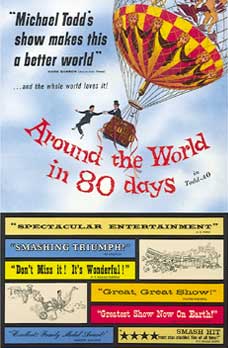
Phileas Fogg wagers at his London club that he can travel around the world in eighty days, then leaves with his valet Passepartout. Their route across Europe and Asia brings balloon travel, local guides, comic mishaps and a detective, Fix, who follows them while suspecting Fogg robbed a bank. In India, the travellers rescue Aouda from a ritual and she joins them. Delays and detours threaten the wager, and Fogg is arrested in Liverpool before evidence clears him. Believing the deadline has passed, he returns to London with Passepartout and Aouda. Passepartout discovers that travelling east has gained them a calendar day; Fogg reaches the Reform Club before the appointed hour and wins the wager, with Aouda accepting his proposal. Their changing route makes distance itself part of the comic challenge.
Michael Anderson’s Around the World in 80 Days turns a travel deadline into an organising principle for scale. Each new location promises a change in colour, rhythm and social texture, so the adventure is built from contrast as much as forward motion. The route supplies a practical question—can the travellers keep moving?—while the production can pause to show the variety of the world they cross. That combination gives the film a slightly unusual pulse. It is not a lean chase that strips away everything except pursuit; it wants the pleasure of arrival, the pause for spectacle and the comic reset before the next leg begins.
David Niven’s Fogg is an exacting centre for such an expansive story. His composure and precision make him appear suited to the ordered rituals of the London club, yet those same qualities become comic when placed against unpredictable travel. He is not a swaggering adventurer who thrives on improvisation. His manner suggests someone who has made a wager on principle and must now discover what that commitment asks of him. Niven plays the restraint as a source of both humour and curiosity: the more controlled Fogg appears, the more striking it is when the journey tests his assumptions about what can be scheduled, measured or safely left outside one’s concern.
Cantinflas gives Passepartout a very different energy. The valet is nimble, expressive and alert to the immediate situation, a natural counterpoint to Fogg’s carefully managed exterior. Their pairing creates a useful comic rhythm: one character embodies method, the other responds to what is happening in front of him. Passepartout is not merely a source of mishaps, though. His practical intelligence helps the journey feel inhabited rather than plotted like a map exercise. The contrast also gives the film a friendly human centre amid its parade of cameos and locations. Fogg may set the schedule, but the film’s liveliest sense of movement often comes from his companion’s quick shifts of attention.
The supporting cast and episodic construction make the film feel like a meeting place for performers as well as a globe-crossing adventure. A guest appearance can briefly change the tone or lend a location its own character, then yield to the onward route. That abundance is part of the design: the film presents travel as exposure to unfamiliar people, not simply the accumulation of landmarks. It can create a deliberate stop-start quality, because each encounter asks for room. But the expansiveness is also the point. The journey is meant to feel too large for a single narrow plot mechanism, even while the wager keeps returning to remind us that time is running.
The 1956 production also belongs to a period when widescreen travel films could make physical distance itself a selling point. Its attraction lies partly in the promise that a cinema audience can move from one environment to another without leaving its seat. The locations are staged as visual events, and the changing settings give the film’s comedy a broader canvas than the London club that begins the wager. The style encourages a viewer to notice how much the world changes from segment to segment. Rather than treat those shifts as background, Anderson makes them part of the adventure’s appeal and a source of wonder.
The premise invites comparisons between order and chance, but Fogg’s journey is not simply a lesson that planning is foolish. The timetable gives the story its shape; without it the sequence of visits would have little pressure. What the trip questions is the belief that planning alone can make experience predictable. Weather, transport, bureaucracy and human need all have their own pace. The film finds comedy in the mismatch between a precise promise and a world that refuses to stay inside its terms. That friction gives Fogg a reason to change without turning the adventure into a solemn lecture about the dangers of routine.
Its tone remains deliberately broad and welcoming. A viewer does not need to know the novel to understand the wager, the route or the basic relationship between the two travellers. At the same time, its leisurely abundance rewards an appetite for classic studio spectacle and old-fashioned comic adventure. The movie’s scale is not only a matter of distance or production size; it is also a willingness to let a story wander among contrasting moods. Anderson builds an expedition that can be funny, romantic and lavish without forcing every stop to serve the same emotional register. The result treats world travel as a grand public event and companionship as the thread that makes the itinerary legible.