
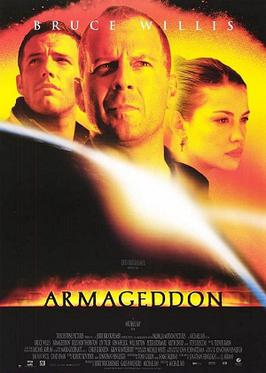
Behind the film
- Year
- 1998
- Director
- Michael Bay
- Writers
- Jonathan Hensleigh, J.J. Abrams
- Genres
- Action, Science fiction, Adventure, Disaster
- Production
- Touchstone Pictures, Jerry Bruckheimer Films, Valhalla Motion Pictures
- Country
- United States
- Cast
- Bruce Willis, Ben Affleck, Liv Tyler, Billy Bob Thornton, Will Patton, Steve Buscemi, Michael Clarke Duncan, Peter Stormare
About the film
Contains story spoilers.
Armageddon begins by making a distant threat visible through destruction close to home. A meteor shower damages New York and destroys a space shuttle before NASA identifies the much larger asteroid travelling towards Earth. The scale of the impending collision exceeds anything an ordinary emergency response could address. The proposed solution is to place a nuclear device inside the asteroid and divide it before it passes the point at which the fragments would still hit the planet. Michael Bay presents that plan as the film's action premise, surrounding it with urgent briefings, machinery and a countdown. Its imagined engineering belongs to a disaster spectacle rather than a realistic instruction for preventing an impact.
Harry Stamper enters the crisis as an expert driller whose authority comes from experience with difficult equipment and the people who operate it. NASA can prepare the journey, but its machinery has to work under conditions the designers cannot entirely anticipate. Harry insists on bringing his own crew, shifting the mission towards a collection of oilfield personalities who have not been chosen for their comfort within a space programme. Their familiarity supplies both a practical advantage and a source of disruption. They know how one another behaves under pressure, while the institution has to accommodate men whose ordinary habits do not resemble those of its trained astronauts.
The most personal tension concerns A.J. Frost, who works with Harry and is involved with his daughter, Grace. Harry's reluctance to accept that relationship gives his professional authority an emotional complication. A.J. needs to demonstrate that he can be trusted as a colleague while confronting a man who still sees him as an unsuitable partner. Grace has to face the possibility that the mission will take both men away permanently. The film makes her relationship with Harry part of the reason his eventual decisions matter: saving the planet is an immense abstract objective, but leaving a daughter with somebody able to share her future is something he can understand directly.
Training turns the crew's differences into comedy before launch gives them irreversible consequences. Their passage through space includes a disastrous stop at a Russian station, where cosmonaut Lev Andropov joins the survivors. On approaching the asteroid, the two shuttles encounter separate difficulties, and a crash leaves A.J. and others needing to reach Harry's group. The mission therefore loses the orderly shape imagined on Earth. A functioning plan has to be rebuilt out of damaged vehicles, surviving equipment and people arriving from somewhere they were not supposed to be. Technical preparation remains necessary, but it cannot eliminate the need to improvise when the actual landscape refuses to match the intended operation.
Harry's drilling effort runs into hard material and a rapidly shortening deadline. Colonel Sharp, responsible for the spacecraft, has obligations that conflict with Harry's determination to finish the job. An order from Earth to detonate prematurely produces a confrontation over who understands the conditions well enough to decide what to do. Their eventual cooperation requires more than recognizing each other's rank. Sharp must trust work he cannot perform himself, and Harry must deliver on an assurance whose failure would leave no second attempt. Further damage makes the surviving crew and a replacement drilling vehicle crucial, while scenes on Earth widen the consequences beyond the people visible on the asteroid.
Reaching the necessary depth does not complete the mission. Damage to the remote detonator means somebody must remain behind, and the draw assigns that task to A.J. Harry sends him back aboard the shuttle and takes his place. Bruce Willis's final exchanges with Ben Affleck and Liv Tyler bring the story's two kinds of responsibility together: Harry can complete the task for which he was recruited while giving Grace and A.J. a chance at the life he has resisted. The shuttle escapes, he detonates the device and the fragments pass Earth. The return and the wedding images honour the people who died without pretending the successful mission has brought everyone home.
Bay builds the expedition out of contrasting physical environments. The oilfield and training sequences allow broad movement and crowded conversation, while the suits, vehicles and abrasive asteroid surface make individual actions harder. Earth's control rooms remain comparatively orderly even as their information becomes less useful to people working beyond immediate assistance. Billy Bob Thornton's Dan Truman gives the ground operation a human point of concentration, making a technical decision register as something that will happen to people he knows. Will Patton's Chick carries another family connection, and Steve Buscemi's Rockhound contributes a restless unpredictability that can be funny before becoming a practical danger.
The film also lets the crew's ordinary relationships determine how the immense disaster is experienced. A global threat is represented through people waiting for a message, watching a broadcast or anticipating somebody's return. Harry's sacrifice does not depend on him being a conventional astronaut; it depends on a mixture of specialist knowledge, stubbornness and affection already present before NASA approaches him. The screenplay credits Jonathan Hensleigh and J.J. Abrams, with additional adaptation and story credits reflecting the project's wider writing team. The resulting adventure moves between workplace banter, military urgency and family melodrama, making each register contribute to the departure and return. Its ending gives the largest possible rescue a particular cost: one man can preserve a shared future without being able to occupy it himself.