
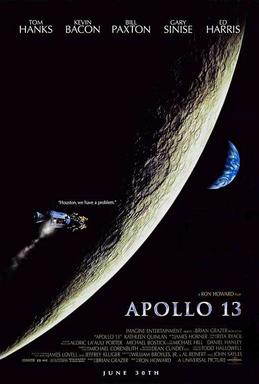
Behind the film
- Year
- 1995
- Director
- Ron Howard
- Writers
- William Broyles Jr., Al Reinert
- Genres
- Docudrama, Adventure, Drama, Survival
- Production
- Imagine Entertainment, Universal Pictures
- Country
- United States
- Cast
- Tom Hanks, Kevin Bacon, Bill Paxton, Gary Sinise, Ed Harris, Kathleen Quinlan
About the film
Contains story spoilers.
Ron Howard’s Apollo 13 begins with Jim Lovell watching Neil Armstrong step onto the Moon and imagining his own future landing. By the time the film reaches 1970, Lovell is commanding Apollo 13 with Fred Haise and Ken Mattingly, aiming to make the third lunar landing. A measles exposure changes the crew shortly before launch: Mattingly is grounded and Jack Swigert takes his place as command module pilot. The substitution gives the early scenes a quiet tension. Lovell must trust a new crewmate while acknowledging the disappointment of losing the colleague he expected beside him. Because the launch has been rehearsed so carefully, the film can show the crew's confidence through small habits instead of explaining every procedure aloud.
The launch lifts the Saturn V into a routine that feels both public and intimate. Marilyn Lovell and the families watch from the ground; inside the spacecraft, the crew settle into measured checklists, instrument readings, and brief exchanges with Houston. The lunar module Aquarius and command module Odyssey are separate craft with different roles, and the film makes their cramped interiors legible without pretending the astronauts have room to move freely. Lovell’s long preparation and the crew’s practiced familiarity with procedures create the calm that the mission’s sudden turn will break. The distinction between Odyssey and Aquarius becomes increasingly important as the astronauts transfer systems and supplies, making their spacecraft layout part of the suspense.
After a television broadcast from space, Swigert stirs the oxygen tanks and hears a bang. Warning lights register failing fuel cells and dropping oxygen; Lovell looks outside and sees gas venting into space. The planned landing is abandoned. The command module can no longer sustain the crew, so they move into Aquarius and use the lunar module as a lifeboat. The change is physically awkward and emotionally stark: a vehicle built for two must shelter three, and the spacecraft they had expected to use for a brief lunar visit is now their only route back. The visible leak changes the emergency from a warning on a panel into a sight the crew can interpret, but its scale is still impossible to judge from orbit.
Gene Kranz and the flight controllers divide the crisis into problems that can be tested and solved. They calculate burns to bend the trajectory around the Moon and back toward Earth, while conserving electricity, water, and oxygen. Ken Mattingly, safe on the ground but intimately familiar with the craft, works through power-up procedures in a simulator. The movie cuts between faces at consoles and astronauts inside dim modules, showing how the same mission depends on different kinds of expertise: the crew must carry out instructions under pressure, while Houston must develop instructions that have never been needed in this combination. Kranz's insistence on working a problem one step at a time gives the crowded room a rhythm, with each specialist responsible for a particular uncertainty.
The carbon-dioxide emergency makes that collaboration concrete. The lunar module’s filter openings do not fit the square canisters from Odyssey, and the rising carbon dioxide threatens the crew. Ground personnel gather the limited materials available on the spacecraft and devise an adapter from bags, cardboard, and tape. The improvisation is not a miracle gadget; the scene’s tension comes from a mundane mismatch becoming life-threatening and from the need to communicate a workable assembly across a radio link. Each technical fix buys time but does not erase the next constraint. The workaround works because the flight controllers can test their proposed assembly on the ground before asking the crew to build it in weightlessness.
The journey around the Moon makes the abandoned landing painfully close, while the return requires further corrections and strict conservation of resources. Haise’s illness adds bodily strain to a cabin already made difficult by cold and limited water. Odyssey has been shut down to save its remaining power, so bringing it back to life becomes a separate problem involving damp electronics and a carefully tested sequence. The damaged service module is jettisoned, letting the astronauts see the scale of the explosion that changed the mission. Aquarius must also be released before re-entry, ending its improvised role as their shelter. Radio silence during descent stretches the uncertainty for Houston and the families: the work has brought the crew to this point, but no one on the ground can yet know whether they have survived.
The spacecraft emerges from blackout and splashes down in the Pacific, where the recovery ship USS Iwo Jima retrieves Lovell, Haise, and Swigert. The landing is a safe return rather than the lunar walk Lovell had wanted, so the film treats the mission as a success in survival and a failure of its original objective. Howard balances large-scale spectacle with procedure: the launch and re-entry make the vehicle feel exposed to enormous forces, while close views of hands, switches, and handwritten calculations keep the danger comprehensible. The homecoming closes the rescue, while Lovell’s unrealized Moon visit remains a small, personal cost. The rescue is communal rather than a solo feat, connecting the astronauts' discipline with the work of families, recovery crews, engineers, and flight controllers.