
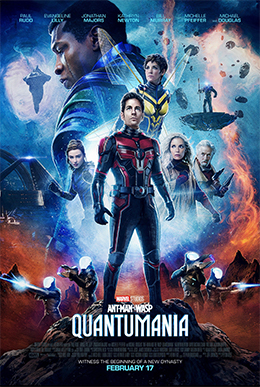
Behind the film
- Year
- 2023
- Director
- Peyton Reed
- Writers
- Jeff Loveness
- Genres
- Action, Science fiction, Adventure, Comedy
- Production
- Marvel Studios
- Country
- United States
- Cast
- Paul Rudd, Evangeline Lilly, Michael Douglas, Michelle Pfeiffer, Kathryn Newton, Jonathan Majors, Corey Stoll, Katy O'Brian
About the film
Contains story spoilers.
Cassie's Quantum Realm device draws Scott, Hope, Hank, Janet and laboratory ants into another world. Janet reveals that she once helped stranded traveller Kang repair his power core before discovering his destruction of timelines; she enlarged it beyond use to prevent his escape. Now the realm's ruler, Kang holds Cassie hostage and forces Scott to retrieve it. Hope helps Scott navigate a storm of multiplying possibilities, but Kang breaks his bargain. Cassie and rebel leader Jentorra organise resistance, while Hank returns with technologically advanced ants. Darren Cross, transformed into M.O.D.O.K., turns against Kang and dies. Scott and Hope destroy the core during a final fight, drawing Kang into it. Cassie opens a route home. Scott resumes ordinary life, though he briefly fears what defeating Kang might have set in motion.
A hero defined by changing his size enters an environment where familiar size no longer supplies a useful account of the world. It has inhabitants, relationships and struggles that predate the family's arrival. The visitors therefore become outsiders in an ongoing story, a useful complication for characters accustomed to understanding themselves as the centre of a crisis. Their immediate desire to return home is understandable, but the setting asks whether that desire is enough. Escaping an unfamiliar world may leave its existing problems exactly where they were, especially if the escape depends on cooperating with its most powerful figure.
Scott's fatherhood gives that question a personal urgency. Paul Rudd's character approaches danger through an attachment that is both admirable and potentially restrictive: he wants Cassie safe. Kathryn Newton's older Cassie also has a view of what safety and responsibility should mean, so the relationship cannot remain a simple arrangement in which the parent acts and the child waits. Her convictions press against his wish for normality. That makes their disagreement more specific than an adolescent objection to authority. Both care about other people, but their priorities do not line up automatically. The film asks how a parent responds when the person he most wants to protect begins making demands on the world herself, including demands that complicate his preferred route out of trouble.
Janet brings another version of the same difficulty. Michelle Pfeiffer's character has a history that her family does not fully possess, and reunion has not made that history easy to share. The emotional tension concerns what secrecy does to relationships built around relief and expectation. Someone can be profoundly glad to have returned without being able to explain every part of the absence. That distinction gives Janet a purpose beyond supplying information when the plot needs it. Her past has shaped her understanding of risk, while her family has had to imagine that past from outside. The unfamiliar realm exposes the gap between those perspectives. Knowledge becomes something that can protect people, burden them or leave them unprepared when it is withheld for too long.
Hope's relationship with Janet gives that gap an especially close setting. Evangeline Lilly's character encounters a mother whose return cannot entirely fulfil the connection she had imagined. That is an emotionally useful complication within such an extravagant world. Extraordinary survival does not automatically repair the ordinary work of knowing another person. Hope's competence also makes her more than a sympathetic witness to Scott's problem. The family contains several people with skills and histories, and its strength depends on how those differences can be brought into a common effort. Treating everyone as a supporting resource for one hero would miss that generational structure. The adventure is about a group learning what it did not know about itself while confronting a place it does not yet understand.
Kang makes control feel like a matter of entitlement rather than merely appetite. His power is alarming partly because he presents his desires with a certainty that leaves little room for anyone else's account of the situation. An apparently reasonable exchange can become coercion when one participant decides that the other's need gives him the right to dictate every term. That makes Scott's position understandable without making the bargain harmless. The villain's larger ambitions increase the scale of the threat, but the immediate mechanism remains personal: use an attachment to narrow somebody's choices. The film's conflict therefore gives a cosmic vocabulary to a recognisable imbalance. A person can know that he is being manipulated and still find the demand difficult to resist when someone he loves is at stake.
The rebellion broadens the stakes beyond the visitors' private relationships. Jentorra and the people around her give the realm a perspective that cannot be reduced to a strange backdrop for family reconciliation. Their need for freedom belongs to a longer struggle, so the heroes' decisions have consequences outside the group they arrived with. That gives the spectacle a social purpose alongside its visual novelty. An unfamiliar environment can become easier to care about when its inhabitants are allowed to want something for themselves. The film's creatures and invented science remain fantasy rather than an account of actual quantum physics. What makes the world readable is not scientific realism but the relationship between power, resistance and the different obligations people discover once their paths intersect.
Quantumania places an ordinary wish for family time inside an adventure that refuses to stay ordinary in any other respect. That contrast is central to its direction. The scale of the setting can be enormous while the most difficult choices remain attached to trust, parenthood and the limits of private loyalty. Its humour keeps Scott recognisable as someone less grandiose than the circumstances around him, but modest self-understanding does not remove his responsibilities. A person who sees himself as an ordinary father may still have to decide what his actions enable elsewhere. The film's deeper question is whether getting your own people home can be a complete definition of success. Its strange world makes that question larger without making the family at its centre less specific.