
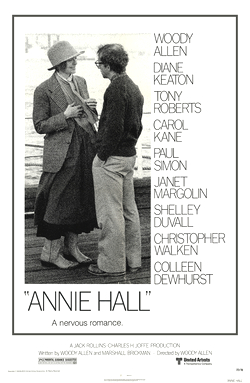
Behind the film
- Year
- 1977
- Director
- Woody Allen
- Writers
- Woody Allen, Marshall Brickman
- Genres
- Romantic comedy, Comedy, Drama
- Production
- Jack Rollins & Charles H. Joffe Productions
- Country
- United States
- Cast
- Woody Allen, Diane Keaton, Tony Roberts, Carol Kane, Paul Simon, Janet Margolin, Shelley Duvall, Christopher Walken
About the film
Contains story spoilers.
Alvy Singer, a New York comedian, addresses the audience while trying to understand why his relationship with Annie Hall ended. The film moves freely through recollection rather than laying events out as a straight chronology: childhood in Brooklyn, earlier marriages and recent moments with Annie all enter the story as Alvy searches for a pattern. His direct address gives him control of the telling, though not necessarily of the meaning. The movie’s quick changes between memory, fantasy and present-tense encounters make his account feel like an argument he is still having with himself.
Alvy and Annie meet through mutual friends after playing tennis doubles. Their awkward small talk leads to a ride uptown and a glass of wine on Annie’s balcony; the spoken conversation sounds casual while imagined subtitles expose the flirtation and insecurity underneath. Annie is an aspiring singer who is unsure of her ability, while Alvy is an established comic whose jokes often carry worry about death, intimacy and rejection. An early evening together includes one of Annie’s club appearances, and the contrast between her tentative performance and Alvy’s overthinking establishes a relationship where everyday encounters can contain two very different inner stories.
The couple’s happier stretches include cooking live lobsters together at a seaside house and teasing one another about previous partners. Those scenes matter because the film does not present their relationship as doomed from the outset. Alvy is delighted by Annie and also evaluates her speech, habits and interests, sometimes as if he were grading a student. Annie, meanwhile, is affectionate but increasingly interested in developing a life that does not revolve around his routines. Their pleasures and irritations coexist, making the shifts in their relationship gradual rather than the result of a single betrayal.
When Annie moves in with Alvy, the balance changes. He gives her books about death, talks about his previous relationships and becomes uneasy as she takes classes and meets other people. He finds her arm-in-arm with an adult-education professor and challenges her about the flexibility they had discussed. Their argument turns a vague promise into a test neither is sure how to pass. The film also revisits Alvy’s earlier marriages and his tendency to distrust people who accept him, connecting his present jealousy to a recurring pattern of pushing away the intimacy he says he wants.
After they separate, Alvy turns the breakup into a problem to investigate. He asks strangers on the street what love means, revisits memories from childhood and even imagines an animated version of himself arguing with a cartoon Annie. Dating again does not quickly settle him; a late-night call from Annie asking him to deal with a spider brings them back together for a time. They promise to stay together, but their separate therapy conversations suggest that they do not share the same expectations. Their reunion is warm and real, yet it does not erase the reasons they split.
Alvy and Annie visit Los Angeles with his friend Rob. On the return trip, they agree that the relationship is not working. Annie later becomes involved with record producer Tony Lacey, and Alvy tries to rekindle the relationship with a proposal, without success. Back in New York, he writes a play based on their story and changes its ending so Annie accepts him. The imagined resolution shows the limits of his control: he can arrange an ending on stage, but it cannot make the real relationship resume.
Annie’s singing gives the relationship a direction that Alvy cannot control simply by supplying advice. At her first club appearance, the room’s distractions reinforce her insecurity; later she can hold an audience and attract the interest of someone who takes her music seriously. He encourages her development, then becomes uncomfortable when it creates possibilities beyond their shared life. The split-screen therapy scene makes their differing expectations especially clear. Asked about their sex life, each reports the same frequency but treats it as an entirely different problem. The joke works because neither has to be lying: their dissatisfaction comes from the meaning they attach to the same experience. Intimacy has become another conversation in which they hear different answers.
The comic devices keep altering the distance between audience and characters. Alvy can speak straight to camera, step out of a queue to summon Marshall McLuhan, or turn a private thought into an onscreen fantasy, while the central romance remains grounded in dates, work, shared rooms and disagreements. Diane Keaton’s Annie is not simply an object in Alvy’s memory: her singing, classes and movement toward Los Angeles show a person pursuing directions he cannot dictate. The conclusion holds both truths at once: the couple has separated, and Alvy still finds value in having loved her. The film’s settings make that distance visible. Gray, overcast Manhattan contrasts with warmer California light, while the couple’s conversations continue across apartments, streets and public places. A split-screen dinner lets the two families occupy one frame while following separate rituals; the device turns an ordinary meal into a comic map of their differences. Long takes let Keaton’s free-associative account of her family run without interruption, giving Annie a lively presence that exceeds Alvy’s recollections. These formal choices support the film’s unusual balance of self-mockery and genuine attachment.