
Behind the film
- Year
- 2014
- Director
- John R. Leonetti
- Writers
- Gary Dauberman
- Runtime
- 1h 39m
- Genres
- Horror
- Production
- New Line Cinema
- Country
- United States
- Cast
- Annabelle Wallis, Ward Horton, Alfre Woodard, Tony Amendola, Brian Howe
About the film
Contains story spoilers.
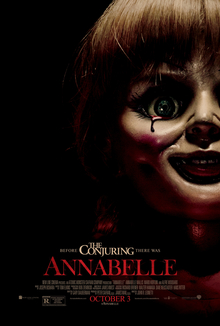
In Santa Monica, expectant parents Mia and John Form are attacked during a home invasion by members of a cult, and the female attacker dies beside the doll John had given Mia. After their daughter Leah is born, the family moves to Pasadena, where the doll reappears among their belongings and unsettling events continue. Mia learns that the cult tried to summon a demon, which is using the doll as a conduit and wants a human soul. A priest tries to take the doll for help, but the entity intervenes and later abducts Leah. Mia is prepared to sacrifice herself to save her child, but neighbour Evelyn offers her own life, seeking atonement for her daughter’s death. The demon and doll vanish; Mia and John keep Leah, and months later the doll is acquired and locked in the Warrens’ collection.
John R. Leonetti builds Annabelle around a familiar domestic question: how safe can a home feel once its ordinary objects no longer seem neutral? A doll is already an intimate thing, placed near a child and surrounded by family routines, yet its fixed face makes it difficult to read. The film uses that contradiction well. The object is visibly still, but its placement and presence invite suspicion. Rather than rely only on a monster rushing into the frame, the story lets familiarity become uncertain. Rooms that should reassure begin to feel like places where a threat can remain unnoticed until the family has already relaxed.
Mia’s perspective gives the supernatural story its emotional centre. Annabelle Wallis plays her as a young mother whose growing concern is easy to understand, even while people around her struggle to accept the scale of the danger. The film’s suspense depends on that mismatch between private certainty and public credibility. Mia has to care for a child and interpret events that sound impossible when described aloud. The role makes fear less abstract: it is tied to responsibility, interrupted sleep and the sense that a parent must decide whether a warning is serious before anyone else agrees.
John occupies a different position in the household. Ward Horton’s character is caring, but his attempts to maintain a stable family life also reveal how difficult it can be to respond to something that has no ordinary explanation. The couple are not simply divided into a believer and a skeptic; they are both trying to protect the same people while working from different thresholds for what counts as evidence. That tension gives the early domestic scenes some substance beyond the horror setup. Their shared home is a place where both affection and disagreement have to coexist, and supernatural danger makes each conversation feel consequential.
The film’s period setting contributes atmosphere without turning the story into a history lesson. Clothing, apartment interiors and the surrounding city give the characters a recognisable everyday world, but the main effect is tonal: a home can look comfortable and still feel exposed. The wider culture of fear provides a background hum, while the smaller domestic spaces keep the threat close. This use of setting helps the film avoid making its supernatural premise seem detached from ordinary life. The horror grows out of recognizable expectations about family, neighbours and safety, then unsettles those expectations one room at a time.
The doll works as a conduit rather than as a character with an inner life of its own. That distinction matters because the fear is not about an object developing human motives. It is about a malign presence using a familiar object to make itself visible and to stay close to the people it targets. The doll’s stillness becomes a screen onto which characters project uncertainty, but the story eventually treats that uncertainty as more than imagination. This allows the film to play with the visual grammar of haunted-object horror while keeping the demon, rather than the toy, at the centre of its supernatural logic.
Evelyn’s role connects present danger with grief that predates the main family crisis. Alfre Woodard gives her a warmth and weariness that make her more than a helpful neighbour who appears when the plot needs information. Her history shapes the way she responds to Mia, and her eventual choice carries an emotional weight rooted in that history. The story frames it as a dramatic act within a supernatural narrative, not as a general model for coping with guilt or grief. That distinction is essential: the film’s heightened premise is fiction, and its choices are not clinical guidance or a real-world solution to loss.
The film often works through anticipation rather than speed. A quiet room, a doorway or an object placed in an unexpected spot can hold attention because the viewer has learned that the ordinary may conceal a threat. This rhythm gives the horror an enclosed quality. The world outside remains present, but the pressure gathers in the home and among the family members who must decide whether to trust what they notice. The structure also lets tension accumulate around care: protecting a child means making judgments under uncertainty, and the film turns that parental responsibility into a source of both tenderness and dread.