
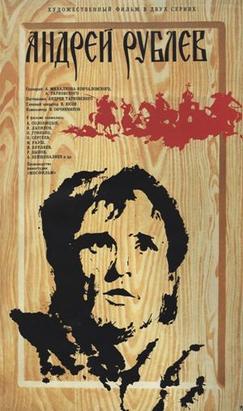
Behind the film
- Year
- 1966
- Director
- Andrei Tarkovsky
- Writers
- Andrei Tarkovsky, Andrei Konchalovsky
- Genres
- Art, Historical, Biographical
- Production
- Mosfilm
- Country
- Soviet Union
- Cast
- Anatoly Solonitsyn, Ivan Lapikov, Nikolai Grinko, Nikolai Burlyayev, Irma Raush, Yuri Nikulin, Nikolay Sergeev, Yuriy Nazarov
About the film
Contains story spoilers.
Andrei Rublev approaches an artist through the world he must inhabit rather than through a tidy sequence of achievements. Andrei Tarkovsky's film places the icon painter among people whose beliefs, needs and conflicts resist a simple account of spiritual life. Work has patrons, rivals and practical demands, while violence can interrupt the conditions that make creating anything possible. Anatoly Solonitsyn's Rublev is therefore not presented as a finished great man waiting to receive recognition. He is someone struggling with what his work should mean. The film allows that struggle to occupy silence, movement and encounters, making doubt part of the artist's presence rather than a temporary obstacle to success.
The episodic story follows Rublev and fellow painters through medieval Russia. Encounters with a jester, master painter Theophanes and persecuted pagans complicate his understanding of faith and authority. He resists making images intended to terrify worshippers. A devastating raid then destroys lives and works; after killing a soldier to protect a woman, Rublev abandons painting and takes a vow of silence. Years later, young Boriska leads the casting of a bell, claiming knowledge inherited from his dead father. The bell succeeds, but the exhausted boy admits that his father never gave him the secret. Rublev comforts him, breaks his silence and proposes that they continue their work. A colour epilogue turns from the dramatized life to images of the painter's actual icons.
The episodic construction lets time pass without requiring every transition to become an explanation. A person may reappear altered by circumstances the audience has not watched continuously. That gives history a density beyond the immediate scene, as though lives extend into stretches of experience outside the film's chosen moments. Rublev's encounters can consequently register as questions that remain with him, rather than as lessons arranged in a reassuring order. The viewer must carry impressions forward and reconsider them when another situation emerges. The form makes uncertainty persistent, allowing one episode's confidence to become more difficult to sustain under the pressure of another.
Religious images raise a question about the relationship between conviction and fear. A painting can offer comfort, instruction or an intimidating vision of judgment, and the choice among those possibilities affects the people who will stand before it. Rublev's reluctance gives artistic responsibility a concrete object. He is not merely deciding whether he possesses sufficient skill to finish a commission. He is asking what the image would do within the lives of its viewers. The film makes that question inseparable from power, because those arranging the work may want something different from what the person making it feels able to give.
The other painters prevent Rublev's uncertainty from becoming the only available response to artistic labour. Nikolai Grinko's Daniil and Ivan Lapikov's Kirill bring different kinds of companionship and friction into the group, while Nikolai Sergeyev's Theophanes offers another powerful presence. Recognition matters in a world where making work also means finding opportunities to practise a craft. Envy, loyalty and ambition can therefore occupy the same relationship without one cancelling the others. Tarkovsky allows a vocation to remain embedded in ordinary human difficulties. Having a spiritual purpose does not release these men from pride or resentment, and technical ability does not automatically settle what they believe about other people.
The bellmaking sequence shifts attention from the painter to a boy attempting to organise a large collective undertaking. Nikolai Burlyayev's Boriska has to make decisions that others will act upon, even though his apparent certainty conceals a terrible insecurity. The work turns belief into something requiring hands, materials and cooperation. Its outcome cannot be guaranteed by confidence alone. This gives the sequence a suspense different from an argument about whether art matters: a shared physical effort may succeed or fail, and everyone involved must wait to discover which. Rublev's position as a witness allows another person's vulnerability to reach him without requiring him to win a debate first.
The film's surfaces make that material world felt. Mud, weather, bodies and unfinished spaces resist any impression that spiritual questions exist in a clean realm separate from daily endurance. The predominantly monochrome imagery gathers those textures without arranging every scene around a beautiful object. The final arrival of colour consequently changes the viewer's relationship to what has been seen. The icons belong to another register of looking, where the finished image can persist after the dramatized struggles surrounding its making have ended. That contrast does not supply an exact documentary history of each work; it puts the survival of art beside the instability of a human life.
Rublev's return to speech matters because it occurs in response to someone else's distress. Renewal is not presented as a private discovery that makes the surrounding suffering irrelevant. The artist recognises a frightened young maker and offers the possibility of continuing together. That places companionship beside faith as a condition of creative work. The film's scale remains vast, but this exchange gives the ending a particular human centre: one person can help another resume an undertaking whose outcome is uncertain. Andrei Rublev leaves room for the endurance of images without turning their maker's life into a simple proof that greatness conquers history. What returns is a willingness to work, not an assurance that the world has become safe for it.