
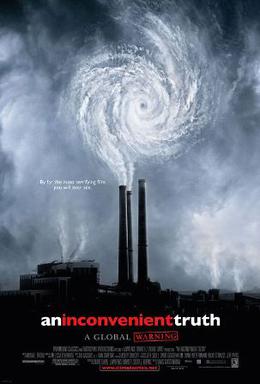
Behind the film
- Year
- 2006
- Director
- Davis Guggenheim
- Writers
- Al Gore
- Runtime
- 1h 37m
- Genres
- Documentary
- Production
- Participant Productions, Lawrence Bender Productions
- Country
- United States
- Cast
- Al Gore
About the film
Contains story spoilers.
An Inconvenient Truth builds a film around an act of explanation. Al Gore addresses an audience through a presentation on global warming, while Davis Guggenheim’s direction places that presentation beside parts of Gore’s personal history. The result is a documentary about the subject being explained and about the effort required to make people attend to it. Its central challenge is one of scale: changes described through scientific measurement can be difficult to connect with everyday experience. The film tries to reduce that distance through images, comparisons and a recognisable speaker, making the structure of a public talk into the main vehicle for its account.
Released in 2006, the documentary follows Gore’s illustrated presentation and the experiences he connects with his environmental concerns. Graphs, photographs and animation support an explanation of greenhouse gases and the risks he associates with warming. Personal passages include his education, family loss and his son’s serious accident. The film presents climate change as a problem demanding public attention and response, rather than as a topic for passive observation. Its figures and projections belong to that release period; they should not be read as a freshly updated report. The story’s movement is towards persuading an audience to act, not towards a fictional resolution in which the problem is solved.
Gore’s political identity is part of the communication problem as well as part of his visibility. A public figure arrives with associations that can encourage some people to listen and others to resist before a particular explanation begins. The documentary cannot remove those associations, so it works with a speaker whose position is already known. That makes his role different from an anonymous scientific narrator. He offers information through a history of attempting to draw attention to it, and the effort becomes personally legible. The film presents advocacy as work that has continued beyond a single campaign or occasion, while leaving the distinction between the speaker and the evidence important.
The charts give the presentation a way to make relationships visible. A numerical change can be described in words, but seeing quantities arranged across time creates a different encounter with the idea of movement. The viewer can compare positions rather than remembering isolated numbers. That visual clarity also carries responsibility. A graph depends on its scale, its labels and the question it is being used to answer. The film’s persuasive use of diagrams makes those features part of understanding the presentation. They are tools for explaining evidence, not objects whose presence makes any interpretation automatically correct. The audience still has to distinguish observation, inference and an account of possible consequences.
Photographs of the Earth give the documentary another scale of attention. A planet seen from a distance can appear both immense and contained, encouraging the viewer to imagine a shared environment beyond the boundaries used in ordinary politics. That image does not answer the technical questions by itself, but it provides a setting in which the questions can feel connected. The presentation moves between such broad views and more specific examples, trying to make the relationship between an overall system and changes within it easier to follow. The film’s visual variety is therefore part of its explanatory strategy, helping an extended talk avoid becoming a sequence of statements with no felt spatial relationship.
The personal history changes the rhythm of that talk. Family experiences create moments in which vulnerability has an immediate human scale, unlike a chart describing processes over long periods. Their inclusion helps explain the speaker’s sense of urgency without making his biography the scientific evidence. That distinction is important to the film’s construction. A personal event can explain why someone commits themselves to a subject, while the subject’s claims require their own support. Guggenheim’s alternating structure allows those functions to coexist: the talk supplies the argument, and the intervening life story supplies a portrait of the person continuing to make it.
The documentary also treats audience attention as something that has to be earned repeatedly. Humour, striking comparisons and shifts of format are used to interrupt the passivity that can settle over a long presentation. The approach assumes that communicating a problem involves more than placing information somewhere available. People have to notice it, retain it and connect it with decisions they believe they can make. That is why the film’s form matters to its subject. It studies a gap between knowing that a topic exists and accepting that it has practical relevance. The speaker’s work is directed towards moving the audience across that gap, not merely towards completing an orderly lecture.
As a film of its period, An Inconvenient Truth preserves a particular presentation and a particular attempt to make climate concern widely accessible. Its argument should be understood in that context, while present-day scientific questions call for current research rather than reliance on a twenty-year-old release. The documentary remains an example of how explanation, biography and visual persuasion can be joined. Its ending cannot supply closure because the subject extends beyond the event of watching the film. The intended change happens in what the audience understands and does afterwards, making the final appeal a handover of responsibility rather than the completion of a self-contained story.