
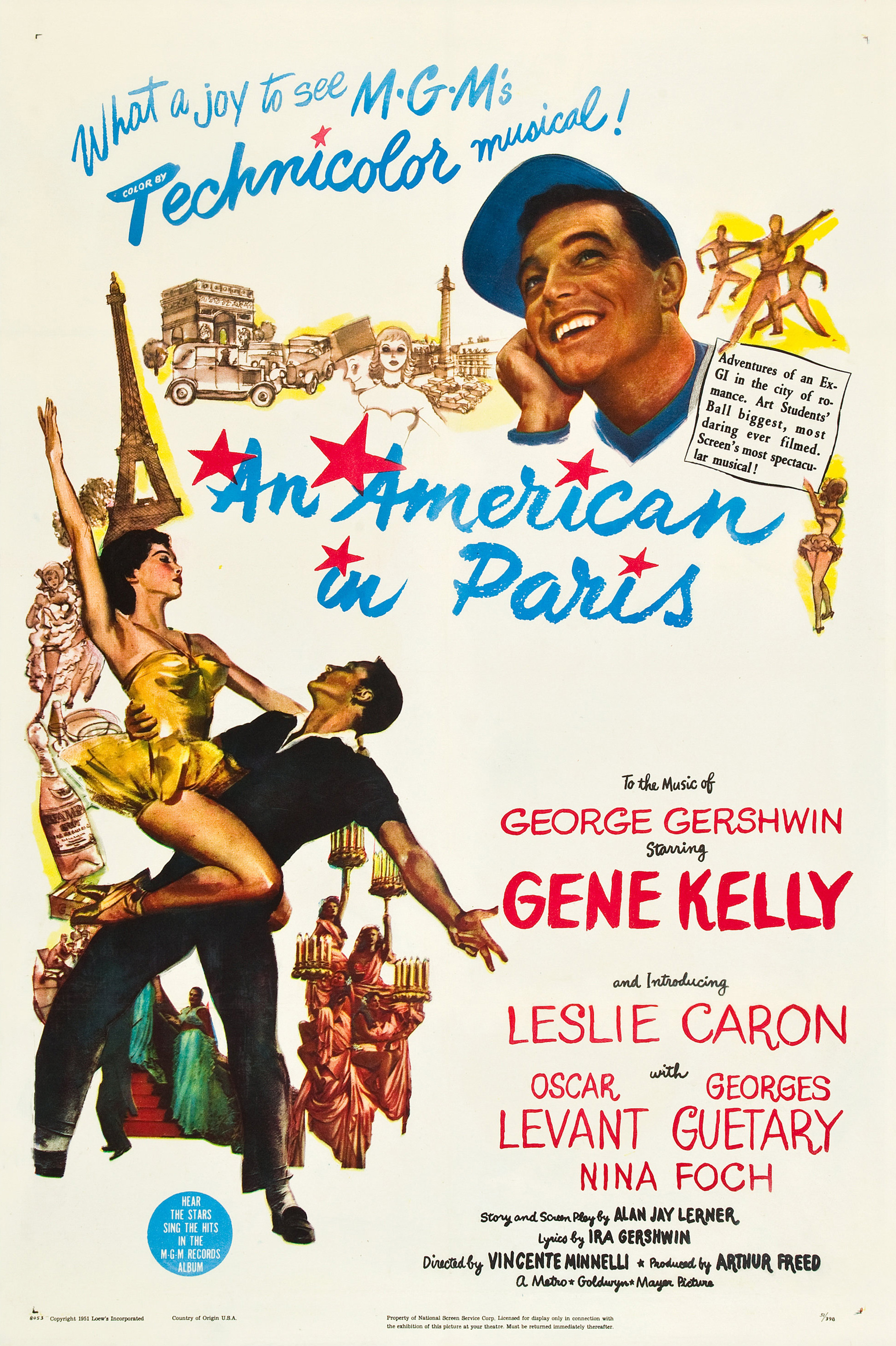
Behind the film
- Year
- 1951
- Director
- Vincente Minnelli
- Writers
- Alan Jay Lerner
- Genres
- Musical
- Production
- Metro-Goldwyn-Mayer
- Country
- United States
- Cast
- Gene Kelly, Leslie Caron, Oscar Levant, Georges Guetary, Nina Foch, Madge Blake, Anna Q. Nilsson, Eugene Borden
About the film
Contains story spoilers.
Jerry Mulligan is an American veteran who has stayed in postwar Paris to paint, living cheaply among local children and fellow expatriate Adam Cook. He is short on money and tries to sell his pictures in Montmartre, where wealthy American Milo Roberts notices them and buys two. Milo offers him access to galleries and an exhibition, seeing both an artist worth supporting and a man she would like to know more closely. Jerry accepts her help but resists being treated as a companion she can purchase along with the paintings.
At a crowded bar, Jerry sees a young woman at another table and asks her to dance by pretending they already know one another. She is Lise Bouvier, whom Jerry has not met but whose life is already connected to his friends: she is Henri Baurel's girlfriend, and Henri has been confiding his plans to Adam. Lise is wary of Jerry's persistence, while Milo is hurt that he flirts in front of her. Jerry does not yet understand that his immediate attraction intersects with a history of loyalty between Lise and Henri.
Milo arranges for a collector to see Jerry's work and rents him a larger studio, framing it as an investment that he can repay when the paintings sell. Jerry visits Lise at the parfumerie where she works, and she eventually agrees to see him away from public attention. They sing and dance along the Seine, sharing a brief romantic interlude before she leaves to meet Henri after his performance. Henri proposes marriage and says he will soon go to America. Lise's affection for Jerry is real, but she feels indebted to Henri for protecting her during the war.
The film lets its musical numbers reveal what conversation cannot settle. Jerry uses a song with neighborhood children to turn an English lesson into play; Henri's stage number shows the practiced charm he brings to his public career; Adam's imagined concert transforms him into the entire orchestra and audience. These passages have their own comic and romantic rhythm, but they also introduce each man's way of performing himself. The characters' intimate choices remain grounded in the postwar lives that the songs momentarily expand. Another number uses dance as a portrait: a sequence of shifting looks gives Lise different appearances and movements, presenting Henri's view of her while also showing how much a performance can simplify a person. The film repeatedly sets that stylized vision beside the practical demands of making a living in the city.
As Jerry's art career advances, his courtship of Lise becomes harder to reconcile with Milo's patronage and Henri's engagement. After a month together, Jerry brings Lise to his building, only for her to hurry away in a waiting taxi. Adam realizes that his two closest male friends love the same woman, though neither has said so openly. Later, Jerry and Henri sing about their respective beloveds without recognizing that they are describing the same person. Their friendship makes the eventual decision harder, because it cannot be resolved as a simple contest between strangers.
Lise tells Jerry that she and Henri plan to marry and leave for America. She admits her obligation to Henri, but she and Jerry confess their love before separating. At a masked ball Jerry attends with Milo, he tells her honestly that he loves Lise. Henri overhears Jerry and Lise saying goodbye and understands the situation. As Henri and Lise leave in a car, Jerry imagines an extended ballet in which he and Lise travel through painterly versions of Paris. The fantasy breaks when a horn sounds, and Henri releases Lise from their engagement; she returns to Jerry.
Vincente Minnelli's film builds toward the long, dialogue-free ballet, where sets and costumes shift among visual styles associated with French painters. The sequence gives Jerry's inner life a physical city to move through, replacing the film's earlier rooms, streets and performance spaces with a succession of imagined landscapes. Gene Kelly choreographed and performs beside Leslie Caron, whose Lise has been both a romantic partner and a figure in Jerry's artistic imagination. The ballet turns the love triangle's resolution into movement rather than explanatory speech. Its shifting backdrops evoke artists including Renoir, Utrillo and Toulouse-Lautrec, creating a gallery of imagined Paris rather than a realistic walk through locations. Music, color and changes in scale let the dance travel between moods without stopping to explain Jerry's fantasy in dialogue.
The story is framed by George Gershwin's music but remains centered on ordinary questions of work, money and loyalty. Jerry's new studio depends on Milo's support; Lise's decision is shaped by gratitude toward Henri; Adam's musical career survives through companionship and wit. The concluding reunion is joyful, but it follows a real relinquishment by Henri and a candid conversation between Jerry and Milo. The film ends in the space between ambition and affection: Jerry has found the person he loves, while the final fantasy has shown how art can reshape a familiar city into an expression of desire.