
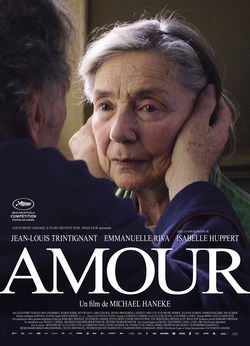
Behind the film
- Year
- 2012
- Director
- Michael Haneke
- Writers
- Michael Haneke
- Runtime
- 2h 7m
- Genres
- Drama
- Production
- Canal+, France 3, Les Films du Losange
- Country
- France, Germany, Austria
- Cast
- Jean-Louis Trintignant, Emmanuelle Riva, Isabelle Huppert, Alexandre Tharaud, William Shimell, Rita Blanco, Ramón Agirre, Carole Franck
About the film
Contains story spoilers.
After Anne suffers a stroke and surgery leaves her paralysed on one side, Georges cares for her at home. She asks him not to return her to hospital. A second stroke further impairs her speech and understanding, making the household increasingly difficult to manage. Their daughter Eva visits and argues for professional care, but the couple remain at odds over how much help to accept. Anne’s condition worsens, and the routines of feeding, washing and communication become increasingly difficult. Georges hires carers, dismisses one, and struggles to keep Anne comfortable as she loses speech and mobility. He tells her a childhood story, then smothers her with a pillow. Later, he adorns her body with flowers and seals the bedroom door. Eva returns to the emptied home; Georges’ fate is left unresolved as the film closes on absence.
Michael Haneke keeps Amour close to the surfaces of ordinary domestic life. The apartment is not a decorative backdrop but the film’s principal world: rooms hold habits, possessions, memories and the changing limits of what the couple can manage. That confinement gives the story a particular intimacy without making it a general lesson. We are asked to attend to these characters and their home, not to treat one fictional marriage as a manual for illness or ageing. The small scale also changes the meaning of drama. A doorway, a chair or a pause in conversation can matter as much as a conventional plot turning point because the film has taught us to notice the rhythm of daily life.
Georges and Anne begin as partners whose shared history does not need explaining in every exchange. Jean-Louis Trintignant and Emmanuelle Riva give their characters the ease of people who know one another’s habits, but familiarity does not make them transparent. Their affection has a texture built from routine, wit and small negotiations. When circumstances alter, the film observes how difficult it becomes to distinguish help from intrusion or dignity from isolation. The couple’s bond is neither idealised as pure selflessness nor dismissed as a social arrangement. Its importance comes from its particularity: these two people have made a life together, and any change to that life affects each of them differently.
The camera’s patience is central to the film’s form. Haneke often lets a scene continue without telling the viewer where to place an emotional response. That restraint can feel challenging because it refuses the quick punctuation of swelling music or explanatory dialogue. Instead, attention settles on gesture, duration and the physical work of being present. The result is not emotional neutrality. On the contrary, the quieter the presentation becomes, the more significant an altered look or an unfinished conversation can seem. Viewers are left to interpret those details themselves, which matches the film’s refusal to turn a private crisis into a tidy moral illustration.
Isabelle Huppert’s Eva brings a different kind of closeness into the apartment. She is their daughter, but she also belongs to a life elsewhere, with obligations and relationships that cannot simply be suspended. Her concern does not automatically solve the tension between what she wants for her parents and what they want for themselves. That gap makes the family dynamic more complex than a disagreement between a caring child and stubborn adults. Each person is acting from a limited position, with incomplete access to the others’ daily experience. The film gives that distance real weight without declaring one person’s judgment universally correct.
The home’s changing atmosphere carries meaning without requiring a symbolic key. Familiar rooms can preserve continuity, but they can also become a setting in which the outside world gradually feels harder to reach. Haneke’s careful compositions make the apartment readable as a real domestic space, with objects and routes that have practical uses before they acquire emotional associations. This attention to material detail is one reason the film’s restraint feels so deliberate. Rather than move quickly through explanatory scenes, it asks what repeated actions look like when their effort changes. The viewer encounters time as something lived through the body and the household, not just indicated by dates or transitions.
Amour’s title does not settle the question of what love requires. It places that question at the centre and allows care, exhaustion, loyalty and autonomy to remain in tension. A dramatic story about illness can easily push audiences toward a single verdict: praise sacrifice, condemn refusal, or search for a correct answer that resolves the situation. Haneke’s approach is more difficult because it presents a relationship under strain without claiming a general ethical formula. The characters’ decisions belong to them, shaped by a shared past and particular circumstances. That makes the film’s seriousness inseparable from its limits: it can invite reflection, but it cannot stand in for medical advice or someone else’s lived experience.
The film’s power comes from its measured refusal to turn intimacy into spectacle. Its subject is devastating, yet the presentation remains controlled enough that viewers must bring their own attention to what changes between one quiet moment and the next. Trintignant and Riva make that demand possible by giving Georges and Anne an interior life beyond their circumstances. The film remains grounded in their apartment, their family and their bond, while leaving room for different viewers to respond differently. It offers no simple checklist for loving someone through hardship. Instead, it makes sustained attention itself part of the experience, and asks how much of a shared life can be carried in small acts and familiar rooms.