
Behind the film
- Year
- 1997
- Director
- Steven Spielberg
- Writers
- David Franzoni
- Runtime
- 2h 34m
- Genres
- Drama, Trial, White savior
- Production
- HBO Films, DreamWorks
- Country
- United States
- Cast
- Anthony Hopkins, Morgan Freeman, Nigel Hawthorne, Djimon Hounsou, Matthew McConaughey, David Paymer, Pete Postlethwaite, Stellan Skarsgård
About the film
Contains story spoilers.
Amistad moves from an act of resistance into a setting where that resistance has to be translated into an argument other people will recognise. The Africans aboard the ship know they have been taken from their lives and carried into slavery. Once captured again, however, they enter proceedings organised around rival claims to their bodies. Their own understanding is not initially the account through which the case is discussed or the competing claims assessed. That distance between a person's experience and the language permitted to describe it becomes central to the film, giving the courtroom's arguments an urgency that extends far beyond the professional success of the lawyers.
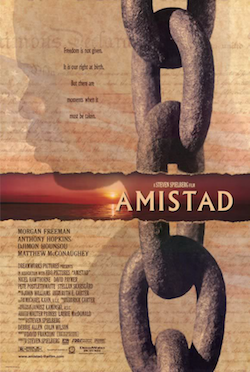
Steven Spielberg directs the 1997 drama from David Franzoni's screenplay. Djimon Hounsou plays Cinqué, Matthew McConaughey is Roger Sherman Baldwin, Anthony Hopkins is John Quincy Adams and Morgan Freeman plays Theodore Joadson. The film dramatises the nineteenth-century Amistad case, with alterations and invented elements rather than documentary completeness. Joadson, for example, is a fictional composite. Keeping that distinction in view allows the story's dramatic relationships to be understood without treating every exchange as recorded history. Its scenes arrange questions of testimony, political interest and personal responsibility around a group whose freedom is being debated by institutions outside their control.
In 1839, Cinqué leads a revolt aboard La Amistad. The surviving navigators bring the ship into American waters instead of returning the captives to Africa. After their arrest, Baldwin and abolitionist allies work to establish that they were kidnapped rather than legally enslaved in Cuba. An interpreter enables Cinqué to describe his capture and the Atlantic crossing. Political interference prolongs the struggle, and Adams eventually argues for them before the Supreme Court. The judgment secures their release. The film's closing account nevertheless describes Cinqué returning to a home where reunion with his family is no longer possible.
The language barrier makes the difference between being present and being heard particularly visible. Cinqué can be physically at the centre of the dispute while remaining excluded from the conversations deciding its direction. Interpretation changes that position, but it also exposes how much has already been assumed without his account. His testimony gives the proceedings a history that cannot be adequately conveyed by discussing paperwork or possession alone. The story's attention to translation therefore concerns power as well as communication: the ability to understand somebody is a necessary condition for responding to them, and the institutions involved have proceeded without meeting it.
Baldwin's work creates a difficult relationship between practical argument and moral recognition. He needs to establish facts that the court can use, which means investigating how the captives reached the ship and how claims about them have been constructed. That approach can make their humanity sound dependent on the success of an evidentiary distinction. The film lets the legal strategy function while keeping the discomfort around its language visible. A route towards release may exist inside a system whose terms are still inadequate to the people seeking it, so the usefulness of an argument does not make the surrounding structure just.
The politicians' involvement widens the distance between the captives and the decisions affecting them. Diplomacy and electoral interests turn their case into something officials assess through consequences for their own positions. That creates a second form of confinement: even when evidence can support release, people with power have reasons to obstruct the outcome. The dramatic problem becomes how to make the particular lives at stake resist being absorbed into calculations about governments and constituencies. The courtroom is a place where those calculations can be challenged, but it remains embedded in the wider interests that have helped prolong the proceedings.
Adams's eventual participation gives the defence another way of addressing that imbalance. His standing allows him to speak within an institution whose attention the captives cannot simply demand. The film uses that access to bring personal conviction into a formal argument, while Cinqué's presence keeps the argument connected to somebody who must live with its result. The danger of allowing the advocate to become the whole story is answered by the continuing weight of the Africans' experience. Winning a speech is not the same thing as recovering the years, relationships and security already taken from them.
The closing account prevents release from becoming an uncomplicated restoration. A favourable judgment can remove one barrier without rebuilding the world that existed before captivity. Cinqué's return therefore gives the ending a scale beyond the courtroom: freedom matters enormously, yet it cannot undo everything that made the case necessary. Spielberg's historical drama places the achievement beside the damage rather than letting one erase the other. The film's lasting question concerns what recognition must include when people have first been treated as objects of competing claims, and how much remains unresolved even after an institution finally agrees that they are entitled to leave.