
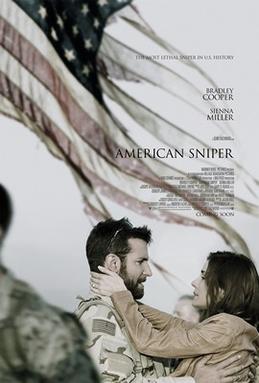
Behind the film
- Year
- 2014
- Director
- Clint Eastwood
- Writers
- Jason Hall
- Genres
- Action, War, Biographical, Drama
- Production
- Warner Bros. Entertainment, Warner Bros. Pictures
- Country
- United States
- Cast
- Bradley Cooper, Sienna Miller, Luke Grimes, Jake McDorman, Cory Hardrict, Kevin Lacz, Navid Negahban, Keir O'Donnell
About the film
Contains story spoilers.
American Sniper follows Chris Kyle from Texas into Navy SEAL service and repeated tours in Iraq, where he becomes a highly skilled sniper. He meets and marries Taya, but deployments repeatedly interrupt their family life. The film shows Chris facing an immediate decision when a woman and boy approach Marines with a grenade, then follows losses among his unit, including Marc Lee and Ryan Job. Mustafa’s presence connects the battlefield story to an extended pursuit; Chris later takes a long-distance shot that exposes his team to return fire. Back home, a psychiatrist encourages him to support wounded veterans, and he gradually finds a role helping them. He leaves to meet fellow veteran Eddie Ray Routh. The film ends with a notice about Chris’s death and actual funeral footage. It is based on a memoir and shaped as a dramatization, not a complete account of the Iraq War or every historical event it depicts.
The film’s structure makes return a repeated problem. Each tour has a departure and homecoming, but the emotional boundary between war and domestic life remains porous. Taya is not simply waiting in a separate subplot; her concerns define what Chris is unable to give when his attention stays fixed on the next danger. The births of their children happen alongside his obligations, making family time something that competes with the sense of duty he carries rather than an uncomplicated reward for completing a mission.
Cooper’s physical transformation gives the character a visible continuity as his roles change from ranch hand to sniper and father. The performance often relies on contained posture and guarded expression, making the moments when he is overwhelmed feel like pressure escaping a maintained surface. Miller’s Taya has her own clear point of view, especially in the scenes where she asks for presence rather than another promise about a future return. Their acting gives the domestic scenes weight independent of the combat material.
The film’s war sequences organize attention around sightlines and incomplete knowledge. Distant movement may become a threat, but the person making the decision cannot see every circumstance surrounding it. That visual setup helps explain why Chris’s competence is framed alongside uncertainty, rather than as effortless omniscience. It also has a limitation: Iraqi civilians and political causes are not developed with the same interiority as the American soldiers. The audience is kept near Chris’s perception, which can create immediate tension while narrowing the historical field of view.
Marc Lee’s death, Biggles’s injury and later death, and the repeated danger to the unit add to Chris’s sense of unfinished responsibility. These losses shape why he returns, but they are not presented as evidence that another tour can restore what has already happened. His long shot against Mustafa is a moment of professional skill that immediately carries risk for the team around him. A sandstorm complicates the retreat, and his phone call to Taya marks a change in what he wants. The film treats that as a personal decision emerging from accumulated strain, not a simple victory in a rivalry.
When Chris comes home, the plot turns toward support work with severely wounded veterans. The psychiatrist’s question helps him name those he could not save, and the film shows him gradually directing his attention to other people’s recovery. This is a modest path rather than a clean cure. He is still adjusting, and family connection remains important, but he has begun to use his experience in a way that does not demand another deployment. That shift makes the film’s idea of service wider than combat, even though its chosen perspective remains centered on Chris.
The transition to funeral footage alters the film’s form. After scenes performed by actors and organized into a dramatic arc, the actual public images create a different relation to the subject. The change can be emotionally forceful, but it also underscores how much of a life the preceding feature has selected, condensed and arranged. The memorial ending does not turn the film into a documentary after the fact; it places its dramatization beside a public record of mourning and asks the audience to recognize the difference.
Eastwood’s visual style often withholds context at the moment Chris must act, using distances and partial views to make interpretation part of the suspense. At home, pauses and interrupted conversations reveal another kind of distance: Taya can stand beside him without feeling that he is present. The contrast connects the battlefield’s intense attention with the family’s need for attention of a different kind. Chris’s familiar skills cannot settle an argument or recover the time spent away. When he starts helping other veterans, the action gives him somewhere to direct that protective impulse while remaining at home, giving that responsibility a daily shape that includes other veterans and his own family. Taya’s conversations make the family’s stake in that adjustment explicit.