
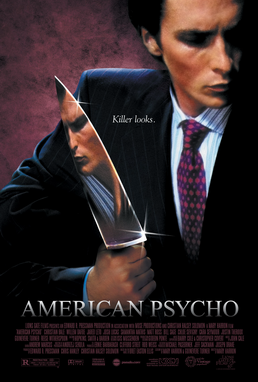
Behind the film
- Year
- 2000
- Director
- Mary Harron
- Writers
- Mary Harron, Guinevere Turner
- Genres
- Crime, Comedy horror, Thriller, Drama
- Production
- Starz Entertainment, Edward R. Pressman Film
- Country
- United States, Canada
- Cast
- Christian Bale, Willem Dafoe, Jared Leto, Justin Theroux, Josh Lucas, Chloë Sevigny, Samantha Mathis, Reese Witherspoon
About the film
Contains story spoilers.
Mary Harron’s American Psycho follows Patrick Bateman, a young Wall Street financier whose immaculate public image belongs to a narrow world of status markers: designer suits, reservation lists, business cards and apartments that advertise taste. In 1987 Manhattan, Bateman and his colleagues resemble one another so closely that they confuse each other’s names and achievements. Patrick’s engagement to Evelyn and his work at a prestigious firm give him the expected shape of success, but his inner life is governed by resentment and a compulsion to control how others see him. The film makes that polished surface part of its horror.
Patrick’s first visible breaks from the social performance are violent. He kills a homeless man and his dog, then grows fixated on colleague Paul Allen after Allen mistakes him for another banker and shows off a business card Patrick considers superior. Patrick takes Allen to dinner, gets him drunk and kills him in his apartment. He then uses Allen’s keys and accounts to sustain the fiction that his colleague is traveling. Private investigator Donald Kimball begins asking questions, but Patrick’s circles are so self-absorbed that a disappearance can be absorbed into another person’s careless assumption.
Harron lets the rituals around Patrick sit beside the killings without a clear moral boundary between them. He compares grooming products, rehearses a presentation of his exercise routine and watches colleagues debate restaurant access with the same intensity he gives to stalking victims. The comedy comes from how much attention the men devote to tiny distinctions while remaining unable to recognize one another as individuals. Patrick’s obsession with Allen’s card is not merely jealousy over money; it exposes a social order where identity seems to be reduced to a printed surface and being mistaken for someone else is both insult and escape.
Kimball interviews Patrick more than once about Allen, and each meeting becomes a test of how much suspicion can coexist with a convincing routine. Patrick invents ordinary explanations, while the investigator notices oddities but cannot connect them to a reliable account of what happened. Patrick’s violence spreads into his private relationships: he uses sex workers, has an affair with Courtney, and nearly attacks Luis Carruthers when a strangling attempt is misread as a sexual advance. His secretary Jean remains close enough to notice something is wrong, but her concern does not initially overcome his control of the room.
Patrick’s engagement to Evelyn collapses as the distance between his public mask and private urges becomes harder to contain. He kills Elizabeth during a drug-fueled encounter and pursues Christie through his apartment building. Elsewhere, a strange episode involving an ATM and a stray cat gives way to a frantic police chase. The film does not turn this escalation into a conventional investigation with an approaching net; instead, it follows Patrick’s shifting perceptions as he tries to keep moving through offices, streets and expensive interiors that continue to look almost unchanged around him.
At the height of the crisis, Patrick leaves a long confession on his lawyer Harold Carnes’s answering machine, naming Allen and others. Yet the confession produces no arrest or clear reckoning. He returns to Allen’s apartment and finds it empty and being shown for sale; the realtor refuses to acknowledge that Allen lived there. Jean discovers Patrick’s journal, filled with drawings of violence, but when Carnes later hears him speak about the killings, he mistakes Patrick for someone else and says he recently saw Allen in London. The men around Patrick keep confusing identities, making it impossible to tell whether his account has reached anyone capable of acting on it.
The closing scenes leave the truth unresolved. Patrick sits with his associates as they talk about dinner and public figures, while his attempt to confess has gone nowhere. He understands that neither punishment nor escape has arrived, and that even a direct statement of what he believes he has done cannot break through the group’s indifference. The ending offers no final confirmation that every event occurred exactly as he experienced it; the point is the trap of a world where consequences can be denied as easily as a name on a reservation. That uncertainty keeps the film’s satire and horror intertwined.
Christian Bale plays Patrick with deliberate switches between smooth charm, practiced blankness and panic. Harron’s controlled compositions and careful attention to clothes, rooms and grooming let the sleek surfaces become unnerving while giving familiar interiors an unnervingly clinical quality. The film adapts Bret Easton Ellis’s novel but shapes its own screen ending and comic rhythm, with Guinevere Turner and Harron credited for the screenplay. Its criticism lands on a culture of competitive consumption and male self-display: Patrick can describe products and status with precision, yet neither he nor his peers can form a stable sense of another person. The increasingly shaky gap between his account and the world’s response is what makes the final ambiguity work.