
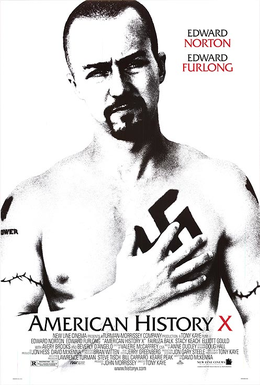
Behind the film
- Year
- 1998
- Director
- Tony Kaye
- Writers
- David McKenna
- Genres
- Drama, Prison, Independent, Crime
- Production
- New Line Cinema
- Country
- United States
- Cast
- Edward Norton, Edward Furlong, Avery Brooks, Beverly D’Angelo, Fairuza Balk, Ethan Suplee, Stacy Keach, Guy Torry
About the film
Contains story spoilers.
American History X opens with a school assignment that already carries the weight of a family crisis. Danny Vinyard has written an admiring essay on Hitler’s book, treating provocation as a way to display his loyalties. Principal Bob Sweeney refuses to let that gesture pass as an ordinary disagreement over coursework. He requires Danny to write about his older brother Derek, who is coming home from prison. The assignment gives the film a reason to move between Danny’s present and the history that has shaped it. What looks to the boy like certainty about his identity becomes something he has to reconstruct through people, actions and consequences.
Derek’s earlier life appears largely in black and white, while the present returns in colour. The distinction lets memories occupy a different visual space without making them safe or distant. Edward Norton plays Derek’s physical assurance and ability to dominate a conversation alongside the instability beneath them. His confidence attracts young men who want their resentments given a direction, and Cameron Alexander knows how to use that appeal. The movement offers belonging, a vocabulary of grievance and permission to intimidate people. Its influence extends across familiar places: a basketball court, a shop, a family table. Everyday contact becomes an occasion for claiming territory or demonstrating power.
The family scenes show how that thinking can become recognisable before it takes the form of organised violence. Derek’s father expresses prejudice at dinner, giving discriminatory assumptions the authority of an ordinary parent explaining the world. His later death intensifies Derek’s anger, but the film also looks back to those earlier conversations. Doris and Davina cannot keep the household apart from his politics; an argument over dinner exposes contempt for his mother’s partner and a readiness to hurt his sister. Danny watches an older brother whose presence is forceful enough to make opposition look weak. Admiration provides a route through which a young person can inherit convictions before examining them.
The violence that sends Derek to prison occurs outside the family home, where Danny witnesses what his brother is capable of doing. The murders are presented with an ugliness that remains central to the film’s account of responsibility. Prison then disrupts Derek’s confidence in the group he expects to protect him. He initially seeks company among white supremacists, but their practical dealings undermine the purity they claim to defend. His work in the laundry puts him beside Lamont, a Black inmate whose humour and conversation cannot be reduced to the categories Derek has been using. Repeated contact gives their relationship a texture that slogans have prevented him from recognising.
Leaving the prison group makes Derek a target, and the assault against him exposes the violence used to enforce membership. Sweeney’s visit brings another kind of pressure: he asks Derek to confront what his choices have actually achieved and tells him that Danny is being drawn further into the same world. Avery Brooks gives those scenes seriousness without turning Sweeney into someone who can simply announce a cure. Lamont’s help also matters to Derek’s survival. The film places his change among relationships that challenge, assist and protect him, making it more than an isolated moment of discovery. He must accept dependence on people his ideology has taught him to dismiss.
Returning home does not give Derek a clean beginning. Danny is still attached to the gang, and the people who once followed Derek expect the same leader to come back. His confrontation with Cameron reveals the distance between a young recruit’s devotion and an organiser’s willingness to exploit it. Walking away threatens the relationships through which Derek once understood himself, including his connection to Stacey and Seth. He still responds with aggression, which makes the attempted break complicated. Rejecting the beliefs has not automatically supplied him with another way to handle conflict. Danny sees behaviour that initially looks like betrayal before he hears the experiences behind it.
The brothers’ conversation changes the meaning of the paper Danny is writing. Derek’s account of prison gives him information that the gang’s image of strength has concealed, while examining their father’s influence lets him see that Derek’s beliefs had a history of their own. Removing extremist posters from their shared room is a small physical action after so much threatening display. It suggests that the surroundings in which they have been living can be altered, even if the people beyond the room have not changed with them. Edward Furlong gives Danny’s movement toward reconsideration an openness that makes the effort feel possible without treating it as complete.
Danny’s death at school destroys the expectation that this change of mind will be rewarded with safety. The boy who shoots him belongs to a conflict already present in the day the film has been following, and Derek arrives too late to protect him. His grief gives the ending a terrible immediacy: understanding his influence cannot recover the person affected by it. The film leaves the brothers’ attempt to break the pattern alongside the consequences that continue beyond their decision. Its close attention to recruitment, family admiration and ordinary conversation explains why those attempts matter, while the ending resists the comforting idea that abandoning hatred can instantly undo the damage it has helped create.