
Behind the film
- Year
- 2007
- Director
- Ridley Scott
- Writers
- Steven Zaillian
- Runtime
- 2h 37m
- Genres
- Biographical, Crime drama, War, Historical drama
- Production
- Imagine Entertainment, Scott Free Productions, Relativity Media
- Country
- United States
- Cast
- Denzel Washington, Russell Crowe, Chiwetel Ejiofor, Josh Brolin, Cuba Gooding Jr., John Ortiz, Ruby Dee, Common
About the film
Contains story spoilers.
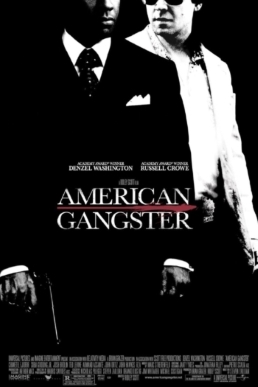
Ridley Scott’s American Gangster follows two men whose work puts them on opposite sides of New York’s drug economy. Frank Lucas rises after the death of Harlem crime boss Bumpy Johnson, using a direct overseas connection to bring heroin into the city and selling it under the name Blue Magic. Detective Richie Roberts, based in Newark, becomes central to a task force investigating a dangerous supply. The film does not make them meet immediately; instead it builds two parallel routines, one organized around expanding a business and the other around assembling enough evidence to reach its hidden leadership.
Frank’s operation is presented as a hierarchy of family and trust. He recruits relatives, insists on discipline and seeks a source that can undercut the established intermediaries. The film links his ambition to an image of personal order: he wants to dress well, control his business and avoid the conspicuous excess he associates with less careful criminals. That discipline does not make the enterprise less violent or harmful. It makes the business more efficient, while keeping the cost of its product visible in the streets and in the families touched by addiction.
Richie’s professional life works by a different logic. His reputation for honesty isolates him from colleagues who see corruption as ordinary, while his disordered personal life makes him an imperfect emblem of virtue. The investigation requires painstaking coordination: surveillance, informants, paperwork and patience rather than one dramatic raid. The contrast with Frank’s tight circle is useful but not absolute. Both men are surrounded by systems that reward loyalty and punish betrayal, and both rely on reading people accurately.
The paths begin to align through details that do not look important at first. Richie notices Frank at the Fight of the Century, where the unusually prominent seats suggest an unexplained source of money and status. The lead sends the investigation closer to Frank’s organization, even as the film continues to show the daily decisions that keep it running. One man measures success through access and presentation; the other learns to treat those same details as evidence. The eventual confrontation feels earned because the film has shown each side building toward it in a different register.
Scott’s period world is constructed from contrasting spaces: Harlem clubs and family gatherings, police offices, streets under surveillance, and the private rooms where business is discussed. The camera often places a polished public image beside the machinery underneath it. Clothes, cars and music are not decorative shorthand alone; they reveal how characters want to be read and what those images conceal. The film’s brisk movement across New York and beyond gives the criminal network scale, while recurring domestic scenes keep the consequences tied to specific relationships. Their different methods also organize the film's pacing. Frank's sections often move through decisions about supply, presentation and loyalty, while Richie's work advances through observation, interviews and paperwork. The parallel editing invites comparison without making their aims morally equivalent: one network profits from a damaging trade, and the other is meant to expose it. What links them is the need to understand how information moves through a group.
The story is based on people and events but shaped as a crime drama. Its portrayal of Frank’s supply network and Richie’s investigation is not a complete historical record, and the film compresses or invents episodes to make the two lives meet within a clear dramatic arc. That distinction matters because the movie gives its characters a strong moral geometry: the officer who insists on honesty is set against a drug entrepreneur who has built a code of loyalty around destructive trade. The arrangement clarifies the conflict while simplifying the complicated public record behind it.
As Frank’s business draws more attention, corruption among law enforcement becomes part of the danger surrounding the investigation. A major shipment is traced through the returning soldiers’ coffins used to conceal heroin, and the resulting action brings the police to the operation. Frank’s nephew Stevie is killed during the raid; Frank and his brothers are arrested. Facing prison, Frank cooperates with Richie and provides information about crooked officers. The film’s closing note places Frank’s release years later and Richie’s later work as a defense lawyer in the same long aftermath.
Denzel Washington gives Frank a measured manner that makes the character’s public control seem like an asset before showing how brittle it can be. Russell Crowe plays Richie as awkward and stubborn, less interested in a composed image than in the routine work needed to make a case. Their single extended confrontation has force because the film has spent so much time keeping them apart. Each man has learned to treat the other as an abstract obstacle; meeting converts the chase into a negotiation about what each can offer and what the law can still change. Their encounter does not erase the years of damage that preceded it; it changes the direction of the story by making information itself the final currency between them. The film ends with that uneasy transformation rather than a simple victory lap.