
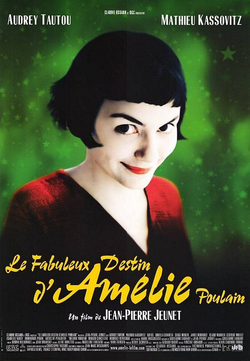
Behind the film
- Year
- 2001
- Director
- Jean-Pierre Jeunet
- Writers
- Guillaume Laurant, Jean-Pierre Jeunet
- Runtime
- 2h 3m
- Genres
- Romantic comedy, Comedy, Drama, Magic realist
- Production
- France 3 Cinéma, Canal+, Miramax
- Country
- France, Germany
- Cast
- Audrey Tautou, Mathieu Kassovitz, Rufus
About the film
Contains story spoilers.
Amélie Poulain grows up with an unusually solitary childhood. Her parents mistakenly believe she has a heart condition, so she is educated at home; her mother dies when a suicidal visitor falls from Notre-Dame and lands on her. Her father retreats into grief and routine, while Amélie learns to fill empty hours with elaborate private games. As an adult she works at the Café des 2 Moulins in Montmartre, where the customers and staff have their own quiet disappointments. Jean-Pierre Jeunet’s film treats this Paris as a heightened, digitally polished storybook, but Amélie’s shyness is grounded in a real difficulty: she can imagine other people’s feelings more easily than she can risk revealing her own.
A small accident changes the direction of her life. News of Princess Diana’s death startles Amélie, and a dropped perfume stopper dislodges a tile in her apartment. Behind it she finds a tin box of childhood treasures left there by a former resident. With help from her neighbour Raymond Dufayel, who has spent years copying Renoir’s Luncheon of the Boating Party, she identifies the owner as Dominique Bretodeau. Amélie returns the box without announcing herself. When Bretodeau finds it, the memories move him to reconnect with his estranged daughter and grandson. Seeing what the gesture means to him, Amélie decides to make a habit of helping people in ways they may never trace back to her.
Her plans are playful, but each is aimed at a particular loneliness. She guides a blind man through a busy street by describing its shopfronts and passers-by; she arranges for her father’s garden gnome to appear in photographs from foreign places, hoping to coax him into travel. She gives the widowed concierge Madeleine a fabricated final letter from her absent husband, and her practical jokes wear down Collignon, the cruel grocer who mistreats his assistant Lucien. These interventions bring real relief, though they also let Amélie stay safely outside the relationships she is shaping. Dufayel notices the pattern and becomes a gentle sounding board rather than simply another person for her to fix.
Dufayel’s repeated painting of Renoir’s gathering becomes a way to talk about Amélie’s own hesitation. He is still trying to capture the expression of the girl with a glass of water, while Amélie reads her own guardedness into that figure. The film’s portrait of Montmartre is built from steep streets, cafés, small shops, métro entrances and the Canal Saint-Martin, where Amélie enjoys skipping stones. Jeunet uses close-ups of ordinary objects and sudden shifts in scale to make her attention visible: a stopper, a photo strip or a spoon tapping crème brûlée can command the screen. Bright colours and brisk narration give the neighbourhood a fable-like texture without making every resident merely a prop in Amélie’s fantasy.
The person who unsettles her routine is Nino Quincampoix, an eccentric young man who collects discarded photographs from booth machines. Amélie notices him, then retrieves the album he accidentally drops. Rather than return it face to face, she turns the exchange into a trail of clues through Paris, letting him search for the person who has found his private collection. Their game gives her a chance to approach him indirectly, but it also makes the cost of hiding apparent: Nino is trying to meet the person behind the clues, not solve an endless puzzle. At the café, Amélie panics and tries to deny that she is the woman he has been seeking.
Misunderstandings among the café regulars deepen her retreat. Gina screens Nino because she worries about Amélie, while Joseph’s remark leads Amélie to think Nino has become interested in Gina instead. Dufayel recognizes that Amélie is using her acts of kindness to avoid a more exposed choice. His advice helps her stop treating romance as another situation to choreograph from a distance. She goes after Nino, and the two begin a relationship. The ending does not suggest that Amélie must abandon her imaginative generosity; it gives that generosity a new direction. She has spent the film arranging moments of connection for other people, and now she allows herself to be present in one.
Jeunet builds the film around small sensory pleasures rather than large changes in fortune. Amélie cracks the top of a crème brûlée, dips her hand into sacks of grain, and skips stones at the canal; the film pauses long enough for those gestures to feel like a private language. Its soundtrack gives weight to tiny sounds, while saturated colour and abrupt changes in scale turn familiar objects into visual punchlines or clues. The streets are real Paris locations, digitally cleaned and arranged to resemble the nostalgic Montmartre that Jeunet remembered from childhood. That choice is part of the film’s perspective: the city is a designed, romantic vision, and its warmth comes from the attention Amélie gives to people who are often overlooked.